• Welcome to Photrio!
    Registration is fast and free. Join today to unlock search, see fewer ads, and access all forum features.
    Click here to sign up

Math problem!

Wheels within Wheels

D
Wheels within Wheels

  • 1
  • 0
  • 0
R-A-O-B Club

A
R-A-O-B Club

  • 0
  • 0
  • 8

Recent Classifieds

Forum statistics

Threads
203,220
Messages
2,851,631
Members
101,729
Latest member
gmed341
Recent bookmarks
0

Boris Mirkov

Member
Allowing Ads
Joined
Nov 12, 2009
Messages
84
Location
Serbia, Belgrade
Format
Multi Format
I`m interested how can I calculate developing time for developer that is 1:60 diluted or more? Considering that you know the time for, let`s say 1:4 there must be a way to calculate it for some bigger dilutions?
I want to expose HP5 at 6400 or 12800. I saw some photos that were at 12800 and I got very interested in gaining similar results. Thanks!
 
Yes, it's not really linear, and with higher dilutions, you will likely exhaust your developing agents part way through.

Also if you want to go high ISO, you probably don't want to go to high dilution at the same time.

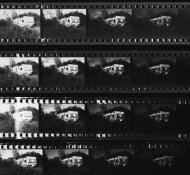
But a general methodology (just to get you going) is to shoot 3 short rolls, all the same typical scene, all at the same ISO, but bracketing exposures from -3 to +3 in one stop increments. Select a convenient dilution to mix up, and develop one roll for say 8 minutes, another for 12, and another for 16. Contact print all three strips together and examine the results. You'll hopefully find a nice diagonal to work with. It will be on your paper too, so you'll be previewing final print quality.

Best to mark the contact sheet for later reference.

The same sort of test could be done by varying the ISO instead of the development time.

Neglecting drying time, shouldn't take more than an hour to get the real world data points you need to put yourself in the right ballpark, and to know what your 'normal' prints will look like.

Just added an example, bad scan, but you get the idea. Longest development time on top, shortest on bottom.

 

Attachments

  • contact-small.jpg
    contact-small.jpg
    54.9 KB · Views: 161
Last edited by a moderator:
Math won't succeed its a purely US concept based ion the supposition that there's only one country in the world :D You need to use Mathematics - Maths, which is about more than one number :smile:

Push processing to high speed works best in lower contrast lighting, I used to push HP5 to 1600 & 3200 a lot back in the late 70's or early 80's but once XP-1 then XP-2 were released I switched as the results were just so much better, good tonality, far less grain, better contrast.

You need to be clearer why you want to push to these high speeds.

Ian
 
At such high dilutions the total quantity of developer would be unmanageable. the amount of concentrated developer per square inch of film does not change regardless of dilution.
 
If you make the dilution high enough, then you could skip adding any developer!

Jus' sayin' :wink:

Steve
 
Homeopathic developer?

IF that was true, somebody could get rich!

Don't buy chemicals! Just think positively and let those thoughts develop the film. :wink:
 
Well, you still have to buy chemicals but one package of developer will be enough to make 1,000,000 photos.
You just dilute your chemistry down to 10,000 to 1 but, first, you have to BELIEVE that your pictures will develop!

:wink:
 
Multiply time by concentration and pray:
1+4->concentration:1/5
1+59->concentration 1/60
Use 24 or 12 exp multiply time by 15 and volume of developper by at leat 3 or 4 to avoid exhaustion go to Lourdes(or any relevant place) and pray.

You may start with 1+14 and multiply time by 3 and volume by 2 (keeping 36exp) and pray at home.
 
I`m interested how can I calculate developing time for developer that is 1:60 diluted or more? Considering that you know the time for, let`s say 1:4 there must be a way to calculate it for some bigger dilutions?
I want to expose HP5 at 6400 or 12800. I saw some photos that were at 12800 and I got very interested in gaining similar results. Thanks!

In the normal dilution range, for continuous agitation, all other things held equal (especially temperature), development time varies as the square root of dilution.

For example, if your time for 1:1 is five minutes, your time for 1:3 would be 5(sqrt(2)) = 7 minutes.

If your agitation scheme is less than continuous, this won't hold. Typically intermittent agitation is closer to linear with dilution. In other words, double the dilution and double the development time.

I suspect (but have never done the research to find out) that it's largely a matter of diffusion through the emulsion, which is why agitation plays such a big role. And if that's true, I would think that very high dilutions would be likewise difficult to chart.

In the end, you'll have to take your best guess and try it. Adjust and repeat until you get the results you want.
 
In the normal dilution range, for continuous agitation, all other things held equal (especially temperature), development time varies as the square root of dilution.

For example, if your time for 1:1 is five minutes, your time for 1:3 would be 5(sqrt(2)) = 7 minutes. ...

Say what?

Are you talking about 1+1 and 1+3, in other words, 50 and 25%?

We recently had a long discussion about this, but I'm still confused.
 
Photrio.com contains affiliate links to products. We may receive a commission for purchases made through these links.
To read our full affiliate disclosure statement please click Here.

PHOTRIO PARTNERS EQUALLY FUNDING OUR COMMUNITY:


Ilford ADOX Freestyle Photographic Stearman Press Weldon Color Lab Blue Moon Camera & Machine
Top Bottom