• Welcome to Photrio!
    Registration is fast and free. Join today to unlock search, see fewer ads, and access all forum features.
    Click here to sign up

Masking techniques and condenser enlargers

Fujino Trail

H
Fujino Trail

  • 0
  • 0
  • 0
Dead and Living.

H
Dead and Living.

  • 5
  • 4
  • 83

Recent Classifieds

Forum statistics

Threads
201,820
Messages
2,830,676
Members
100,973
Latest member
Arthur Deomi
Recent bookmarks
1

M Carter

Member
Allowing Ads
Joined
Jan 23, 2013
Messages
2,149
Location
Dallas, TX
Format
Medium Format
Hey masking experts! I'm thinking it's time to up my game a bit and experiment with masking. For now I only have a condenser enlarger (Beseler 67, but I will eventually track down a diffusion head, they're out there).

So far, I've done the simplest mask - matte mylar penciled dodge mask - no duping required. Severe light falloff in the corners with the condenser. Tried layers of matte mylar in the condenser box (faux diffusion?) Just made things worse. Did get a print that worked for bromoil though.

I'm assuming that duped sandwich masks without a diffusion layer should function more like a thick piece of film though? Interested in:

Unsharp mask

Shadow contrast mask (requires registration as the SCIM gets its own exposure - currently experimenting with getting a neg holder registered)

Duped highlight dodge mask (sandwiched, and - my research says - can be stacked with an unsharp mask).​

So far I've just been getting a feel for ortho lith film & developing, ready to try some for-real masks in the weeks ahead. Thanks for any thoughts.
 

bernard_L

Member
Allowing Ads
Joined
Feb 17, 2008
Messages
2,133
Format
Multi Format
Beseler 67: sure, it has a condenser, but not a point source. Maybe you can move a little in the direction of diffusion head, by replacing the original small bulb by a larger bulb (same wattage, 75W, and also of "enlarger" type). Not guaranteed to work for you, but easy.
 
OP
OP
M Carter

M Carter

Member
Allowing Ads
Joined
Jan 23, 2013
Messages
2,149
Location
Dallas, TX
Format
Medium Format
I have the newer 67 that uses the common, larger 75w frosted enlarger bulb (and negates the need for the 35mm condenser).

Michael, I've seen the Radeka site - but he also has an excellent writeup in "Way Beyond Monochrome" that covers the steps for each kind of dupe and suggests starting densities, etc. And he covers doing this without a densitometer, judging the dupes visually, etc. That and general googling has given me a lot to go on.

Mainly wondering for the silver techniques if I'll be tearing my hair out with the condenser. I can get a diffusion head (even the more modern built-in transformer model) if I shop around, there's one on eBay for $50 now… but every time I get on there, I buy up all the old Brovira and MC-110, dammit! My wife is giving me the stinkeye...
 
OP
OP
M Carter

M Carter

Member
Allowing Ads
Joined
Jan 23, 2013
Messages
2,149
Location
Dallas, TX
Format
Medium Format
Thanks - I've experimented with diffusing it and the light falloff has been, umm, impressive… actually, in the 90's I learned to dupe my own E6 slides to 4x5 and 8x10 Velvia and EPP, using a little printmaker 35. I made a black cardboard front door for the condenser box, cut a hole and taped a cheap and weak camera flash to it (instant daylight), lined the box in white paper and stuck diffusion and varying levels of ND gel under the bulb. Dialed it in with 4x5 polaroid and the big chromes were pretty stunning and worked great in the pre-iPad , bring-a-portable-lightbox portfolio era. But the 67 has a much more cramped head, tried several things but haven't had much luck.

As for masking goals… first off, I want to choose a neg and just get a feel for creating masks, how much they affect the image, what the range of possibilities are.

But I can definitely find something that, say, could use a shadow contrast bump, something where popping some highlights would work. Even if a final print doesn't necessarily "need" that help, I should at least go from theoretical thinking to hands-on experience.

I don't mind blowing through some Ilford RC to learn some new tricks… isn't that what it's there for??
 

David Lyga

Member
Allowing Ads
Joined
Nov 25, 2007
Messages
3,445
Location
Philadelphia
Format
35mm
Why use a 'diffusion head'? I bought a large sheet of drafting film at the art supply store for a couple of bucks. It is translucent, white, and leaves absolutely no pattern. It converts my Meopta Axomat to a diffusion enlarger, as the drafting film (3 inch x 3 inch) is left permanently in the filter drawer. For focusing, I open the filter drawer halfway for more light to enter onto the baseboard. - David Lyga
 
OP
OP
M Carter

M Carter

Member
Allowing Ads
Joined
Jan 23, 2013
Messages
2,149
Location
Dallas, TX
Format
Medium Format
Why use a 'diffusion head'? I bought a large sheet of drafting film at the art supply store for a couple of bucks. It is translucent, white, and leaves absolutely no pattern. It converts my Meopta Axomat to a diffusion enlarger, as the drafting film (3 inch x 3 inch) is left permanently in the filter drawer. For focusing, I open the filter drawer halfway for more light to enter onto the baseboard. - David Lyga

David, as I mentioned in a couple posts above, I've tried adding diffusion to my head. I've made several attempts in fact.

I've tried Dura-Lar Matte Film in the filter drawer, above the condensers and below the condensers. I've also tried opal diffusion from my lighting kit, and I've worked with pencil dodge-masks above the neg with dura-lar. In all cases, I get severe falloff in the corners.

I was able to diffuse a cheap Beseler Printmaker 35 just fine. The 67, I've had no luck. I don't know how to explain it more clearly.
 

David Lyga

Member
Allowing Ads
Joined
Nov 25, 2007
Messages
3,445
Location
Philadelphia
Format
35mm
Honestly, M Carter, I am a bit confused. The sheet of drafting film goes into the filter drawer, cut to the same size as a filter would be cut. That should 'guarantee' that coverage will be complete (as it is for filters). Maybe there is something mysterious about your particular situation, but filter drawers do not compromise coverage. - David Lyga
 

MartinP

Member
Allowing Ads
Joined
Jun 23, 2007
Messages
1,569
Location
Netherlands
Format
Medium Format
Are the correct condensers for the format being used? And are they in the right 'slot' (if the Beseler uses that mounting system) or position within the head, and also the right way up ??

Unless the filter drawer was modified in some way, perhaps with an adapter to take a smaller than original filter, then the drawer and it's contents shouldn't be the cause of any vignetting.
 
OP
OP
M Carter

M Carter

Member
Allowing Ads
Joined
Jan 23, 2013
Messages
2,149
Location
Dallas, TX
Format
Medium Format
Guys, I still need to investigate this - I posted my initial findings some time ago… enlarger not modded, condensers correct, etc.

One thing I do recall - the 67 doesn't have a glass carrier available, and I experimented with a sheet of glass with a cardboard mask on the bottom, and negs/mylar sandwiched on top with a 2nd black paper mask on top. That gave me some insane falloff, just at the picture edges. But maybe the thickness was giving me some kind of shadows.

Kind of gone astray from my initial question, as to which masks can be used with a condenser… guess I'll start testing, I need to make the masks regardless.

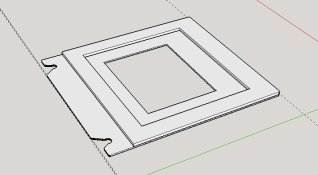
Anyway, the diffusion experiments led me to this… I learned Sketchup, got on Shapeways.com, and just got a 3D printed Beseler 67 neg holder from the mailman with a space for glass and registration pins. 3D printing… man, that's the freaking future. Imagine it and order it. Spent 30 bucks I think. Yeah, one of these days I'll get a better enlarger, but I don't wanna be that "throw piles of money at it" types...

attachment.php
 

Attachments

  • holder.jpg
    holder.jpg
    72.8 KB · Views: 309
OP
OP
M Carter

M Carter

Member
Allowing Ads
Joined
Jan 23, 2013
Messages
2,149
Location
Dallas, TX
Format
Medium Format
Guys, I still need to investigate this - I posted my initial findings some time ago… enlarger not modded, condensers correct, etc.

One thing I do recall - the 67 doesn't have a glass carrier available, and I experimented with a sheet of glass with a cardboard mask on the bottom, and negs/mylar sandwiched on top with a 2nd black paper mask on top. That gave me some insane falloff, just at the picture edges. But maybe the thickness was giving me some kind of shadows.

Kind of gone astray from my initial question, as to which masks can be used with a condenser… guess I'll start testing, I need to make the masks regardless.

Anyway, the diffusion experiments led me to this… I learned Sketchup, got on Shapeways.com, and just got a 3D printed Beseler 67 neg holder from the mailman with a space for glass and registration pins. 3D printing… man, that's the freaking future. Imagine it and order it. Spent 30 bucks I think. Yeah, one of these days I'll get a better enlarger, but I don't wanna be that "throw piles of money at it" types...

attachment.php
 

Dennis McNutt

Member
Allowing Ads
Joined
May 5, 2007
Messages
9
Format
4x5 Format
Thanks - I've experimented with diffusing it and the light falloff has been, umm, impressive… actually, in the 90's I learned to dupe my own E6 slides to 4x5 and 8x10 Velvia and EPP, using a little printmaker 35. I made a black cardboard front door for the condenser box, cut a hole and taped a cheap and weak camera flash to it (instant daylight), lined the box in white paper and stuck diffusion and varying levels of ND gel under the bulb. Dialed it in with 4x5 polaroid and the big chromes were pretty stunning and worked great in the pre-iPad , bring-a-portable-lightbox portfolio era. But the 67 has a much more cramped head, tried several things but haven't had much luck.

As for masking goals… first off, I want to choose a neg and just get a feel for creating masks, how much they affect the image, what the range of possibilities are.

But I can definitely find something that, say, could use a shadow contrast bump, something where popping some highlights would work. Even if a final print doesn't necessarily "need" that help, I should at least go from theoretical thinking to hands-on experience.

I don't mind blowing through some Ilford RC to learn some new tricks… isn't that what it's there for??


Hi M. Carter,

I am sorry that I haven't seen this thread before now, so I hope this isn't too late to be helpful. When Mark Jilg and I created our special series of silver masks for B/W contrast control I used both a cold light head and a condenser head for my masks. For the past 20 years I have used only the condenser head.

Masks are made by contact printing masking film with the original negative or another film mask. If diffusion is needed (i.e., for unsharp masks) a diffusion sheet can be used while exposing the mask.

The power and variety of film masks for B/W photography makes them invaluable, but there is a bit of a earning curve. I encourage you to start by getting Lynn Radeka's Masking Kit, if only for the articles (You may be able to buy reprints--the three articles were published in 1989 the magazine Darkroom Techniques. I think it has been renamed Photo Techniques.) In my opinion Lynn is the expert on masking, as he has been practicing it and teaching masking workshops for something like two decades. Check him out at: http://www.maskingkits.com

Radeka's kit will save you countless hours of experimenting and frustration, and will give you techniques that are unmatched.

For a brief, and free, introduction to masking written by Radeka, see: http://www.freestylephoto.biz/contrast-masking-the-traditional-print
 
Photrio.com contains affiliate links to products. We may receive a commission for purchases made through these links.
To read our full affiliate disclosure statement please click Here.

PHOTRIO PARTNERS EQUALLY FUNDING OUR COMMUNITY:


Ilford ADOX Freestyle Photographic Stearman Press Weldon Color Lab Blue Moon Camera & Machine
Top Bottom