• Welcome to Photrio!
    Registration is fast and free. Join today to unlock search, see fewer ads, and access all forum features.
    Click here to sign up

mask question

Recent Classifieds

Forum statistics

Threads
203,174
Messages
2,850,949
Members
101,712
Latest member
Plastic
Recent bookmarks
0

CMoore

Member
Joined
Aug 23, 2015
Messages
6,352
Location
USA CA
Format
35mm
In the link...1 big picture then 4 little pictures.
Below the lower left picture it says.....
A small cut-out black paper mask was laid over the lighthouse on the hill, so it was not burned in

Pardon my Ignorance, but how does he do that.? Is he actually laying a black shape on the paper itself that covers the lighthouse, doesn't that leave a halo of some sort.?
Thank You

http://www.rogerandfrances.com/subscription/ps dodge & burn.html
 
You are right unless this is done with fine precision. This would be tricky with the cited image.
 
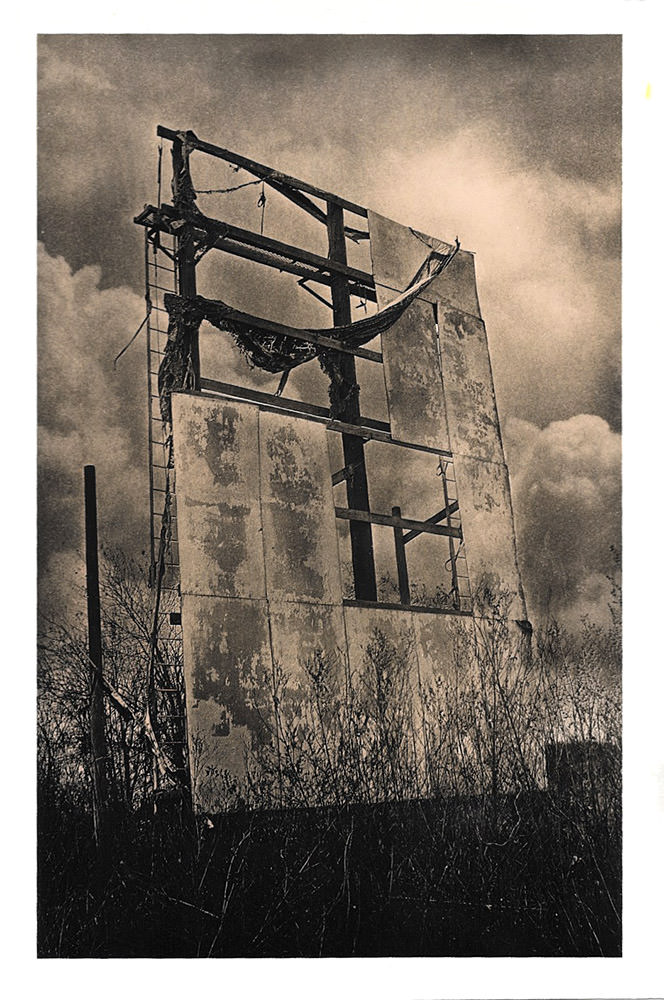
I've done this sort of thing, but I'll use silkscreen register pins and a paper punch. I'll make a dark print and trim out an area and "pin it" so it's in exact register. Nowadays I do it with litho film in a glass neg carrier. I put a sky in this image using a litho film mask and a separate sky negative:

N1w35R1.jpg
 
Is that like an old Billboard or something.?
Anyway.....the upper left of that "billboard"...that one shorter vertical piece, between the two, longer horizontals.....would you feel comfortable cutting a mask, for just that piece, and putting it on the paper while you did a 5-6 second burn of the surrounding area.?
If i am not mistaken, that is what the guy in the link is talking about.
I would think THAT technique would leave a noticeable halo.?

I dig that photo BTW. :smile:
 
My goodness. The mask for the lighthouse in his description must have been a minuscule and very precise undertaking - especially in the darkroom!
 
I've done this sort of thing, but I'll use silkscreen register pins and a paper punch. I'll make a dark print and trim out an area and "pin it" so it's in exact register. Nowadays I do it with litho film in a glass neg carrier. I put a sky in this image using a litho film mask and a separate sky negative:

N1w35R1.jpg
Thanks must look into that method. My masking efforts are pretty poor, but I persist wont learn without trying.
Wonderful picture btw.
 
Roger and Francis are always worth a look. Thanks for the link. I don't think I have seen this module before. I am unclear by how much this scan of the print has been reduced in size but as it was a 6x7 neg projection it may have been that the mask wasn't that miniscule. Certainly at first glance it looks to have been an almost impossibly precise mask to be laid on the lighthouse but if my speculation above has any basis and the dodge mask is anyway in the middle of a white clouds section, then maybe it wasn't as hard as we think. Certainly R and F make no big thing about the difficulty of using a mask here

pentaxuser
 
Using a mask like this, i.e., laid on the print at the time of exposure, is not all that hard. (Note that it's the print that's being masked, not the negative, which would need a lot finer registration.)

First, it's fairly easy to make the exact correct size mask from a reject print that was just made and use that as a template for the black paper mask (you can't easily use the print cut-out with fiber-base paper, since it curls). Second, in the example linked to, the printer wasn't using the mask for a significant amount of the overall exposure, just to hide the little lighthouse from the burn. That's not going to leave much of a halo, and likely none at all if it's registered halfway correctly.

I use this technique from time to time and it works well if you're careful. And, you can trash the prints that don't come out correctly.

Best,

Doremus
 
OK.
So you make a "junk" print, and cut out that shape of the lighthouse.
Now you have a piece of paper in the easel, ready for exposure, how do you know where to place the mask at.?
Do you use a red filter.?
 
OK.
So you make a "junk" print, and cut out that shape of the lighthouse.
Now you have a piece of paper in the easel, ready for exposure, how do you know where to place the mask at.?
Do you use a red filter.?

This is "paper plane masking" (vs. masking on the negative plane). I've gotten the correct sized silkscreen pins from ternes burton to fit a standard 3-hole paper punch - 9/32" round hole.

I'll punch a sheet of RC paper (doesn't curl) and tape the pins to the baseboard, like 2 holes 6" apart. I put a piece of scrap fiber paper down where the print will be, and register a sheet of RC with the pins and expose it. Without the scrap paper, the RC will have to "arc" a hair to mask the print and won't align. (I use RC for speed and flatness). Then I expose and process and dry the print. I usually spray paint the back black, and them trim what's needed. this works pretty well. Tim Rudman has a few pages in "master printing course" where he tapes a flap of clear acetate to the baseboard and uses opaque paint. I've also pin regsitered 16x20 sheets of ortho-litho film (cheap) and made positives which i can bleach and paint and then lay over the print.

Once you picture the main ideas ("I need an opqaue and transparent mask that returns to the same place every time"), you can come up with strategies.

The biggest issues with paper-plane masking: you can't touch a thing. If the neg or lens moves, you'll have to re-align. I've found even changing aperture slightly can throw things out of whack, which is why a glass carrier and neg-stage works so much better - you can redo the print at any size, and you can save your masks and return years later to redo the print.

I've ghetto'd up a pin-register system, where my neg carrier snaps into the same place in the enlarger, and the negs register to the carrier. It's not as precise as I'd like, but the freaking immense power means I'll be sending $400-some dollars to Lynn Radeka this summer for a proper setup.
 
Right...i had forgotten you were using Registry Pins.:redface:
Thanks Again
 
OK.
So you make a "junk" print, and cut out that shape of the lighthouse. Now you have a piece of paper in the easel, ready for exposure, how do you know where to place the mask at? Do you use a red filter?

Yes, that's the only reason I can see for the red filter in the first place. FWIW, I don't have a pin-register system, just accurately place whatever mask I need by hand under the filter. This has worked just fine for the few times I've needed it.

Doremus
 
Photrio.com contains affiliate links to products. We may receive a commission for purchases made through these links.
To read our full affiliate disclosure statement please click Here.

PHOTRIO PARTNERS EQUALLY FUNDING OUR COMMUNITY:


Ilford ADOX Freestyle Photographic Stearman Press Weldon Color Lab Blue Moon Camera & Machine
Top Bottom