
• Welcome to Photrio!
    Registration is fast and free. Join today to unlock search, see fewer ads, and access all forum features.
    Click here to sign up

Making a printing frame

Tied to the dock

D
Tied to the dock

  • 4
  • 0
  • 56
Running in the Snow

H
Running in the Snow

  • 1
  • 2
  • 70

Recent Classifieds

Forum statistics

Threads
203,081
Messages
2,849,591
Members
101,649
Latest member
fat-totoro-cat
Recent bookmarks
1
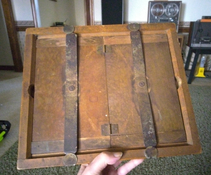
I made a printing frame for less than $10 using these two components:

A.


( 2 pieces)
and

B.


(3 pieces)

There is a groove in A that allows B to be used as springs (after bending them at center.)


:Niranjan.
 
Here is te completed frame, less back. It's late. Ill do the back tomorrow. I set this up for woodworkers or 3D printers. You make your own choice. On a Neptune 4 Max it will take 15hrs, 19m requiring 515g of PETG filament at 50% infil. For woodworkers, here is the plan. Do it however you want. The finger holes are 1 1/4 inch diameter. the glass is 3/32 x 10 x 12. The zipped file is the stl

Thanks again, much appreciated
 
What you will be making is a reverse engineered copy of my old Century 10x12 hinged back contact frame. This is a work in progress. Although I do good work I would recommend that readers not make heir own till I have made a proof. Stand by. I'm working. I'll post the checked results directly.
 

Attachments

  • frame.jpg
    frame.jpg
    806.1 KB · Views: 74
I've been printing platium/palladium for over 40 years and I have always used two pieces of quarter inch plate glass clamped together with industrial spring clamps. I don't know why anyone wants to use a wooden frame which is hard to get a tight register and often gives slivers of wood. If you are doing print out and need to examine the print you could clamp the top glass to a piece of wood that is in two parts.

Generally speaking, complete agreement. Yet, in the past I’ve used both 4x5 and 8x10 vintage printing frames to get clean borders. Works both ways, actually.
 
Generally speaking, complete agreement. Yet, in the past I’ve used both 4x5 and 8x10 vintage printing frames to get clean borders. Works both ways, actually.
Currently I am masking my 8x10 negs off so that just the black border from the edge of the film prints. In order to do that I have to precisely lay the mat over the paper and neg. In a frame I would have to lay the mask down first then the neg and then put the bottom up coated paper down on it. It would be extremely difficult if not impossible to do that in a frame. But you do what you gotta do and it is great to love your tools.
 
I made my print frames out of Aluminum square tube section profiles linked in corners by their special corner pieces. Not that difficult to make them. They are quite solid. I've used some thicker glass for them and some hard plywood sheets on which I glued a sheet of cork. The great advantage of Al frames is that they can be used as paper presses, too.
1.jpg
2.jpg
 
I've finished the work. For the benefit of all, and for highest visibility in the search engines I will create a separate thread will all the pertinent files I generated, if the moderators allow.
 
I've been printing platium/palladium for over 40 years and I have always used two pieces of quarter inch plate glass clamped together with industrial spring clamps. I don't know why anyone wants to use a wooden frame which is hard to get a tight register and often gives slivers of wood. If you are doing print out and need to examine the print you could clamp the top glass to a piece of wood that is in two parts.

That sounds like a great way to do it.

Anyone who knows how to make things out of wood won't make a frame that will give people splinters.
 
I've been printing platium/palladium for over 40 years and I have always used two pieces of quarter inch plate glass clamped together with industrial spring clamps. I don't know why anyone wants to use a wooden frame which is hard to get a tight register and often gives slivers of wood. If you are doing print out and need to examine the print you could clamp the top glass to a piece of wood that is in two parts.

I need a hinged back to see how things are cooking in the sun....but essentially the same thing with a thick wooden hinged back.
 
Photrio.com contains affiliate links to products. We may receive a commission for purchases made through these links.
To read our full affiliate disclosure statement please click Here.

PHOTRIO PARTNERS EQUALLY FUNDING OUR COMMUNITY:


Ilford ADOX Freestyle Photographic Stearman Press Weldon Color Lab Blue Moon Camera & Machine
Top Bottom