• Welcome to Photrio!
    Registration is fast and free. Join today to unlock search, see fewer ads, and access all forum features.
    Click here to sign up

Making 1925 Gelatin Emulsion and Coating Film for 1925-2025 Leica Centnnial

Watch Your Step

H
Watch Your Step

  • 7
  • 2
  • 140
The Royal Mile.

A
The Royal Mile.

  • 5
  • 5
  • 175

Forum statistics

Threads
201,648
Messages
2,827,881
Members
100,867
Latest member
TheBlackAcorn
Recent bookmarks
0
OP
OP

Mark Osterman

Member
Allowing Ads
Joined
Sep 7, 2011
Messages
67
Format
Large Format
It would go offtopic rather strongly, but I think I'm not alone in having some issues with what Facebook represents and how the business model works. I'm afraid there will always be a group of people who simply refuse to take part in it. Perhaps it's a shame that this results in practitioners becoming divided/distributed across different platforms. Of course, all are welcome here on Photrio. Either way, I think the reality is, and will continue to be, that there are different platforms and no single platform will be home for all individuals within a certain community. We'll have to learn to live with that, one way or another.


There's always a dilemma there; on the one hand we want people to feel free in speaking up, but the drawback of this is that not everything shared is on-topic, relevant or of high quality. I think by and large Photrio does fairly well compared to other online platforms, which is also evident in how many people find this place through online searches for specific information. Lots of pearls, but also lots of mud. It's difficult to get just one without the other.
As to Ron, he was a regular and frequent participant here on Photrio right up to his final days. We all thank him dearly for his commitment to sharing his knowledge so freely through several channels, and he's still sorely missed today. What he has shared here remains easily accessible and indeed intensively used/referenced by many.

Sure I understand. Well as you can see I‘m reaching out now to this group as a way to put this information out there. If there is a different subgroup here you think I should use, let me know. I just guessed my post might be viewed by someone and it worked since I got response quickly enough. We are currently prepping to teach a five day 8x10” dry collodion negative workshop here in Sicily … beginning tomorrow. So, I initiated this thread here but may be “away“ for the next few days while teaching.

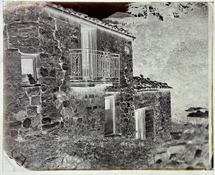
Below: typical dry collodion negative taken in rural Sicily last year. Made for salt printing.
 

Attachments

  • IMG_2087.jpeg
    IMG_2087.jpeg
    1.4 MB · Views: 128

Don_ih

Member
Allowing Ads
Joined
Jan 24, 2021
Messages
8,533
Location
Ontario
Format
35mm RF
I can't think of a better place to put your information than here. This forum likely has more non-vocal members who are interested in what you're doing than any other place on the internet. This particular project also likely won't generate much armchair criticism or pointless (or misguided) speculation, since most people find the idea of emulsion making and film coating intimidating and beyond the limits of their skill.

I, for one, clicked "watch" on this thread when I saw what it was with no intent to say anything. But at this point, I thought it might be good top encourage you to continue.

Brilliant repurposing of the belt sander, by the way.
 

koraks

Moderator
Moderator
Joined
Nov 29, 2018
Messages
26,636
Location
Europe
Format
Multi Format
Well as you can see I‘m reaching out now to this group as a way to put this information out there.

And I cannot stress my appreciation of this enough! Thanks so much.

That collodion negative looks beautiful btw. I only pursued wet plate for a relatively brief period, in which I've taken inspiration from many of your writings and the videos you did for/with the museum. Indeed, salt prints from collodion negatives quickly turned into a favorite of mine! One day I might revive my wet plate work, but for now, I enjoy other processes that involve much less persistent silver stains in floors and windowsills...
 

rmazzullo

Subscriber
Joined
Mar 24, 2007
Messages
326
Location
Northeast US
Format
Multi Format
Hello Mark,

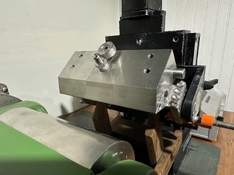
Thank you for posting the (daylight) photo of the coating machine. If other, close up photos are one day available, they will most certainly generate ideas for building a functionally similar machine. What I am curious about is how, when and for how long was the coated film cooled and dried. Can you please add some explanatory notes about the coating head as well? There are discussions of coating methods in the patents and in Focal Press books, but I would like to learn if / how these concepts were applied to the coating head as shown. I am kind of surprised this equipment didn't get more visibilty years ago in this (or a similar) forum - unless I missed it entirely. I am also wondering if the coating machine / coating head design is scalable. Lots of ideas to experiment with...

Thank you again for sharing this with us.

Bob
 

Lee Rust

Member
Allowing Ads
Joined
Feb 7, 2010
Messages
514
Location
Rochester NY
Format
Multi Format
Hi Mark,

It's very encouraging to see what you've been up to since the Eastman Museum days. That 1925 Leica is a great match for your 1923 Ford! Whenever I catch sight of a Model T roadster on Rochester area streets, I'm pretty sure it's you, since a 102-year-old automobile really sticks out amongst everyday vehicles.

As digital imaging gets more and more mysterious, the relative simplicity of early analog processes seems more and more attractive, even given the chromatic limitations of the emulsions. Actually, being able to see almost everything you're doing under a safelight is a huge advantage for do-it-yourselfers.

Have a great time in Sicily, and best wishes to you and to France.

Lee Rust
 

Harry Callahan

Member
Allowing Ads
Joined
Nov 15, 2017
Messages
555
Location
?
Format
Analog
I wonder if the reason we didn’t have static was that we were always shooting film we made no older than a day before shooting.

Statics also does depend on the base material. In a movie camera PET is more problematic regarding statics than acetate. In the beginning of movie film they didn`t have acetate but celluloid afaik, so maybe the problems back then were due to the base material...
 

Kino

Subscriber
Allowing Ads
Joined
Jan 20, 2006
Messages
7,938
Location
Orange, Virginia
Format
Multi Format
I wonder if the reason we didn’t have static was that we were always shooting film we made no older than a day before shooting.

The relatively "green" nature of the emulsion might have helped dispel any static build-up.

Static problems in early cinema were not monolithic in nature. The very earliest film was shipped slit but unperforated as it shrank slightly, but continuously. The cinematographer would get up extra early in the morning and have to perforate enough film stock for the day's shooting to insure smooth running in the camera's movement. I would imagine the added handling, temperature and humidity variations and the rush to complete the job contributed substantially to the static problem.

There is a fair amount of information on the subject buried in various autobiographies and histories, but it hasn't been condensed in any serious survey that I know about.

Thanks again, please continue to post as you find the time!
 

Harry Callahan

Member
Allowing Ads
Joined
Nov 15, 2017
Messages
555
Location
?
Format
Analog
I never heard of static built up being a problem in the early days, but movie cameras back then often had film in a cartridge probably because film didn`t have AHL, so loading a cartridge into a camera was better. Such cartridges often have a velvet light trap, which does produce friction on the film and therefore probably static charge. An eyemo takes daylight spools, this also should be a factor.
 

Kino

Subscriber
Allowing Ads
Joined
Jan 20, 2006
Messages
7,938
Location
Orange, Virginia
Format
Multi Format
No, magazines were used from the beginning; cartridges were certainly later. Depends on the camera used.

I don't want to divert this thread from it's original intent, so i will leave it there.
 
OP
OP

Mark Osterman

Member
Allowing Ads
Joined
Sep 7, 2011
Messages
67
Format
Large Format
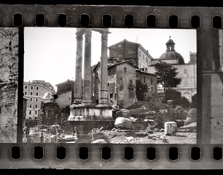
First Roll of my MO-1925 Film

I took this picture last week in the Roman Forum. Was shot with a 1937 Leica IIIa and the emulsion I made two weeks before. It is ISO 12-15 and has an anti-halation layer which I left on the negative as a reference. That accounts for some “noise” visible in the D-min areas.
 

Attachments

  • image0.jpeg
    image0.jpeg
    1.4 MB · Views: 87
OP
OP

Mark Osterman

Member
Allowing Ads
Joined
Sep 7, 2011
Messages
67
Format
Large Format
@Mark Osterman this is quite spectacular and it shows how the antihalation is working excellently! I suspect that a better quality scan will reveal an excellent image. Bravo, and congratulations!

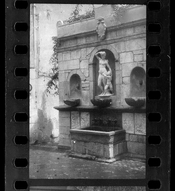
I don’t own a scanner for transmission but yes, the negative has very good resolution. Here is another.
 

Attachments

  • IMG_9657.jpeg
    IMG_9657.jpeg
    1.3 MB · Views: 81
OP
OP

Mark Osterman

Member
Allowing Ads
Joined
Sep 7, 2011
Messages
67
Format
Large Format
Mark, these are gorgeous. I think the optics, film and subject matter work very well together here!

Thanks … yes, I am please with the results.
 

Attachments

  • IMG_0034.jpeg
    IMG_0034.jpeg
    383.6 KB · Views: 81
  • IMG_0033.jpeg
    IMG_0033.jpeg
    356.8 KB · Views: 84
OP
OP

Mark Osterman

Member
Allowing Ads
Joined
Sep 7, 2011
Messages
67
Format
Large Format
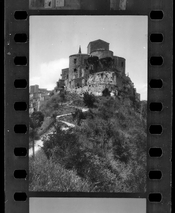
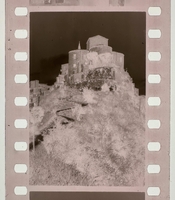
Still working on my film coating and development of MO-1925 film. Here is a single frame test of un-perforated film developed in an MQ borax developer formula from 1832. Essentially D-76
 

Attachments

  • IMG_0163.jpeg
    IMG_0163.jpeg
    1.1 MB · Views: 67
  • IMG_0164.jpeg
    IMG_0164.jpeg
    1.1 MB · Views: 61

thinkbrown

Member
Joined
Mar 7, 2025
Messages
311
Location
Boston MA
Format
Multi Format
Still working on my film coating and development of MO-1925 film. Here is a single frame test of un-perforated film developed in an MQ borax developer formula from 1832. Essentially D-76

I'm seriously impressed at the results you're getting. Were it not for the handful of little emulsion defects I'd totally believe it was a commercial product.
 
OP
OP

Mark Osterman

Member
Allowing Ads
Joined
Sep 7, 2011
Messages
67
Format
Large Format
I'm seriously impressed at the results you're getting. Were it not for the handful of little emulsion defects I'd totally believe it was a commercial product.

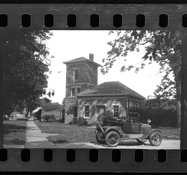
Yes, when there is a spec of dust it’s more noticeable on a 35 mm negative than a 4x5” plate. But dust is always a problem with enlarging and that’s why God invented retouching. Here is one I shot in the 1928 Leica earlier this week. Fun that I can also drive to locations in my model T that’s the same era as my emulsion.
 

Attachments

  • IMG_0354.jpeg
    IMG_0354.jpeg
    631 KB · Views: 71

mghis

Member
Allowing Ads
Joined
Aug 20, 2012
Messages
24
Format
Medium Format
Hello Mr. Osterman,

I was wondering if you could upload some more pictures of the coating head. Also, if you happen to open it, it would be very interesting to see the shape of the distribution chamber.

Also, if you plan to test more dyes for the antihalation layer, I would like to suggest triarylmethane dyes. Many should discolor readily in common developer solutions. I remember fuchsin becomes colorless at once in a sodium sulfite solution. I also found some patents using them as antihalation dyes, like US1994876A.

Thank you for sharing your work! I think your results are really impressive.
 
Last edited:
OP
OP

Mark Osterman

Member
Allowing Ads
Joined
Sep 7, 2011
Messages
67
Format
Large Format
Hello Mghis,

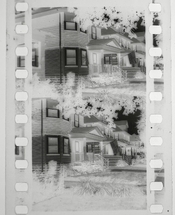
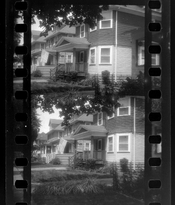
First of all, what is your actual name? I cam show other images of the coater but if you are seriously interested it’s better if you contact me by email or text as I can only post so many pictures here. LOL .. I am generally confused how to start new threads on this site where people can find them. So if you can find out, let me know. I will look into the other water soluble dye you mentioned. Thanks. Here is the coating head. Also some recent samples of my film shot in a vintage half frame Memo camera.
 

Attachments

  • IMG_0474.jpeg
    IMG_0474.jpeg
    357.1 KB · Views: 64
  • IMG_0475.jpeg
    IMG_0475.jpeg
    320.6 KB · Views: 55
  • IMG_3343.jpeg
    IMG_3343.jpeg
    766.8 KB · Views: 58
OP
OP

Mark Osterman

Member
Allowing Ads
Joined
Sep 7, 2011
Messages
67
Format
Large Format
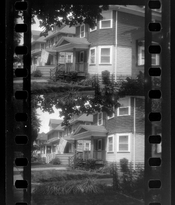
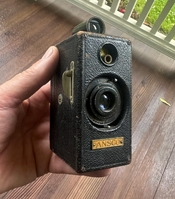
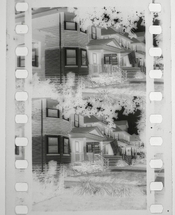
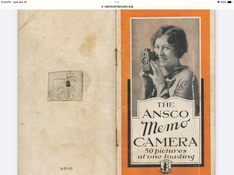
I recently ran some of my MO-1925 emulsion 35 mm film through a vintage Ansco Memo camera. Developed with 1929 formula Borax MQ developer (Kodak D-76)
 

Attachments

  • IMG_0471.jpeg
    IMG_0471.jpeg
    491.9 KB · Views: 36
  • IMG_0475.jpeg
    IMG_0475.jpeg
    320.6 KB · Views: 33
  • IMG_0474.jpeg
    IMG_0474.jpeg
    357.1 KB · Views: 35
  • IMG_0472.jpeg
    IMG_0472.jpeg
    248.3 KB · Views: 39
OP
OP

Mark Osterman

Member
Allowing Ads
Joined
Sep 7, 2011
Messages
67
Format
Large Format
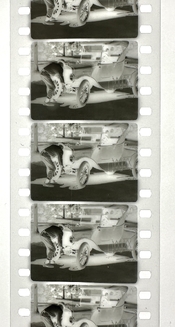
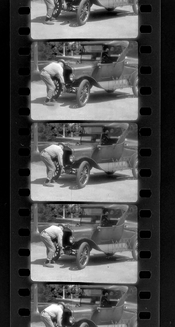
Last week we ran some tests of my MO-1925 emulsion 35 mm film through a vintage Eyemo cine camera. These were shot at 8 fps by hand cranking. Developed in 1929 Borax MQ developer formula (Eastman D-76)
 

Attachments

  • IMG_0482.jpeg
    IMG_0482.jpeg
    1.2 MB · Views: 49
  • IMG_0482.jpeg
    IMG_0482.jpeg
    1.1 MB · Views: 44
  • IMG_0459.jpeg
    IMG_0459.jpeg
    427.4 KB · Views: 44

koraks

Moderator
Moderator
Joined
Nov 29, 2018
Messages
26,636
Location
Europe
Format
Multi Format
Last week we ran some tests of my MO-1925 emulsion 35 mm film through a vintage Eyemo cine camera. These were shot at 8 fps by hand cranking. Developed in 1929 Borax MQ developer formula (Eastman D-76)

Oh! Any chance you'll publish the moving pictures online as well? If you end up doing so, please be sure to post a link here!
 
OP
OP

Mark Osterman

Member
Allowing Ads
Joined
Sep 7, 2011
Messages
67
Format
Large Format
Forgot to mention that these cine film tests were developed with a rare 1926 Leitz revolving drum apparatus.
Oh! Any chance you'll publish the moving pictures online as well? If you end up doing so, please be sure to post a link here!

Those films were part of a demonstration of emulsion making and film coating for Davey Bendiksen, a teacher of cine film shooting up in Massachusetts. He took the three strips of film negatives with him and will get back to me with a digital edit and reversal. I’ll be able to post them then.
 
Photrio.com contains affiliate links to products. We may receive a commission for purchases made through these links.
To read our full affiliate disclosure statement please click Here.

PHOTRIO PARTNERS EQUALLY FUNDING OUR COMMUNITY:


Ilford ADOX Freestyle Photographic Stearman Press Weldon Color Lab Blue Moon Camera & Machine
Top Bottom