
-
Welcome to Photrio!Registration is fast and free. Join today to unlock search, see fewer ads, and access all forum features.Click here to sign up
You are using an out of date browser. It may not display this or other websites correctly.
You should upgrade or use an alternative browser.
You should upgrade or use an alternative browser.
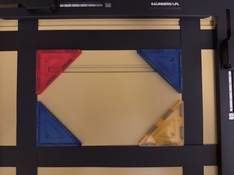
Magnetic triangles for easel
-
A
- Thread starter hiroh
- Start date


Recent Classifieds
-
For Sale Schneider Kreuznach Super Angulon MC 120mm f8
- Started by RoboRepublic
-
Sold JOBO MultiTank 2 2521 4 X 5
- Started by Inayat Noor
-
For Sale Ilford 5X7 Paper Lot
- Started by davela
-
For Sale Omega Audible Repeating Timer II
- Started by davela
Forum statistics

gordrob
Subscriber
Awesome idea! 

I used a drafting triangle to set mine at right angles, then placed a strong magnet to clamp them together semi-permanently. Mind you, I only use one paper size.

- Joined
- Apr 4, 2004
- Messages
- 718
- Format
- 35mm
Clever..

A 7 year old darkroom assistant - great to start them young  .
.
.- Joined
- Jul 14, 2011
- Messages
- 15,215
- Format
- 8x10 Format
Just make sure your triangle or square does have a true right angle. I double check them with an expensive machinist's square. You'd be surprised how many are off; the same goes for carpentry squares.
Just make sure your triangle or square does have a true right angle. I double check them with an expensive machinist's square. You'd be surprised how many are off; the same goes for carpentry squares.
I made a couple of prints after aligning my easel with these, and they’re accurate enough that my eyes perceive them as perfectly square.
Just make sure your triangle or square does have a true right angle. I double check them with an expensive machinist's square. You'd be surprised how many are off; the same goes for carpentry squares.
You don’t need anything expensive to do this. Just lay down a true straight line, which you can verify from one end by eye, and check that your square gives the same perpendicular laid first one way, then flipped over. In fact, one should check an expensive square the same way.

Ha
Haha, yes, but if they were all from the same mould that could be the case, though I’m sure they are amply good enough!
Obviously you proved they are all 90 degrees in the posted image; great idea. If they were faulty, the errors would have to be complementary and shared by two each placed diagonal to each other.
Haha, yes, but if they were all from the same mould that could be the case, though I’m sure they are amply good enough!
Last edited:
- Joined
- Jul 14, 2011
- Messages
- 15,215
- Format
- 8x10 Format
Of course on cane simply draw a line and flip the thing over to see if there's a match. But did you precisely scribe it? Was it perfecty in line with a reference edge. Were the edges of the device completely smooth?
What is nice about bigger easels with masking blades is that you have four corners to check, and they will all match if the right angle is true.
Sadly, not only are many carpenter's squares off these days, but art store drafting supplies sure aren't what they used to be either. Glad I saved some serious old gear.
Otherwise, every shop or studio should have a least one really good square on hand; there are all kinds of uses for them.
What is nice about bigger easels with masking blades is that you have four corners to check, and they will all match if the right angle is true.
Sadly, not only are many carpenter's squares off these days, but art store drafting supplies sure aren't what they used to be either. Glad I saved some serious old gear.
Otherwise, every shop or studio should have a least one really good square on hand; there are all kinds of uses for them.
- Joined
- Jul 14, 2011
- Messages
- 15,215
- Format
- 8x10 Format
Of course on cane simply draw a line and flip the thing over to see if there's a match. But did you precisely scribe it? Was it perfecty in line with a reference edge. Were the edges of the device completely smooth? I once did a comparison test : dozens of "expert" cabinet makers and carpenters with their flip method, versus a true machinists square check; statistically, the flip method lost the contest over 90% of the time.
What is nice about bigger easels with masking blades is that you have four corners to check, and they will all match if the right angle is true.
Sadly, not only are many carpenter's squares off these days, but art store drafting supplies sure aren't what they used to be either. Glad I saved some serious old gear.
Otherwise, every shop or studio should have a least one really good square on hand; there are all kinds of uses for them.
What is nice about bigger easels with masking blades is that you have four corners to check, and they will all match if the right angle is true.
Sadly, not only are many carpenter's squares off these days, but art store drafting supplies sure aren't what they used to be either. Glad I saved some serious old gear.
Otherwise, every shop or studio should have a least one really good square on hand; there are all kinds of uses for them.
Otherwise, every shop or studio should have a least one really good square on hand
Which inevitably brings rise to this:
- Joined
- Jul 14, 2011
- Messages
- 15,215
- Format
- 8x10 Format
Ha! My picture framing room carpenters square is not only aluminum to prevent rust, but I machined all the edges square. They don't come that way - large carpenter's squares are stamped out in large numbers. So are many plastic
art store triangles. And as far as even the expensive variety of woodworking try squares go, I found over 80% of them to be off. I've gone through cases of them to find one suitable for my own usage.
And now a confession : even though the participants in my flip method square-test trial knew that approach, every one of them used Starrett precision tools for their own non-structural woodworking. They had the most expensive clients in the world (Elllison, Gates, etc). Every one of them could charge 50K for a garden gate or chair, or 70K for an end table. But like me, their own furniture and homes were a lot more humble. When woodworking is a labor of love,
you're not necessarily going to get rich yourself. Likewise with photography.
art store triangles. And as far as even the expensive variety of woodworking try squares go, I found over 80% of them to be off. I've gone through cases of them to find one suitable for my own usage.
And now a confession : even though the participants in my flip method square-test trial knew that approach, every one of them used Starrett precision tools for their own non-structural woodworking. They had the most expensive clients in the world (Elllison, Gates, etc). Every one of them could charge 50K for a garden gate or chair, or 70K for an end table. But like me, their own furniture and homes were a lot more humble. When woodworking is a labor of love,
you're not necessarily going to get rich yourself. Likewise with photography.
Last edited:

It's actually safe to assume the plastic building blocks would be close enough to square for any practical purpose. When you assemble such blocks, any error in the angles would accumulate as you add more and more blocks until they would no longer connect well. So, they practically need to be more precise than an average rafter square (for rough carpentry).
A rough carpentry square does not need to be of the greatest precision since dimensional lumber is almost never perfectly straight - so it hardly matters is the angle you cut at the end is exactly correct.
A rough carpentry square does not need to be of the greatest precision since dimensional lumber is almost never perfectly straight - so it hardly matters is the angle you cut at the end is exactly correct.
- Joined
- Jul 14, 2011
- Messages
- 15,215
- Format
- 8x10 Format
Don - just be aware that the worst cheapo try square of the 70's was way better than most today. And I sure as heck wouldn't classify my mat cutting demands or picture frame assembly in the same category as dimensional lumber rough constructions projects. Would you?
As far as easel squareness goes, it all depends. I always trim off the margins of black and white prints anyway before dry mounting, and in that case, the big trimmer is very precisely squared. But with color prints, which are cold mounted, I leave the margin intact, and leave a bit of it revealed under the window mat. So in the latter case, I want my easel blades spot on square.
As far as easel squareness goes, it all depends. I always trim off the margins of black and white prints anyway before dry mounting, and in that case, the big trimmer is very precisely squared. But with color prints, which are cold mounted, I leave the margin intact, and leave a bit of it revealed under the window mat. So in the latter case, I want my easel blades spot on square.
| Photrio.com contains affiliate links to products. We may receive a commission for purchases made through these links. To read our full affiliate disclosure statement please click Here. |
PHOTRIO PARTNERS EQUALLY FUNDING OUR COMMUNITY:  |