
• Welcome to Photrio!
    Registration is fast and free. Join today to unlock search, see fewer ads, and access all forum features.
    Click here to sign up

Looking for info on Yellow negatives

Recent Classifieds

Forum statistics

Threads
201,763
Messages
2,829,724
Members
100,930
Latest member
WBM
Recent bookmarks
0

MT Shooter

Member
Allowing Ads
Joined
Feb 11, 2013
Messages
6
Location
Montana
Format
Med. Format RF
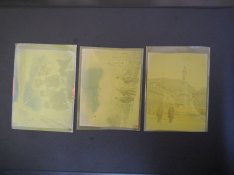
I have received some old glass plate and gelatin negatives from a Historical Society for scanning and printing. I have 3 of those gelatin negatives that are totally yellow. They look like normal negatives other than the coloring. I have scanned them on my Epson V800 scanner as B&W and they produce a "normal" image.
What I am trying to find out is if anyone here knows why these negatives are totally yellow. They are from just after the turn of the century Germany, prior to WW I if this helps, taken with a 4x5 camera of unknown origin.
I have tried uploading a pic here but even a 3MB file appears to be too large.
 
OP
OP

MT Shooter

Member
Allowing Ads
Joined
Feb 11, 2013
Messages
6
Location
Montana
Format
Med. Format RF
I reduced the file size and have posted a pic of the negatives here.
 

Attachments

  • YellowNegsSmall.jpg
    YellowNegsSmall.jpg
    129.1 KB · Views: 159

trendland

Member
Allowing Ads
Joined
Mar 16, 2012
Messages
3,398
Format
Medium Format
The glass plate negatives you probably own are made from wet collodion type.
Negatives with a collodion layer were varnished after processing.
This aged "varnished" layer contibutes to image stabitity.
It often lent a brownish- yellow tone to wet collodion plates.
Well - I would guess your negatives should be handled carefully because they seams to be real old....:angel:
But beware of danger : Don't use "alcohol"
don't use "aceton" to clean the plates.
Because this cleaning action could bring you in conflict with your institute - better use photoshop.

with regards

PS : The collodion layer is soluble in alcohol and acetone :whistling::whistling:
 

Svenedin

Member
Allowing Ads
Joined
Mar 19, 2016
Messages
1,191
Location
Surrey, United Kingdom
Format
Med. Format RF
I have received some old glass plate and gelatin negatives from a Historical Society for scanning and printing. I have 3 of those gelatin negatives that are totally yellow. They look like normal negatives other than the coloring. I have scanned them on my Epson V800 scanner as B&W and they produce a "normal" image.
What I am trying to find out is if anyone here knows why these negatives are totally yellow. They are from just after the turn of the century Germany, prior to WW I if this helps, taken with a 4x5 camera of unknown origin.
I have tried uploading a pic here but even a 3MB file appears to be too large.

Those look wonderful. Is there any chance we could see the positive images please? If they are too big you could either resize them or host them on Flickr (for instance) and link to them.
 
OP
OP

MT Shooter

Member
Allowing Ads
Joined
Feb 11, 2013
Messages
6
Location
Montana
Format
Med. Format RF
The glass plate negatives you probably own are made from wet collodion type.
Negatives with a collodion layer were varnished after processing.
This aged "varnished" layer contibutes to image stabitity.
It often lent a brownish- yellow tone to wet collodion plates.
Well - I would guess your negatives should be handled carefully because they seams to be real old....:angel:
But beware of danger : Don't use "alcohol"
don't use "aceton" to clean the plates.
Because this cleaning action could bring you in conflict with your institute - better use photoshop.

with regards

PS : The collodion layer is soluble in alcohol and acetone :whistling::whistling:

I have done many glass plate scans here, I don't do preservation work myself at all. The Historical Society has me scan and print all this old stuff PRIOR to preservation just so they have a record in case something does go wrong in that preservation process. I have seen slight "yellowing" caused by colloidal oxidation many times, but these totally yellow negatives are a mystery to them as well as to me.
 
OP
OP

MT Shooter

Member
Allowing Ads
Joined
Feb 11, 2013
Messages
6
Location
Montana
Format
Med. Format RF
Those look wonderful. Is there any chance we could see the positive images please? If they are too big you could either resize them or host them on Flickr (for instance) and link to them.
I will try to post some reduced size versions here for you.
YellowNeg001Tiny.jpg
 
OP
OP

MT Shooter

Member
Allowing Ads
Joined
Feb 11, 2013
Messages
6
Location
Montana
Format
Med. Format RF
Great quality I would like to state - let me ask : It looks like 13cm x18cm from format of the plates (somewhere in this size? )

with regards
They actually measure 8cm x 10.4cm. I have no idea what camera made them at this time either. One clue can be found in the picture of the two men by the statue in Bolzen, Austria. The man on the right is carrying a camera case that looks like it may hold an Agfa Folding camera, or maybe a Kodak Folder from the period.
YellowNeg002Tiny.jpg
 

Svenedin

Member
Allowing Ads
Joined
Mar 19, 2016
Messages
1,191
Location
Surrey, United Kingdom
Format
Med. Format RF
Those are fantastic. Thank you. Bözen/Bolzano is in the Süd-Tyrol. Now part of Italy but was Austrian until 1919. I’ve been there quite a few times.
 

Nodda Duma

Member
Allowing Ads
Joined
Jan 22, 2013
Messages
2,686
Location
Batesville, Arkansas
Format
Multi Format
Some orthochromatic plates of that period were dyed yellow during manufacturing to provide a sort of built-in yellow filter...so you could buy those plates and get pictures of skies with clouds even if you didn't have a yellow filter for the camera. They were sometimes called self-screened or non-filter plates.

There's discussion of this in emulsion-making sources of the time, such as Wall, "Photographic Emulsions," 1929, pg 69.
 
Last edited:
Photrio.com contains affiliate links to products. We may receive a commission for purchases made through these links.
To read our full affiliate disclosure statement please click Here.

PHOTRIO PARTNERS EQUALLY FUNDING OUR COMMUNITY:


Ilford ADOX Freestyle Photographic Stearman Press Weldon Color Lab Blue Moon Camera & Machine
Top Bottom
