
• Welcome to Photrio!
    Registration is fast and free. Join today to unlock search, see fewer ads, and access all forum features.
    Click here to sign up

Looking for advice about halide solvent for B&W reversal

Do Not Come Here

A
Do Not Come Here

  • 9
  • 3
  • 94
Heavy

H
Heavy

  • 13
  • 5
  • 135

Recent Classifieds

Forum statistics

Threads
201,931
Messages
2,832,220
Members
101,023
Latest member
scodth
Recent bookmarks
0

josephchesshyre

Member
Allowing Ads
Joined
Jun 4, 2014
Messages
53
Location
Chester, Che
Format
35mm
Hello all, I'm new around here although I've been hovering for a few months as I've been interested in b&w reversal for a while.

I've been following the Ilford instructions with a couple of modifications. Firstly, I've halved the amount of KMnO4 in the bleach having read that this was a good idea. The bleaching seems to be working perfectly like that, even when sticking to the specified 5 minutes.

The other change I've made concerns the sodium thiosulphate that Ilford specifies at a concentration of 8-12g/l in the first developer. It has quickly become clear to me (no pun intended) that this is too much. My first roll of film came out extremely faint and seemingly over-exposed, with some frames completely blank. Initially I blamed this on too much bleach, but when the same thing happened with my second film and following some extensive online reading I decided that the sodium thiosulphate was to blame.

These first two rolls were Ilford FP4 exposed at box speed. Several online posters have suggested that the amount of thiosulphate that Ilford recommends is based on older films with much thicker emulsion than modern films, and although this makes sense it strikes me as odd that Ilford specifically mention FP4 as requiring 12g/l of thiosulphate. Could it be that even their own films have changed since that document was written?

The third roll I developed was HP5. Although Ilford say that this is likely to yield slides with 'unacceptably low contrast', this roll actually turned out beautifully, but based on several articles I read I added NO thiosulphate at all. The results are anything but lacking in contrast - if anything they are verging on too contrasty!

E.g. Pinkhill.jpg

My fourth film was one of Kodak TMax 100 that I had lying around waiting to be developed for a while. This turned out brilliantly with 12g/l thiosulphate, but I know these films have notoriously thick emulsion.

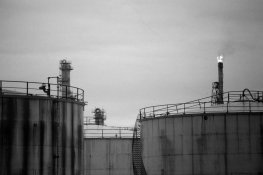
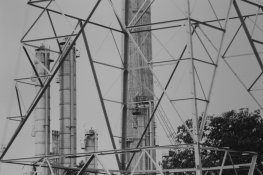
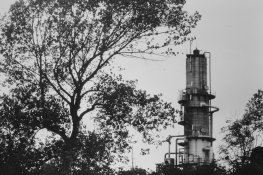
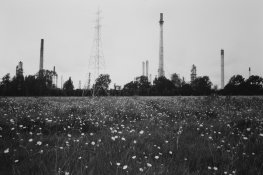
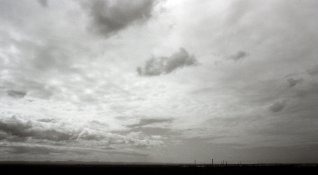
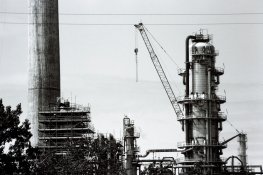
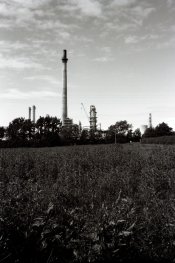
My fifth film was another FP4. Here are a couple from it, my most successful so far.
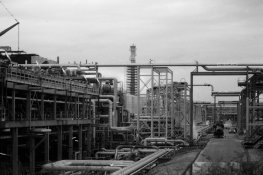
Stanlow (1).jpgStanlow (2).jpg

With this roll I omitted the thiosulphate from the first developer but used a bath of it at 10g/l after the bleach clearing bath and before second exposure. Looking back now that I've developed a sixth film, I don't think I really held it in this bath long enough to make more than a tiny difference and could possibly have done without it.

So, for my sixth film, which was of the same oil refinery but at night and so with a lot of black in many of the shots, I used the same method but with more time in the post-clearing thiosulphate bath. I kept checking and could hardly see any change occurring, so kept going, for a total of four minutes in the thiosulphate bath. Much to my irritation this film has turned out badly. The images aren't too faint because they're mostly dark-ish as I say, but all the blacks are dark greys (include the film edges) and some of the shots with the longest exposures are almost completely invisible. In general there is a washed-out look and a lack of richness. All images also have bad 'swirling' and what looks like silver 'run-off' across the image from the halide in the film edges.

I'd rather cut out this extra thiosulphate stage as it seems unpredictable and not very accurate, and although the idea of clearing the highlights by inspection appeals to me, in practice it doesn't seem that easy to do, especially if the images don't have many highlights or large bright areas.

Does anyone else have experience of adjusting this parameter, especially with Ilford films? Does anyone have any idea why the amount in the Ilford directions is clearly too high? Some other recipes posted on here over the years have included much smaller amounts of sodium thiosulphate than Ilford specify. I really want to get to the stage where I know how much thiosulphate to add to the first developer, both for HP5 and FP4 (the two films I use most) without wasting too many more films and chemicals.

I'm thinking that for my next roll of FP4 I will shoot at box speed as before and add 1g/l thiosulphate and take it from there.

By the way, I'm using Ilford Universal PQ at 1+5 and developing for 12 mins at 20C with an inversion every 15 seconds, i.e. exactly what Ilford recommend.
 
Last edited by a moderator:

Simon R Galley

Member
Allowing Ads
Joined
Nov 2, 2005
Messages
2,034
Location
Cheshire UK
Format
Medium Format
Dear Joseph,

The area of reversal processing monochrome is not something I am terribly au fait with to be honest, my suggestion is that you have read our 'instructions' and adapted them, as always information that we give regarding any 'process' is meant as 'a starting point' and indicative, in saying that, I am aware of the detail to which our Technical Service go to, and the knowledge that exists with in it, and I would tend to follow it rather than anything else I had heard to be absolutely honest, but if you have adapted it and got good results for you then super.

Simon ILFORD Photo / HARMAN technology Limited :
 
OP
OP

josephchesshyre

Member
Allowing Ads
Joined
Jun 4, 2014
Messages
53
Location
Chester, Che
Format
35mm
Dear Simon,

Thanks so much for your quick and encouraging reply. Of course part of the fun of all this is the experimentation, and I suppose if I have developed pictures I care about before I have settled on a process completely then being disappointed with some of the results is a risk I should acknowledge perhaps more than I have.

One possible explanation for the crux of my query (why do the thiosulphate quantities specified in the Ilford reversal sheet seem to be rather high) may be to do with the need to distinguish between the anhydrous and the pentahydrate forms of sodium thiosulphate. My reading has informed me that the latter is less concentrated in effect than the anhydrous form (to be precise one need only use 64% of anhydrous vs pentahydrate to achieve the same effect). I am using anhydrous sodium thiosulphate – the Ilford sheet doesn't absolutely specify, but perhaps its use of the word 'crystals' means that it refers to the pentahydrate form? If this is the case then perhaps I have my answer...!
 

pdeeh

Member
Allowing Ads
Joined
Jun 8, 2012
Messages
4,770
Location
UK
Format
Multi Format
yep
 

Gerald C Koch

Member
Allowing Ads
Joined
Jul 12, 2010
Messages
8,131
Location
Southern USA
Format
Multi Format
Rather than tinkering with the formulas follow Ilford's advice to adjust your EI. The amount of silver halide solvent should only be adjusted to clear the highlights in the slides. It should not be changed to adjust the exposure. It appears from posts tinkering usually results in failure. Reversal processing is more complex than normal BW development. Making changes can lead to unexpected problems.
 
Last edited by a moderator:
OP
OP

josephchesshyre

Member
Allowing Ads
Joined
Jun 4, 2014
Messages
53
Location
Chester, Che
Format
35mm
Rather than tinkering with the formulas follow Ilford's advice to adjust your EI. The amount of silver halide solvent should only be adjusted to clear the highlights in the slides. It should not be changed to adjust the exposure. It appears from posts tinkering usually results in failure. Reversal processing is more complex than normal BW development. Making changes can lead to unexpected problems.

Thank you. This is excellent advice.

I've just processed a roll that I exposed today, using the equivalent of 8g/l sodium thiosulphate and 12 mins' developing time. They're drying now...they looked great although some seemed over-exposed. Of course this may just be my own exposure error. I'll report back when they're dry and I've looked at them properly.

So, maybe I'll try 10 mins' development next time with similar subject matter and lighting and compare.
 

Xmas

Member
Allowing Ads
Joined
Sep 4, 2006
Messages
6,398
Location
UK
Format
35mm RF
You may need to bracket for exposure and use an incident meter as direct transparencies have little exposure latitude and need to be exposed for highlights in most cases.
 

Gerald C Koch

Member
Allowing Ads
Joined
Jul 12, 2010
Messages
8,131
Location
Southern USA
Format
Multi Format
As Xmas points out bracketing is a very good idea.

You may need to adjust the amount of thiosulfate for each different film that you use. It is therefore important to keep notes.
 

Xmas

Member
Allowing Ads
Joined
Sep 4, 2006
Messages
6,398
Location
UK
Format
35mm RF
The ISO speed is a toe speed you need a 'shoulder' speed which will depend on toe speed and film dynamic range and your processing.

E6 is not difficult but you need to be exact every time.

The cine people normally shoot on negative and contact print for positive. Forgotten what the lantern slide people did.
 
  • Deleted member 2924
  • Deleted
OP
OP

josephchesshyre

Member
Allowing Ads
Joined
Jun 4, 2014
Messages
53
Location
Chester, Che
Format
35mm
I have been bracketing +1 and -1 for most shots.

I am not using a chemical fogger, but rather a 70W (100W tungsten equivalent) halogen bulb. I held the film about 40cm under the light and passed it under slowly, twice on each side, for a total of around a minute per side plus the other incident exposure it gets during the process, all of which is relatively near the light because I have a small kitchen.

In these shots there is clearly not a lack of black, but rather the highlights are sort of blown out and almost solarised-looking in places (more so in a few other shots in fact). Could this be due to too much second exposure, or is it even possible that a halogen bulb is for some reason unsuitable?

Here are some examples from the roll I developed yesterday.

PICT0001.jpgPICT0012.jpgPICT0027.jpgPICT0040.jpgPICT0017.jpg
 
Last edited by a moderator:
  • Deleted member 2924
  • Deleted
OP
OP

josephchesshyre

Member
Allowing Ads
Joined
Jun 4, 2014
Messages
53
Location
Chester, Che
Format
35mm
Thanks Alessandro. Does it look to you as if I'm overdoing the second exposure? I know that that can cause a solarisation effect which is kind of what some of the images appear to have, especially that first one.

Would bleaching for longer reduce the greyness of the highlights?

I'll try halving the amount of thiosulphate next time too.
 
Last edited by a moderator:

Gerald C Koch

Member
Allowing Ads
Joined
Jul 12, 2010
Messages
8,131
Location
Southern USA
Format
Multi Format
You can also use a sodium sulfide solution as a fogging developer. This will produce sepia slides that many people find attractive.
 
OP
OP

josephchesshyre

Member
Allowing Ads
Joined
Jun 4, 2014
Messages
53
Location
Chester, Che
Format
35mm
I shot another roll of FP4 the other day, bracketing +1 and -1. None of the +1s were keepers, which isn't surprising. In future I'll bracket just -1, or maybe -2/3 and -1 1/3.

I used 0.75g anhydrous sodium thiosulphate in 0.3l developer, i.e. the equivalent of 4g/l thiosulphate crystals. I bleached for 8 mins (using half Ilford's permanganate amount) as Alessandro suggested.

I'm much happier with the results (although hate how they look when scanned with my not very good Reflecta X7).

Here are three of them. PICT0037.jpgPICT0092.jpgPICT0106 (2).jpg

The other film I want to use is HP5. What adjustments should I try making to the developing for that relative to FP4? Less, or no, thiosulphate in the 1st developer?
 
  • Deleted member 2924
  • Deleted

Europan

Member
Allowing Ads
Joined
May 21, 2009
Messages
647
Location
Äsch, Switzerland
Format
Multi Format
From my experience as a professional film developer with several commercial laboratories including my own from 1999 through 2008 I should like to give the following hints.

  • Expose a film at its nominal speed.
  • Do away with sodium thiosulphate in every bath except the one for fixing the pictures.
  • Keep constant agitation in all baths. Switching from closely nesting tanks to wide open containers with more liquid you will be able to introduce the necessary constant flow around the film. This way you will be able to shorten bath times by about 25 percent.
  • Introduce a short watering between first developing and bleach and after bleach.
  • Reexpose with tungsten incandescent light under water (the film, not the lamp).

Upon reversing a film one makes use of all the silver salts it contains. Some of the salts get dissolved during first developing depending on formula, more is dissolved in the clearing bath, and the rest finally dissolved out by the fix. So one will want to balance the silver of the primary negative image against the silver of the resulting positive one. A film made for becoming a negative can not act as powerfully as a true reversal stock such as Fomapan R and Agfa Scala. Forget about thickness of layers and what Ilford tries to suggest. They don’t make clear-base reversal films.*

Of course one can inverse almost every classic black-and-white film. It works. But the fineness of grain will never be near what a blent-emulsion film can bring. The late Agfa-Gevaert Dia Direct was the NON PLUS ULTRA here. That was simply phantasmagorial.
______________________

*Perhaps they will some day. EI 20 or 25, cut into LF sheets and as ciné stock. Cameras are hungry for Double-Eight as well as 16-mm. film. If that happened, I’d reopen my lab at once.

8mm-double-reel.png
 

thefizz

Member
Allowing Ads
Joined
Dec 8, 2004
Messages
2,351
Location
Ireland
Format
Medium Format
As per The Darkroom Cookbook, David Wood of Dr5 Chrome recommends not using any thiosulfate or thiocyanate in the developer. He recommends Kodak D-11 which consists of:

Distilled water at 125F 500ml
Metol 1g
Sodium sulfite anhydrous 75g
Hydroquinone 9g
Sodium carbonate anhydrous 26g or monohydrate 30g
Potassium bromide 5g
Water to make 1 liter

Dilute 1:3 for 12 to 15 minutes at 68F for first developer.
 
  • Deleted member 2924
  • Deleted

thefizz

Member
Allowing Ads
Joined
Dec 8, 2004
Messages
2,351
Location
Ireland
Format
Medium Format
Dr5 seems to be producing great positives with thiosulfate.
 
OP
OP

josephchesshyre

Member
Allowing Ads
Joined
Jun 4, 2014
Messages
53
Location
Chester, Che
Format
35mm
Hmm see this is why I'm a bit confused. I've read an almost equal number of articles or posts stating that one does or does not need a silver halide solvent in the first developer.

Presumably it depends on choice of film, development time, and choice of developer. My confusion lies in the fact that I've yet to deduce any meaningful pattern or correlation as to which developers or films do or do not require solvent.

Alessandro, I really like the idea of developing small strips of film separately with differing amounts of thiosulphate. I hadn't thought of that...! I will try that with some HP5+.
 

thefizz

Member
Allowing Ads
Joined
Dec 8, 2004
Messages
2,351
Location
Ireland
Format
Medium Format
Dr5 produce beautiful positives on almost any film (except Acros) without a solvent so they must be doing something right.
 
OP
OP

josephchesshyre

Member
Allowing Ads
Joined
Jun 4, 2014
Messages
53
Location
Chester, Che
Format
35mm
In the Ilford reversal sheet, the fixer stage is described as removing 'any last traces of silver halide that did not develop and leaves the image clean and fully transparent in the clear parts.'

Some of what I've read claims that the solvent in the first developer does this – clears highlights of undevelopable silver halide. Other sources say that the solvent is not merely for silver halide that could never develop, but that it is to effectively raise the speed of the film.

These threads (there was a url link here which no longer exists) and (there was a url link here which no longer exists) raise some relevant and interesting points but again don't seem to conclude anything, even in vague terms, about any trends to consider between film, developer and silver halide solvent quantity.
 
Last edited by a moderator:
  • Deleted member 2924
  • Deleted
OP
OP

josephchesshyre

Member
Allowing Ads
Joined
Jun 4, 2014
Messages
53
Location
Chester, Che
Format
35mm
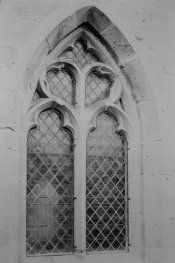
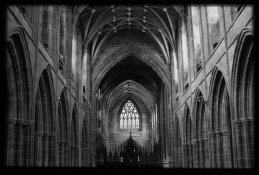
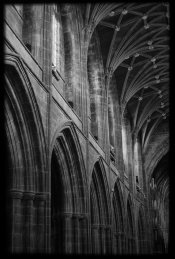
Well, I shot a roll of HP5+ at ISO400, bracketing -1 and -2, of the interior of Chester cathedral.

Here's a scan of one P1070046.jpg and one more P1070051.jpg.

I developed with the equivalent of 1g/l hypo crystals. It's really interesting how the effect of what should be underexposure (both the above were -2) is mainly to increase contrast when viewed in a slide viewer – I imagine that effect might be even greater when projected.

I arrived at the 1g/l figure by crudely assuming that if 4g/l worked with an ISO100-rated film then I'd quarter the amount for an ISO400 film.

I'm happy with these results but do they strike you more experienced b&w reversers as over- or under-hypoed, as far as you can tell from a digital scan? I say scan – I actually used a Panasonic DMC-FZ8 in RAW mode and a slide viewer with the lenses removed. The only adjustments I made was to set the exposure so that the highlights didn't clip and some light sharpening. Of course I know that it's partly a matter of taste.

I think what I'd still love to know is if anyone can succinctly summarise the effect that adjustments to exposure and hypo quantities have in general terms on contrast and other aspects of the image – I know of course that more hypo = lighter positive, but once one gets near the 'right' amount it is clear to me that there is some room for playing with the relationship between exposure and hypo quantity. E.g. I could have used less, or no, hypo with the shots above, and I imagine the pictures with more exposure might have turned out as the keepers, rather than the ones at -2 EV which were best with 1g/l hypo. I'm not looking for an easy way out, and enjoy experimenting, but it would be fun to hear any conclusions that others have drawn with regard to these parameters.
 
Last edited by a moderator:
Rudeofus

Member
Joined
Aug 13, 2009
Messages
5,119
Location
EU
Format
Medium Format
Two things come to mind:
  1. The first development step in reversal processing is the only step that does not go to completion. Knowing this allows you to reduce the number of variables considerably. You control contrast by varying development time, and as PE argued in one of the threads you linked to, you need some strong solvent in first developer to create some controlled fog. I bet you could inspect contrast and fog by just inspecting FD'd and fixed negatives.
  2. If you look at E6, this process reaches full emulsion speed. I see no reason why you shouldn't be able to get this with B&W reversal, assuming your process if properly dialed in.
 
Photrio.com contains affiliate links to products. We may receive a commission for purchases made through these links.
To read our full affiliate disclosure statement please click Here.

PHOTRIO PARTNERS EQUALLY FUNDING OUR COMMUNITY:


Ilford ADOX Freestyle Photographic Stearman Press Weldon Color Lab Blue Moon Camera & Machine
Top Bottom