• Welcome to Photrio!
    Registration is fast and free. Join today to unlock search, see fewer ads, and access all forum features.
    Click here to sign up

Literature on Emulsion Making

Somewhere...

D
Somewhere...

  • 2
  • 1
  • 69
Iriana

H
Iriana

  • 6
  • 1
  • 129

Recent Classifieds

Forum statistics

Threads
202,740
Messages
2,844,938
Members
101,494
Latest member
FlyingDutchman
Recent bookmarks
0
If I were in a Commonwealth nation and a citizen thereof, then I would use it.

Besides, I save a lot of the letter "u" that way. Much less typing.

PE

I once put in a Kwik Kaizan at work to save cost of ink and labor by dropping silent letters out of typed words. My boss wasn't amused.
 
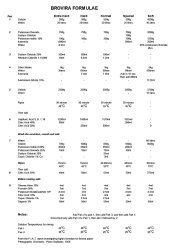
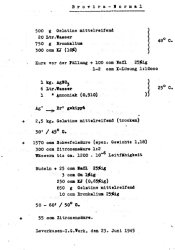
I am wrestling, as I said, with trying to decipher formulas and patents for my next book and have run into a number of seeming errors, omissions and misprints. I am able to see the original BIOS and FIAT reports from the RIT library, the U of R library, the GEH (now GEM) library, and the Kodak Research Library. I have compared the BIOS and FIAT reports (British and US Intelligence) and find that they are virtually identical, but the copies of them are quite different. Here below is the original Brovira Normal formula with some German, and the Glafkides copy.

Note that the original (this is the BIOS copy) gives names to the two different gelatins used and includes a conductivity end point for the wash. This is all either omitted by Glafkides or so rearranged using text over several pages and charts, that this original is difficult to reconstruct.

This is just an example for you all taken from the original documents.

A fellow APUG member called me on the phone, and said that there was no Iodide in Brovira, but he did not know that KJ is chemical notation for KI in German. I am referring to no person who has posted in this thread thus far. So, I hope there is no stir created by this comment. Yes, there is dump Iodide.

PE

 

Attachments

  • brovira formulas.jpg
    brovira formulas.jpg
    132 KB · Views: 212
  • Brovira normal from BIOS.jpg
    Brovira normal from BIOS.jpg
    67.5 KB · Views: 218
I was doing some research on glycin developers and have been reading and old formula collection written in the 1940s by Josef Maria Eder.

After I saw this thread, I got curious and decided to have a look at the chapters with regards to emulsion making and coating of glass plates.

I have learned one thing from this part of the book: Unless you already know exactly what you are doing, the recipes will be of no value to you. And if you know what you are doing, the procedure described will be more of an inspirational nature than a cookbook recipe which can be exactly reproduced.
 
I have learned one thing from this part of the book: Unless you already know exactly what you are doing, the recipes will be of no value to you. And if you know what you are doing, the procedure described will be more of an inspirational nature than a cookbook recipe which can be exactly reproduced.

A lot of computer software manuals are still like this.
 
I was doing some research on glycin developers and have been reading and old formula collection written in the 1940s by Josef Maria Eder.

After I saw this thread, I got curious and decided to have a look at the chapters with regards to emulsion making and coating of glass plates.

I have learned one thing from this part of the book: Unless you already know exactly what you are doing, the recipes will be of no value to you. And if you know what you are doing, the procedure described will be more of an inspirational nature than a cookbook recipe which can be exactly reproduced.

IMHO, from the formulas that I have looked at so far, Eder gives more information than Baker.

And what you say is quite true about value of an old formula vs prior experience.

EDIT: Baker above should read WALL. But then Baker is not much better.

PE
 
Last edited:
And what you say is quite true about value of an old formula vs prior experience.

In order to give some credit to Eder: The books he has written were not intended as "Darkroom for Dummies", but as a reference for skilled professionals who had passed through several years of apprenticeship and practical/theoretical training. And as each master passed his particular technique to the apprentice, maybe Eder never had the intention of giving a reproducible recipe.

It just struck me that in some chapters he is very detailed (e.g. fixing prior to development) and the chapters on plate making are rather superficial.
 
A lot of computer software manuals are still like this.

Heh, sometimes the documentation I write for updates to our production servers are written for one skilled in the art! For example, "Do the same thing you did for Staging, but do it for the production servers and databases, making sure to check the applicable scheduled tasks as well." At other times the documentation is very detailed step-by-step how to do something.

I love how if PE doesn't know something, he comes right out and says that he doesn't know, but encourages you to experiment! I suspect when it comes to emulsion making, it's a lot like computers - there's only so much you can learn out of a book, then you just have to get in there and do it!
 
I've been reading expired patents recently, looking for old, abandoned processes. I laughed out loud reading this patent awarded in the 1930s:

"Adhesion to the silver image layer is ensured as by wetting either the colloid layer, or the image layer, or both, before bringing them together, as with plain water, or with a softening agent such as an aqueous solution of an alkali, alkaline salt, or glacial acetic acid, or with a dilute solution of glue or by incorporating glue in one or both layers or by roughening one or both layers either mechanically as by pressure against an engraved roller, or chemically by an etching liquid such as an aqueous solution of calcium or potassium ferricyanide, zinc chloride, calcium nitrate, ferric chloride, or sodium chloride."

I'm no patent clerk, but what I took away from this was that if we can manage to get silver halide adhere to anything via any process at any point in the space time continuum we probably owe this guy some royalties, because he seems to have patented all of them in a single paragraph.
 
Photrio.com contains affiliate links to products. We may receive a commission for purchases made through these links.
To read our full affiliate disclosure statement please click Here.

PHOTRIO PARTNERS EQUALLY FUNDING OUR COMMUNITY:


Ilford ADOX Freestyle Photographic Stearman Press Weldon Color Lab Blue Moon Camera & Machine
Top Bottom