• Welcome to Photrio!
    Registration is fast and free. Join today to unlock search, see fewer ads, and access all forum features.
    Click here to sign up

Light-proofing an Exhaust Fan?

Recent Classifieds

Forum statistics

Threads
203,289
Messages
2,852,441
Members
101,766
Latest member
Onetrick
Recent bookmarks
1

brian steinberger

Member
Allowing Ads
Joined
Jan 5, 2007
Messages
3,077
Location
Pennsylvania
Format
Med. Format RF
I just built a new darkroom and the exhaust fan is right by the outside wall where the air exhausts. The run is so short and when the fan is on in the daytime light leaks back into the fan and it kinda just glows in the darkroom. I know I'll need to built some sort of light baffle but am looking for recommendations. Something out of black foamcore maybe? Its just a standard bathroom exhaust fan that has one of those simple plastic white covers, which could be removed of course.
 
My bathroom / darkroom had an exhaust fan into the roof, which leaked light because of the skylights into the roof cavity.

What I did was get about a 1-foot cube black plastic bucket, I think it was originally made to be a collection-point for stormwater from driveway drains or something.
Then just drilled some 90mm holes in that, screwed in some 90mm PVC flange adapters, and glued about a foot-long bit of PVC onto that. Then spraypainted the PVC pipes and flange bits matt-black.
I was thinking I'd have to put a bend in the PVC 'arms' to stop light coming in (like a swastika-shape), but it's light-tight enough with just the straight arms.

I bought 4 flange-adapters, but I've just seen that there are 3 sitting on the shelf next to me, so there's only one in the bucket on the roof, which is enough to exhaust the air by itself.
 
Build a baffle box around it. I'll see if I can find pix of what you need (even tho I know you're clever and can figure it out).

Found this:

(there was a url link here which no longer exists)
 
Build a baffle box around it. I'll see if I can find pix of what you need (even tho I know you're clever and can figure it out).

Found this:

(there was a url link here which no longer exists)

Yes,You need to build a light trap of any material and paint the inside and the surrounding wall flat black .Take a look inside WBM for an example.
 
Instead of lightproofing the fan, I lightproofed the exhaust port which was a standard dryer vent pipe and flap. I spray painted the inside of the pipe and the part that went thru the wall flat black. I then built a small shroud that went over the outside port which extended the downward airflow, again painting it flat black. I also wired the fan into a dimmer switch so I could run it on low speed, It really reduced the noise level.
 
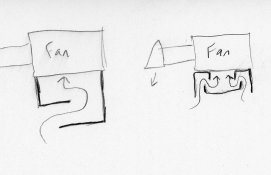
Thanks guys. I had a look at some books and came up with two ideas. Here's a sketch. Which do you think would be better. I'll probably make out of black foamcore, but maybe thin plywood.
 

Attachments

  • fan ideas.jpg
    fan ideas.jpg
    137.8 KB · Views: 372
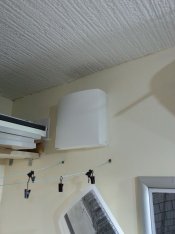
I have exactly this configuration. I made a light baffle for the inside out of a cornflake box.........
 
I would love to see a pic!!!!

20150223_082504.jpg

It's not very pretty. BTW that's just shadow on the ceiling, not grime!

Although no "turns" other than just pointing upwards, it seems totally light proof - can't see it at all.
 
Improvement upon first design, with addition of the blue baffle makes first design easy to build yet more effective in blocking light!

fan20ideas_zpsgtkq62mt.jpg
 
View attachment 103911

It's not very pretty. BTW that's just shadow on the ceiling, not grime!

Although no "turns" other than just pointing upwards, it seems totally light proof - can't see it at all.

Thanks! I understand the theory here. However mine in on the ceiling. Not sure if this would work for me.
 
Fantastic! Thanks! How large do you think the spaces between these baffles need to be?

It depends upon the flow rate of air to be exhausted! Fan is rated in CFM (cubic feet/min) and an HVAC could give you guidance.

Keep in mind that light travels only in straight lines, although reflected light can change direction. So if reflection surfaces have a coating of some scattering material (flocked contact paper, for example), the reflections are reduced and light 'leakage' is greatly diminshed thru such a maze.
 
Last edited by a moderator:
Sorry, I am a photographer and darkroom hobbyist, not an HVAC hobbyist
 
Yes,You need to build a light trap of any material and paint the inside and the surrounding wall flat black .Take a look inside WBM for an example.

I hope , thisis a better link
 

Attachments

  • EquipmentEd1.pdf
    113.1 KB · Views: 288
(Caveat: I am not an HVAC wizard, I do not even try to play one on the Interwebz ... :whistling: )

Most of those bathroom fans are a centrifugal beast, "squirrel cage," blower. In general, I believe flow restrictions on the inlet side have more consequences than the outlet side. I would look at the actual opening (circular) in the internal baffle that goes into the fan and check its diameter. If it's, say, 5 inches, ignore pi, just square it = 25 sq inches and try to maintain at least that much cross sectional area in the passages of the light baffle. Bends affect the flow too, but ya gotta do what ya gotta do. So I'd look for a clear area of 5x5, 4x6, 3x8 or whatever through the baffle. If you have room to make it larger, so much the better.

I have some sort of non-bathroom centrifugal ventilator outside my darkroom wall (which is still inside -- a garage). I made a trapezoidal baffle* that went over the inlet on the darkroom side, shaped to try to pull air from fairly low at the back of the wet counter; e.g., over the trays. Light wasn't a problem for me as the fan and the ducting are metal. But alas, it is noisier than I would wish.


* Corrugated cardboard painted with several coats of wall paint to confuse those wondering what it is.

 
(Caveat: I am not an HVAC wizard, I do not even try to play one on the Interwebz ... :whistling: )

Most of those bathroom fans are a centrifugal beast, "squirrel cage," blower. In general, I believe flow restrictions on the inlet side have more consequences than the outlet side. I would look at the actual opening (circular) in the internal baffle that goes into the fan and check its diameter. If it's, say, 5 inches, ignore pi, just square it = 25 sq inches and try to maintain at least that much cross sectional area in the passages of the light baffle. Bends affect the flow too, but ya gotta do what ya gotta do. So I'd look for a clear area of 5x5, 4x6, 3x8 or whatever through the baffle. If you have room to make it larger, so much the better.

I have some sort of non-bathroom centrifugal ventilator outside my darkroom wall (which is still inside -- a garage). I made a trapezoidal baffle* that went over the inlet on the darkroom side, shaped to try to pull air from fairly low at the back of the wet counter; e.g., over the trays. Light wasn't a problem for me as the fan and the ducting are metal. But alas, it is noisier than I would wish.


* Corrugated cardboard painted with several coats of wall paint to confuse those wondering what it is.


Thanks Dave! I have used your configuration to design my light baffle. My fan does measure 5" across. I am building the baffle today so I will post a pic when finished.
 
Photrio.com contains affiliate links to products. We may receive a commission for purchases made through these links.
To read our full affiliate disclosure statement please click Here.

PHOTRIO PARTNERS EQUALLY FUNDING OUR COMMUNITY:


Ilford ADOX Freestyle Photographic Stearman Press Weldon Color Lab Blue Moon Camera & Machine
Top Bottom