• Welcome to Photrio!
    Registration is fast and free. Join today to unlock search, see fewer ads, and access all forum features.
    Click here to sign up

Light meter settings don't match my cameras - Advice please.

Tree with Big Shadows

Tree with Big Shadows

  • 2
  • 0
  • 38
Everal Barn

A
Everal Barn

  • 0
  • 0
  • 38

Forum statistics

Threads
203,453
Messages
2,854,932
Members
101,850
Latest member
psimon
Recent bookmarks
0

Carl170

Member
Allowing Ads
Joined
Oct 15, 2013
Messages
15
Location
Newcastle Up
Format
35mm
Hi everyone. I have a question about using old light meters with old analogue cameras.

The cameras I have generally have speeds such as 1/25, 1/50, 75, 100, 200, 500, 1000

The old light meters I have all seem to have scales like 1\30, 1\60, 125 250 etc

So when I am taking readings on them,and transfer them over, I will use a very approximate value.As I know this isn't quite correct, I will then use the light meter app on my phone to verify my settings. Usually my guesses are incorrect! On the phone app, I can lock a setting and the ISO and see what the other setting is eg aperture or shutter speed. However, while this works, I am not actually learning anything about photography!

So I quite often just end up using the meter on my phone.

Any suggestions, or is there a chart to learn how to interpret my light meter settings better?

I hope this makes sense. Apologies if it doesn't!

Regards

Carl
 
Actually I will take it as safety factor and happily expose 1/25 when meter indicates 1/30 and so for other speeds.
 
I agree with baachitraka, especially with old mechanical shutters the number is only an approximation to begin with! Unless you are shooting transparency films, which are less forgiving of exposure, even a stop of overexposure can be pretty much ignored (and 1/25 for 1/30 isn't off by nearly that much).
 
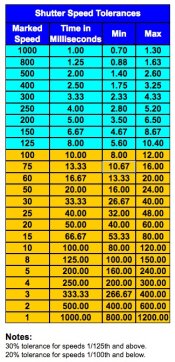
Got this off Flutot's Camera Repair site, You can see what the tolerances are for shutter speeds. 1/25th or 1/30th, 1/100th or 1/125th - really don't matter. Just judge your negatives and adjust accordingly.
 

Attachments

  • Screen shot 2016-10-17 at 11.25.17 AM.jpg
    Screen shot 2016-10-17 at 11.25.17 AM.jpg
    133.6 KB · Views: 377
I use a meter (Sekonic L-308S) and I also have an iphone meter app. I don't think you should worry about the difference between 1/25 or 1/30 of a second on an old camera as the shutter is unlikely to be that accurate anyway. Using an iphone light meter app is fine if that works for you. I sometimes use this as I always have my phone with me. It is still learning about photography and your app is giving you shutter speed and aperture just like my Sekonic hand-held meter does.
 
If shooting negative film, use the setting that provides slightly more exposure. Negative films almost always benefit more from increased exposure compared to decreased exposure.
 
In addition to what the previous posters have said (they're all correct), have you compared your shots to what you thought you'd get? If your images are grossly over- or under- exposed, then maybe a change is in order. But those older cameras are usually a little off anyway. Use either your iphone or an old meter, but be consistent about it. Maybe take one roll and keep track of what the light looked like (really bright, intense shadows, cloudy, etc..) and what the meter reading was and what you set on the camera. Take two shots - one using the meter's reading and one with the app setting (keep track as you do it). Then look at it afterwards and see if you think you want to change how you do it. And members here can help with that part, too.
 
Since film and chemicals cost $$..... my advice is invest in a good lightmeter... like a pentax spotmeter, etc.
work from the there. Kind of like having some reasonably accurate standard to work from.
 
Don't use your phone and think it will confirm or not confirm anything related to analog photography.
As for your concern with the difference in 20th century and 21st century listings of shutter speeds, using the closest in the alternate setting is well within tolerances. If you took an image at 1/25 th second and another with same lens and shuter at an "accurate" 1/30th second, I have little doubt that you could not ascertain the difference.
 
If shooting negative film, use the setting that provides slightly more exposure. Negative films almost always benefit more from increased exposure compared to decreased exposure.
true up to a point.too much of a good thing can still be too much;a bullet-proof negative can be a bugger to print.
 
... The cameras I have generally have speeds such as 1/25, 1/50, 75, 100, 200, 500, 1000
The old light meters I have all seem to have scales like 1\30, 1\60, 125 250 etc...
Carl

The older scale is 1/2, 1/5, 1/10, 1/25, 1/50, 1/100, 1/200, 1/400... The more modern scale is closer in doublings: 1/2, 1/4, 1/8, 1/15, 1/30, 1/60,...

If you want accuracy in exposure from any clockwork shutter, you need to have it tested and calibrated. That doesn't mean the speeds have to match the markings, rather the shutter needs to be consistent and you need to know the actual speeds to whatever degree of accuracy you need. I test my shutters regularly and list the actual shutter speeds to the nearest 1/3-stop on a sticker that goes on the lens board. FWIW, the progression of shutter speeds from 1 sec up in approximate third stop increments is:

1 sec., 4/5 sec., 2/3 sec., 1/2 sec., 2/5 sec., 1/3 sec, 1/4 sec., 1/5 sec., 1/6 sec., 1/8 sec., 1/10 sec., 1/12 sec...

You can extrapolate from here by simply multiplying the denominator of the previous set by 2. As you can see, the older scale 1/5, 1/10, 1/25... is included in this sequence. If you need real accuracy, you choose the most appropriate shutter speed and make the smaller adjustments with the aperture. Chrome film benefits from trying to be accurate the the third stop, negative film is much more forgiving, but err on the side of overexposure, as mentioned above.

Best,

Doremus
 
Keep in mind that your old meter and phone may not be measuring the same thing. I have an inexpensive, but modern, light meter Sekonic bottom of the line L-208 - http://www.sekonic.com/united-states/products/l-208/overview.aspx. I also have an iPhone app that functions more like a spot-meter.

If your goal is to learn more about manual settings and not just reading from an app, consider an "exposure calculator" app. I use "expositor" on my iPhone and a similar app on my android tablet. These apps do not include a light meter, but allow you to see a graphical representation of all the various combinations.
 
Photrio.com contains affiliate links to products. We may receive a commission for purchases made through these links.
To read our full affiliate disclosure statement please click Here.

PHOTRIO PARTNERS EQUALLY FUNDING OUR COMMUNITY:


Ilford ADOX Freestyle Photographic Stearman Press Weldon Color Lab Blue Moon Camera & Machine
Top Bottom