

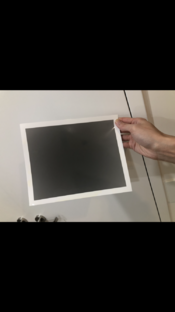
Try printing a middle gray. The slope is steepest at the middle of the curve. This will show the abnormality best.
Usually small changes in focus have no effect with a diffusion light source (unlike condenser), however, if the lens is way out of place (closer than the focal length) you will see falloff.
View attachment 371509
-
Welcome to Photrio!Registration is fast and free. Join today to unlock search, see fewer ads, and access all forum features.Click here to sign up
You are using an out of date browser. It may not display this or other websites correctly.
You should upgrade or use an alternative browser.
You should upgrade or use an alternative browser.
Light falloff on kienzle enlarger
-
A
- Thread starter yya
- Start date
Recent Classifieds
-
Sold JOBO MultiTank 2 2521 4 X 5
- Started by Inayat Noor
-
For Sale Ilford 5X7 Paper Lot
- Started by davela
-
For Sale Omega Audible Repeating Timer II
- Started by davela
-
Want to Buy Widelux
- Started by Jeff Bennett
Forum statistics
- Joined
- Oct 31, 2004
- Messages
- 388
- Format
- Multi Format
I've heard it said, that light fall-off at the camera/negative taking phase is 'automatically' corrected by the enlarger/paper printing stage.
I'm curious whether this is not just a natural phenomenon of all camera's & enlargers and whether it would be at all perceptible in a print?
I'm curious whether this is not just a natural phenomenon of all camera's & enlargers and whether it would be at all perceptible in a print?
- Joined
- Oct 31, 2004
- Messages
- 388
- Format
- Multi Format
Put it this way, I've sometimes seen what looks like light fall-off, without a negative, on my base board but never with a negative in place.
And I've never tested any of my enlargers simply because the prints are all fine.
And I've never tested any of my enlargers simply because the prints are all fine.


I'm curious whether this is not just a natural phenomenon of all camera's & enlargers and whether it would be at all perceptible in a print?
It's "natural" to an extent and yes it does pop up in prints in problematic situations, and no it's not something that magically corrects itself. In problem cases it's often to do with light beam shaping issues above the negative stage as @DREW WILEY also alludes to; problems with diffusing chambers being wrongly configured, wrong condenser choice for the lens used, wrong lens - condenser distance etc.
It's "natural" to an extent and yes it does pop up in prints in problematic situations, and no it's not something that magically corrects itself. In problem cases it's often to do with light beam shaping issues above the negative stage as @DREW WILEY also alludes to; problems with diffusing chambers being wrongly configured, wrong condenser choice for the lens used, wrong lens - condenser distance etc.
Well said. It's possible that the lens is messed up or not used correctly, but ignoring that unlikely possibility, the problem lies in the "set up" of this (according to yya, the OP) "new" enlarger.
- Joined
- Jul 14, 2011
- Messages
- 15,214
- Format
- 8x10 Format
I became painfully aware of all these potentially cumulative issues way back when I first started printing the original version of Cibachrome, which was a very contrasty direct positive process involving high contrast originals (color Chromes, including Kodachrome at the time). Black and white work is quite a bit more forgiving.
Cold lights have their own issues. They tend to have lower output at the tube bends. I have a high-output oversized 14X14 blue-green Aristo cold light, and prints from 8x10 film generally need a little corner burning-in regardless of an optimal focal length lens. Ic-Racer just posted an extreme example.
Another common issue with some sheet films is that you can get a bit of development surge unevenness at the perimeter, creating higher density there, which requires some burning-in correction even if your diffusion system itself is perfectly even.
Even designing a fully even light chamber can be quite a challenge. I've horse traded and modified all kinds of colorheads over the years, and some were miserable in this respect. I don't take anything for granted. Manufacturers don't always get it right.
Cold lights have their own issues. They tend to have lower output at the tube bends. I have a high-output oversized 14X14 blue-green Aristo cold light, and prints from 8x10 film generally need a little corner burning-in regardless of an optimal focal length lens. Ic-Racer just posted an extreme example.
Another common issue with some sheet films is that you can get a bit of development surge unevenness at the perimeter, creating higher density there, which requires some burning-in correction even if your diffusion system itself is perfectly even.
Even designing a fully even light chamber can be quite a challenge. I've horse traded and modified all kinds of colorheads over the years, and some were miserable in this respect. I don't take anything for granted. Manufacturers don't always get it right.
Last edited:
There's always light fall-off with camera lenses and enlarging lenses. The important question is "Do you notice it?". Chances are, you don't -- but it's there. One reason you don't notice it is because it's gradual -- from the center to the edge of the image, and it varies depending on the f-stop used, as well as other factors.
Take a picture of a clear blue sky. Do you notice that the corners are darker in a print or lighter in a slide? Probably not -- but maybe if the lens is used wide-open.
It's the same thing with enlarging lenses. Stop down the lens and make a print of a clear blue sky -- without any filtration -- and you probably won't notice any change from center to corners.
Pull out a light meter, and you probably record a small difference, but who cares?
To answer your question, the "standard" is not "zero". The "standard" is YOU.
Take a picture of a clear blue sky. Do you notice that the corners are darker in a print or lighter in a slide? Probably not -- but maybe if the lens is used wide-open.
It's the same thing with enlarging lenses. Stop down the lens and make a print of a clear blue sky -- without any filtration -- and you probably won't notice any change from center to corners.
Pull out a light meter, and you probably record a small difference, but who cares?
To answer your question, the "standard" is not "zero". The "standard" is YOU.
- Joined
- Jul 14, 2011
- Messages
- 15,214
- Format
- 8x10 Format
Well, in terms of wide angle lens falloff, center filters were made for a reason - it can be as much as two full stops! You can also use center filters on enlarger lenses. But since CF's are designed to work best somewhere around f/16-f/22, they're not ideal for the wider apertures characteristic of typical enlarging work. But I have successfully done it.
Esthetically, you're more likely to get away with darkening toward the corners in an image than lightening the corners. That's why we mainly burn-in the corners of prints rather than dodge them.
Therefore, Martie, you've posed what is just as much an esthetic question as a logistical one; and for that reason, there is no standard simple answer.
In color printing, especially if multiple steps are involved, a perfectly even field of illumination on the print easel is wise. But most of the immediate conversation seems to revolve around basic black and white printing instead. Even in that case, I personally prefer a fully consistent field of illumination; there's less fuss when printing. But not everyone has that kind of equipment flexibility. That fact doesn't stop them; we all learn how to improvise.
Esthetically, you're more likely to get away with darkening toward the corners in an image than lightening the corners. That's why we mainly burn-in the corners of prints rather than dodge them.
Therefore, Martie, you've posed what is just as much an esthetic question as a logistical one; and for that reason, there is no standard simple answer.
In color printing, especially if multiple steps are involved, a perfectly even field of illumination on the print easel is wise. But most of the immediate conversation seems to revolve around basic black and white printing instead. Even in that case, I personally prefer a fully consistent field of illumination; there's less fuss when printing. But not everyone has that kind of equipment flexibility. That fact doesn't stop them; we all learn how to improvise.
Last edited:
- Joined
- Feb 8, 2009
- Messages
- 1,338
- Format
- Large Format
This is principally aimed at the questions posed in post #33. It addresses the light falloff due to the natural characteristics of lenses. Light sources can introduce problems of their own, of course.
I did the following informal test to measure the falloff from center to corners in a projection sized to cover an 8” x 10” sheet of paper. I used an Omega D5XL with the Dichroic II diffusion head and Componon-S 5.6/150 lens. I disengaged the detent mechanism so that I could smoothy position the aperture ring in fine increments.
I first sized and focused a 4” x 5” negative Then I removed the negative from the carrier and replaced the carrier, since I want to measure the light intensity delivered by the lens, not influenced the varying density of the various parts of the negative.
With the aperture wide open at f/5.6, I placed the small sensor of my Ilford EM-10 in the corner of the projection and adjusted the sensitivity dial to get the green LED. Then I moved the EM-10 to place its sensor in the center of the projection. I slowly closed the aperture until I once again got the green LED. In room light I examined the position of the aperture ring relative to the index line. It appears to be closed about 0.7 stops from f/5.6 towards f/8.
Next, I started with the aperture set at f/8 and repeated the above steps. This time I could move the aperture ring in only a tiny increment with the sensor in the center of the projection to get the green LED again. The total movement of the aperture ring was less than 0.1 stop closed (likely something like 1/20th of a stop) from the f/8 setting I used for the corner.
Next, I used the spot metering function of my Sekonic L508. Leaving the aperture wide open at the f/5.6 setting, I got readings of f/8 + 0.8 stops in the corner and f/11 + 0.4 stops in the center, a difference of 0.6 stops. (Note: The resolution of most digital displays is to the nearest 0.1 stop).
When I did this with the aperture set to f/8, my Sekonic showed the same in corner as it did in the center. There probably was a difference, but it was less than the resolution of the display.
Both instruments gave similar center-to-corner differentials. This is consistent with center-to-corner readings I’ve measured with other enlargers. I usually get something like 0.6 to 0.7 stops difference from corner to center with the aperture wide open. The difference is much smaller with the aperture closed one or more stops.
My condenser enlargers usually show about 0.3 to 0.2 stops difference from corner to center with the aperture closed one or more stops, while my diffusion enlargers show a smaller difference, usually 0.1 stop or less.
A badly designed, badly made, or badly adjusted light system, especially a condenser light source, can give worse falloff than what I’ve usually measured.
By closing the aperture at least one stop, we’ve done about all we can to reduce the falloff to an acceptable value insofar as the falloff is due to the lens.
It makes good sense to learn how to give just enough of a burn to the corners/edges to make our prints look good. Done with the skill gained through experience, most viewers will never know that you did so. It’s easy to learn.
I did the following informal test to measure the falloff from center to corners in a projection sized to cover an 8” x 10” sheet of paper. I used an Omega D5XL with the Dichroic II diffusion head and Componon-S 5.6/150 lens. I disengaged the detent mechanism so that I could smoothy position the aperture ring in fine increments.
I first sized and focused a 4” x 5” negative Then I removed the negative from the carrier and replaced the carrier, since I want to measure the light intensity delivered by the lens, not influenced the varying density of the various parts of the negative.
With the aperture wide open at f/5.6, I placed the small sensor of my Ilford EM-10 in the corner of the projection and adjusted the sensitivity dial to get the green LED. Then I moved the EM-10 to place its sensor in the center of the projection. I slowly closed the aperture until I once again got the green LED. In room light I examined the position of the aperture ring relative to the index line. It appears to be closed about 0.7 stops from f/5.6 towards f/8.
Next, I started with the aperture set at f/8 and repeated the above steps. This time I could move the aperture ring in only a tiny increment with the sensor in the center of the projection to get the green LED again. The total movement of the aperture ring was less than 0.1 stop closed (likely something like 1/20th of a stop) from the f/8 setting I used for the corner.
Next, I used the spot metering function of my Sekonic L508. Leaving the aperture wide open at the f/5.6 setting, I got readings of f/8 + 0.8 stops in the corner and f/11 + 0.4 stops in the center, a difference of 0.6 stops. (Note: The resolution of most digital displays is to the nearest 0.1 stop).
When I did this with the aperture set to f/8, my Sekonic showed the same in corner as it did in the center. There probably was a difference, but it was less than the resolution of the display.
Both instruments gave similar center-to-corner differentials. This is consistent with center-to-corner readings I’ve measured with other enlargers. I usually get something like 0.6 to 0.7 stops difference from corner to center with the aperture wide open. The difference is much smaller with the aperture closed one or more stops.
My condenser enlargers usually show about 0.3 to 0.2 stops difference from corner to center with the aperture closed one or more stops, while my diffusion enlargers show a smaller difference, usually 0.1 stop or less.
A badly designed, badly made, or badly adjusted light system, especially a condenser light source, can give worse falloff than what I’ve usually measured.
By closing the aperture at least one stop, we’ve done about all we can to reduce the falloff to an acceptable value insofar as the falloff is due to the lens.
It makes good sense to learn how to give just enough of a burn to the corners/edges to make our prints look good. Done with the skill gained through experience, most viewers will never know that you did so. It’s easy to learn.
So, does anyone happen to know, what an acceptable tolerance or deviation would be of enlarger light fall-off between the centre vs the edges/corners, expressed in f-stops?
And should the standard be zero?
Too many variables to standardize. Some enlarger brands are better than others. Durst stands out as one of the best. The 10x10 enlargers used a fancy two-part system.
Also, every lens has a different light falloff pattern that changes with magnification and aperture. For example the common Schneider Componon-S 150mm loses about 2 stops at the edge at large magnifications when wide open.
When I did this with the aperture set to f/8, my Sekonic showed the same in corner as it did in the center. There probably was a difference, but it was less than the resolution of the display.
Thanks for your report. Although I too have meters that can measure the light as you did, I've never found a need to delve that deep. I've tested all of my enlarging lenses stopped down two stops (which is where I normally use them), and I can't tell the difference -- visually (center-to-edge) even at high contrast levels. I'm sure there is a difference, but an insignificant one.
For example the common Schneider Componon-S 150mm loses about 2 stops at the edge at large magnifications when wide open.
Even though large prints can require long exposure times when stopped down, I can't imagine not stopping down two f-stops, even though the exposure time will increase dramatically. But I would stop down two f-stops even if there was no light fall-off wide open. For me, it's a non-issue.

The lens no problem, I checked another lens(nikkor el 150mm) at same result
I also don't understand what the picture is trying to show (I can't make out any light fall-off)but a misaligned light source typically causes light fall-off.
- Joined
- Jul 14, 2011
- Messages
- 15,214
- Format
- 8x10 Format
Ian - thanks for your input. But that little Ilford device isn't cosine corrected, and you'd need to make a series of measurements at various representative print sizes and f/stops. I have instruments easily fifty times more expensive. But if available, it's best to go with the lens manufacturer's own published graphs.
Then you still have to contend with the efficiency of the mixing box and overall diffusion system. Even Durst didn't get that right at first. They did on later 8X10 colorheads. But all of that diffusion head engineering has to factor the angle of ray incidence too.
A couple years ago I made detailed charts of all my key LF enlarging lenses - Rodagon, Apo Rodagon N's and especially Apo Nikkor process lenses, determining at what f-stops and magnification distances I could achieve a perfectly even illumination with each of my enlargers, including both 138 and 184 Durst systems. My old Omega D has been retired, so I didn't measure that. This has proven worthwhile in relation to expensive large roll color printing media.
xkaes - I've personally had to use wide f-stops for certain applications, such as highly masked (up to .90 density) chromes for Ciba prints - a slow medium to begin with; or for actual enlarging onto slow contact papers like Azo. But in ordinary black and white silver printing, or RA4 work, my light sources are way too powerful for that, and I too consistently stop down.
Then you still have to contend with the efficiency of the mixing box and overall diffusion system. Even Durst didn't get that right at first. They did on later 8X10 colorheads. But all of that diffusion head engineering has to factor the angle of ray incidence too.
A couple years ago I made detailed charts of all my key LF enlarging lenses - Rodagon, Apo Rodagon N's and especially Apo Nikkor process lenses, determining at what f-stops and magnification distances I could achieve a perfectly even illumination with each of my enlargers, including both 138 and 184 Durst systems. My old Omega D has been retired, so I didn't measure that. This has proven worthwhile in relation to expensive large roll color printing media.
xkaes - I've personally had to use wide f-stops for certain applications, such as highly masked (up to .90 density) chromes for Ciba prints - a slow medium to begin with; or for actual enlarging onto slow contact papers like Azo. But in ordinary black and white silver printing, or RA4 work, my light sources are way too powerful for that, and I too consistently stop down.
Last edited:
- Joined
- Oct 31, 2004
- Messages
- 388
- Format
- Multi Format
This is principally aimed at the questions posed in post #33. It addresses the light falloff due to the natural characteristics of lenses. Light sources can introduce problems of their own, of course.
I did the following informal test to measure the falloff from center to corners in a projection sized to cover an 8” x 10” sheet of paper. I used an Omega D5XL with the Dichroic II diffusion head and Componon-S 5.6/150 lens. I disengaged the detent mechanism so that I could smoothy position the aperture ring in fine increments.
I first sized and focused a 4” x 5” negative Then I removed the negative from the carrier and replaced the carrier, since I want to measure the light intensity delivered by the lens, not influenced the varying density of the various parts of the negative.
With the aperture wide open at f/5.6, I placed the small sensor of my Ilford EM-10 in the corner of the projection and adjusted the sensitivity dial to get the green LED. Then I moved the EM-10 to place its sensor in the center of the projection. I slowly closed the aperture until I once again got the green LED. In room light I examined the position of the aperture ring relative to the index line. It appears to be closed about 0.7 stops from f/5.6 towards f/8.
Next, I started with the aperture set at f/8 and repeated the above steps. This time I could move the aperture ring in only a tiny increment with the sensor in the center of the projection to get the green LED again. The total movement of the aperture ring was less than 0.1 stop closed (likely something like 1/20th of a stop) from the f/8 setting I used for the corner.
Next, I used the spot metering function of my Sekonic L508. Leaving the aperture wide open at the f/5.6 setting, I got readings of f/8 + 0.8 stops in the corner and f/11 + 0.4 stops in the center, a difference of 0.6 stops. (Note: The resolution of most digital displays is to the nearest 0.1 stop).
When I did this with the aperture set to f/8, my Sekonic showed the same in corner as it did in the center. There probably was a difference, but it was less than the resolution of the display.
Both instruments gave similar center-to-corner differentials. This is consistent with center-to-corner readings I’ve measured with other enlargers. I usually get something like 0.6 to 0.7 stops difference from corner to center with the aperture wide open. The difference is much smaller with the aperture closed one or more stops.
My condenser enlargers usually show about 0.3 to 0.2 stops difference from corner to center with the aperture closed one or more stops, while my diffusion enlargers show a smaller difference, usually 0.1 stop or less.
A badly designed, badly made, or badly adjusted light system, especially a condenser light source, can give worse falloff than what I’ve usually measured.
By closing the aperture at least one stop, we’ve done about all we can to reduce the falloff to an acceptable value insofar as the falloff is due to the lens.
It makes good sense to learn how to give just enough of a burn to the corners/edges to make our prints look good. Done with the skill gained through experience, most viewers will never know that you did so. It’s easy to learn.
Many thanks for the info.
I think it would be fair to assume that the centre-to-corner/edge fall-off, would be exacerbated by printing larger say from 8x10" to 16x20"?
Or would the fall-off be correlated, based purely on enlarger head height?
I know for a fact that the newer Durst 'N' designated femoboxes had raised, thicker middle to edge diffuser panels in their bases in order to gain better light spread especially for colour printing.
I think it would be fair to assume that the centre-to-corner/edge fall-off, would be exacerbated by printing larger say from 8x10" to 16x20"?
.
The bigger you enlarge, the closer the lens comes to the negative (in order to focus). This increases light falloff as, one reaches the limits of coverage.
- Joined
- Oct 31, 2004
- Messages
- 388
- Format
- Multi Format
The bigger you enlarge, the closer the lens comes to the negative (in order to focus). This increases light falloff as, one reaches the limits of coverage.
Yes, that makes sense. Most lenses have enlargement factors and not for nothing, it seems.
xkaes - I've personally had to use wide f-stops for certain applications, such as highly masked (up to .90 density) chromes for Ciba prints - a slow medium to begin with; or for actual enlarging onto slow contact papers like Azo. But in ordinary black and white silver printing, or RA4 work, my light sources are way too powerful for that, and I too consistently stop down.
OK, I'll confess. There are times when I use my enlarging lenses wide open too -- when I'm using my point light source.
The bigger you enlarge, the closer the lens comes to the negative (in order to focus). This increases light falloff as, one reaches the limits of coverage.
That depends on lots of factors -- the enlarger as much as the lens. I have not found it relevant. In any event, to avoid losing sleep, just run a simple test with scrap paper.
- Joined
- Jul 14, 2011
- Messages
- 15,214
- Format
- 8x10 Format
Keep in mind that there are special design enlarger lenses as well as graphics lenses which are designed to perform better at high magnifications, like for mural sized printing. And on that scale, it's harder to burn-in areas. So you still need a very effective even light source.
My own space is a little cramped with all the gear, so I decided not to print larger than 30X40 inches, and standardized my other equipment around that, including the maximum size of my roll paper cutter and print developing drums, mounting presses etc.
My own space is a little cramped with all the gear, so I decided not to print larger than 30X40 inches, and standardized my other equipment around that, including the maximum size of my roll paper cutter and print developing drums, mounting presses etc.
| Photrio.com contains affiliate links to products. We may receive a commission for purchases made through these links. To read our full affiliate disclosure statement please click Here. |
PHOTRIO PARTNERS EQUALLY FUNDING OUR COMMUNITY:  |