
-
Welcome to Photrio!Registration is fast and free. Join today to unlock search, see fewer ads, and access all forum features.Click here to sign up
You are using an out of date browser. It may not display this or other websites correctly.
You should upgrade or use an alternative browser.
You should upgrade or use an alternative browser.
Light falloff on kienzle enlarger
-
A
- Thread starter yya
- Start date

Recent Classifieds
-
For Sale Recently CLA'd Plaubel Makina 67 + Box
- Started by infamouspbj
-
For Sale Goerz APO Red Dot Artar 16.5" (420mm) Copal 3 Lens
- Started by Kyle1234
-
For Sale Canham DLC45 Metal 4x4 Camera
- Started by Kyle1234
-
Want to Buy Mamiya Paramender II or III
- Started by pdccamerqs
-
For Sale Mamiya 7 35mm adapter
- Started by romosoho
Forum statistics

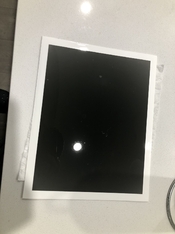
I'm not sure what that photograph is supposed to be showing, but if the lens is stopped down and correctly focused there should be no light fall-off. My first thought is that something in the system is missing, misaligned, broken, or not set correctly (many enlargers require setting the condenser for the 4x5 format).
The first thing I would do would be to eliminate the lens as the problem, and try a different lens.
The first thing I would do would be to eliminate the lens as the problem, and try a different lens.
I'm not sure what that photograph is supposed to be showing, but if the lens is stopped down and correctly focused there should be no light fall-off. My first thought is that something in the system is missing, misaligned, broken, or not set correctly (many enlargers require setting the condenser for the 4x5 format).
The first thing I would do would be to eliminate the lens as the problem, and try a different lens.
The lens no problem, I checked another lens(nikkor el 150mm) at same result
That's what I thought.
Is this enlarger new to you, or is this a new problem for an enlarger you have used before without any problem?
yes this is my new enlarger, I had devere 504 condenser head and another lpl enlarger

Is this a grade 5 print? If so, I wouldn't worry about it too much.
Do you get the same pattern at f/22?
this is print without any filter, I'm not try f22 today

There will be some light falloff with any enlarging lens. Make some prints and see. Almost always some edge burn is needed unless you have custom diffuser that compensates for a specific lens at a certain aperture and magnification.
Last edited:
this is print without any filter, I'm not try f22 today
OK, was this with the focus set on the film plane? Note that if the focus was above the film plane it's to be expected that you end up with light falloff. It's best to focus on a test negative and then remove the negative from the holder, then make a print on grade 5 and aim for a middle grey that makes it easy to visually assess the degree of falloff.
Doremus Scudder
Member
Learn to edge burn. Every enlarger has some light fall-off, simply because it's farther for the light to travel to the corners of the paper than to the center. Think of edge burning in a percentage of your base exposure. Soon you'll arrive at a number that you can use for most prints.
Best,
Doremus
Best,
Doremus
if the lens is stopped down and correctly focused there should be no light fall-off.
I try not to repeat myself, but sometimes it's necessary.
OK, was this with the focus set on the film plane? Note that if the focus was above the film plane it's to be expected that you end up with light falloff. It's best to focus on a test negative and then remove the negative from the holder, then make a print on grade 5 and aim for a middle grey that makes it easy to visually assess the degree of falloff.
Can I ask why 5
Learn to edge burn. Every enlarger has some light fall-off, simply because it's farther for the light to travel to the corners of the paper than to the center. Think of edge burning in a percentage of your base exposure. Soon you'll arrive at a number that you can use for most prints.
Best,
Doremus
Thanks!
Can I ask why 5
It'll emphasize the falloff due to the high contrast. If the result is acceptable or at least tolerable at grade 5, it'll be fine at lower grades.
- Joined
- Oct 31, 2004
- Messages
- 314
- Format
- Multi Format
OK, was this with the focus set on the film plane? Note that if the focus was above the film plane it's to be expected that you end up with light falloff. It's best to focus on a test negative and then remove the negative from the holder, then make a print on grade 5 and aim for a middle grey that makes it easy to visually assess the degree of falloff.
I totally agree.
Doremus Scudder
Member
... if the lens is stopped down and correctly focused there should be no light fall-off.
Well, not to pick nits too much, but the laws of physics haven't been repealed as far as I knowI try not to repeat myself, but sometimes it's necessary.

Any lens has an illumination fall-off that grows with the distance from the center of the image and is proportional to how much the angle of view deviates from perpendicular to the film/paper/ground glass/sensor. The falloff is approximated by the cos4 law of illumination fall off, where the fall off is proportional to the fourth power of the cosine of the angle at which the light strikes the projection surface. This makes the fall-off worse for lenses with greater angles of view (that's why short lenses need center filters), but any lens has a bit. When enlarging at higher-contrast settings and full-frame (i.e., using the lens' full coverage capacity), the fall-off can be really noticeable even with an excellent lens.
This is also compounded a bit in practice, by the fall-off of the taking lens, especially if it was a shorter focal length without a center filter. A bit of edge burning usually remedies the fall-off nicely.
However, if the fall-off is excessive, then there is likely a problem with the illumination (or lens coverage) . That's not an uncommon problem with enlargers (and why I have a 5x7 head on my 4x5 enlarger).
yya: It would help if you made that grade print at middle gray and posted it here. Then we could tell if the fall-off was "normal" or if there were other issues that you need to look into. I would think a Rodagon 150 at f/11 would only exhibit marginal fall-off. More info about the diffusion head, mixing box, etc. would help too.
Best,
Doremus
Is there just a single diffuser box or panel above the film, for all formats ?
I say this because enlargers like the Meopta have slightly different inserts for smaller formats.
I say this because enlargers like the Meopta have slightly different inserts for smaller formats.
If anyone has an enlarging lens that displays obvious, visible light fall-off on a #2 paper, when the lens is stopped down two or more stops, they should buy a better lens. Even inexpensive, three-element lenses pass this test.
Last edited:

A work around for dark-ish corners in a projected image is to use a longer focal length enlarging lens.
My Omega D2V 4x5 enlarger hints of darker corners with a 135 mm lens but not with a 150mm lens.
My Meopta Magnitarus 4x5 enlarger hints of dark corners with a 150mm lens but not with the 180mm lens that Meopta recommends and
certainly not with the 210mm lens I can use on it.
My Omega D2V 4x5 enlarger hints of darker corners with a 135 mm lens but not with a 150mm lens.
My Meopta Magnitarus 4x5 enlarger hints of dark corners with a 150mm lens but not with the 180mm lens that Meopta recommends and
certainly not with the 210mm lens I can use on it.
-

- Don_ih
- Deleted
- Joined
- Jul 14, 2011
- Messages
- 14,835
- Format
- 8x10 Format
A "better" lens won't cure it. An expensive 150mm Apo Rodagon N has just as much falloff at a comparable f-stop as a cheaper 150 lens, in relation to any ordinary sized diffusion chamber.
Nearly all 4X5 enlargers will exhibit some corner illumination falloff with a 150 lens. In most cases, this can be offset by simply burning in the print corners a little. If you want to outright cure it, one method is to make a custom convex white acrylic diffuser ground thinner toward the edges and corners than in the middle (simple in principle, but a nerve-wracking chore logistically). A few enlarger heads come with a convex diffuser standard. The other basic option is to use a longer than "normal" focal length enlarging lens, like 180mm.
Doremus already spelled out the cosine law. The Supreme Court might rule on it next year; and to my knowledge, none of them are physicists. But I selectively employ all the following : oversized mirror or diffusion boxes, custom diffusers, longer than normal focal length lenses, edge and corner burning when necessary.
For example, that 150 Apo Rodagon I just mentioned only has perfectly even illumination for 4x5 film at f/16 or smaller aperture in conjunction with the 12X12 inch mirror box on my L184 enlarger. But in relation to smaller 6X9 film, it is perfectly even as wide as f/5.6 with a 5X7 inch mirror box above the negative stage. When I want the convenience of complete illumination consistency with that same L138 5X7 system when printing a 4x5 neg, I use a 180 Rodagon instead.
To test for the FACTUAL PRESENCE of falloff (rather than quantifying it), you want a high paper grade and extended development to exaggerate the effect and make it more apparent. To quantify it, you need a special cosine-corrected enlarging meter or easel densitometer.
But keep in mind that negatives taken with wide-angle camera lenses have falloff characteristics of their own, which might offset the enlarging lens problem itself. Old timers would sometimes use the same lens for printing as for shooting, to cure the falloff issue, although that was certainly not optically ideal.
Nearly all 4X5 enlargers will exhibit some corner illumination falloff with a 150 lens. In most cases, this can be offset by simply burning in the print corners a little. If you want to outright cure it, one method is to make a custom convex white acrylic diffuser ground thinner toward the edges and corners than in the middle (simple in principle, but a nerve-wracking chore logistically). A few enlarger heads come with a convex diffuser standard. The other basic option is to use a longer than "normal" focal length enlarging lens, like 180mm.
Doremus already spelled out the cosine law. The Supreme Court might rule on it next year; and to my knowledge, none of them are physicists. But I selectively employ all the following : oversized mirror or diffusion boxes, custom diffusers, longer than normal focal length lenses, edge and corner burning when necessary.
For example, that 150 Apo Rodagon I just mentioned only has perfectly even illumination for 4x5 film at f/16 or smaller aperture in conjunction with the 12X12 inch mirror box on my L184 enlarger. But in relation to smaller 6X9 film, it is perfectly even as wide as f/5.6 with a 5X7 inch mirror box above the negative stage. When I want the convenience of complete illumination consistency with that same L138 5X7 system when printing a 4x5 neg, I use a 180 Rodagon instead.
To test for the FACTUAL PRESENCE of falloff (rather than quantifying it), you want a high paper grade and extended development to exaggerate the effect and make it more apparent. To quantify it, you need a special cosine-corrected enlarging meter or easel densitometer.
But keep in mind that negatives taken with wide-angle camera lenses have falloff characteristics of their own, which might offset the enlarging lens problem itself. Old timers would sometimes use the same lens for printing as for shooting, to cure the falloff issue, although that was certainly not optically ideal.
Last edited:
To test for the FACTUAL PRESENCE of falloff (rather than quantifying it), you want a high paper grade and extended development to exaggerate the effect and make it more apparent. To quantify it, you need a special cosine-corrected enlarging meter or easel densitometer.
Sure, light fall-off exists, even if the lens is stopped down. And if you exaggerate it to the extreme by using a high contrast paper or filter you might actually see it, but that's not what is going on here. With a #2 paper, and a stopped down lens it will be difficult to see. We're trying to figure out what the OP's problem is, and I think the light fall-off notion is off-base.
Sure, light fall-off exists, even if the lens is stopped down. And if you exaggerate it to the extreme by using a high contrast paper or filter you might actually see it, but that's not what is going on here. With a #2 paper, and a stopped down lens it will be difficult to see. We're trying to figure out what the OP's problem is, and I think the light fall-off notion is off-base.
I'm sure the problem is happend on the light source
- Joined
- Jul 14, 2011
- Messages
- 14,835
- Format
- 8x10 Format
Well, he himself called it "falloff". I have no idea what the posted print is supposed to be. There's just a little white disc surrounded by black. For all I know, it's a fuzzy picture of the moon, although it is probably the light being projected from his enlarger, missing some or all of the diffusion system in between.
Last edited:
Try printing a middle gray. The slope is steepest at the middle of the curve. This will show the abnormality best.
Usually small changes in focus have no effect with a diffusion light source (unlike condenser), however, if the lens is way out of place (closer than the focal length) you will see falloff.

Usually small changes in focus have no effect with a diffusion light source (unlike condenser), however, if the lens is way out of place (closer than the focal length) you will see falloff.
| Photrio.com contains affiliate links to products. We may receive a commission for purchases made through these links. To read our full affiliate disclosure statement please click Here. |
PHOTRIO PARTNERS EQUALLY FUNDING OUR COMMUNITY:  |