

• Welcome to Photrio!
    Registration is fast and free. Join today to unlock search, see fewer ads, and access all forum features.
    Click here to sign up

Lifting drop bed for shots?

Beach walkers

A
Beach walkers

  • 0
  • 0
  • 21
Romy

A
Romy

  • 1
  • 1
  • 25

Forum statistics

Threads
204,410
Messages
2,868,129
Members
102,255
Latest member
brianalog
Recent bookmarks
0

inglis

Member
Joined
Jul 31, 2013
Messages
27
Format
Medium Format
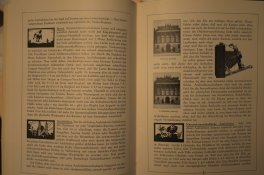
A discussion and photo appears in the Voigtlander 1928 catalog of raising the drop bed for architecture shots. Is there a name for this in English?

Since these cameras have knobs to raise or lower the lens for shift, when would a person want to raise the drop bed?

How is this different from ordinary shift?

This technique must do a tilt like number on focus, but the photo examples look more like shift.

Any thoughts?

Does anyone do this today?

Here is a image of the page:
attachment.php

John
 

Attachments

  • 15845464777_275969d537_b.jpg
    15845464777_275969d537_b.jpg
    337.2 KB · Views: 342
Possibly that model camera didn't have any or enough front rise to correct the shot. It's definitely a good trick to remember.
 
I used front rise to correct for perspective with my 4"x5" Speed Graphic. It does not have the movements that are normally found in view cameras, however I can also use the camera hand held.
 
At view cameras a oblique raising of the base and tilting the front and rear standard vertical again, such operation is called indirect vertical shift. (At cameras that yield direct shift, both types of shifting can be combined.)

That operation proposed by Voigtländer I consider a indirect shift too, though the front standard no longer is vertical. But at at least with architecture the idea behind indirect shifting would come true nonetheless. And in addition it yields the benefit to use a lens with an image circle too small for proper (vertical) shifting.
 
Last edited by a moderator:
This thread is difficult to follow because some of the terminology is wrong. Raising or lowering either standard is "rise & fall". "Shift" is moving a standard to the right or left. Pivoting a standard to the left or right is "swing" and tilting a standard forward or back is "tilt". These terms have been in use for at least 100 years, and are unambiguous. If your drop bed is raised and the front standard is corrected back to a vertical position, it is "rise". If the front standard is not corrected back to vertical it is "tilt".
 
The diagram on the extreme right of the document looks about right for photographing a ceiling. It is an effective front tilt, though in the reverse direction from the more common direction for landscapes. The main benefit looks to be because a) there is no actual front rise, or b) the optical axis need to be kept centered on the film.
 
This thread is difficult to follow because some of the terminology is wrong. Raising or lowering either standard is "rise & fall". "Shift" is moving a standard to the right or left. Pivoting a standard to the left or right is "swing" and tilting a standard forward or back is "tilt". These terms have been in use for at least 100 years, and are unambiguous. If your drop bed is raised and the front standard is corrected back to a vertical position, it is "rise". If the front standard is not corrected back to vertical it is "tilt".

But your latter example incorporates also a rise.

Thus you are being ambiguous too....


The classic tilt would not incorparote an upward movement of the lens.
The many different mechanical approaches, leading to various pivoting axes and movements make it difficult to apply a standard terminology.
 
Last edited by a moderator:
Looking closer at the examples in the publication, it is back tilt. The illustrations show converging line correction with this method. The camera is tilted upward to capture the image, causing converging lines. The back is tilted in the proper direction to correct. I stand corrected on my comment of front rise.
 
Photrio.com contains affiliate links to products. We may receive a commission for purchases made through these links.
To read our full affiliate disclosure statement please click Here.

PHOTRIO PARTNERS EQUALLY FUNDING OUR COMMUNITY:


Ilford ADOX Freestyle Photographic Stearman Press Weldon Color Lab Blue Moon Camera & Machine
Top Bottom