
-
Welcome to Photrio!Registration is fast and free. Join today to unlock search, see fewer ads, and access all forum features.Click here to sign up
- Home
- Forums
- Analog Workflow Forums (100% Analog/Traditional)
- Analog Equipment
- Medium Format Cameras and Accessories
You are using an out of date browser. It may not display this or other websites correctly.
You should upgrade or use an alternative browser.
You should upgrade or use an alternative browser.
Lens seperation? what is it?
-
A
- Thread starter ToddB
- Start date


Recent Classifieds
-
Want to Buy Jobo CPP-3
- Started by lifeandmylens
-
Want to Buy Dagor 12" F6.8
- Started by lifeandmylens
-
Want to Buy Arca Swiss 8 x 10 F Metric
- Started by lifeandmylens
-
Want to Buy Canon 5D IV low shutter count
- Started by Nathan Olsen
-
For Sale Film Freezer, Whirlpool 16 cu/ft Upright
- Started by Roger Thoms
Forum statistics
Dan Fromm
Member
- Joined
- Mar 23, 2005
- Messages
- 6,971
- Format
- Multi Format
Some lenses have elements that are cemented together. When the cement fails and a gap opens between the cemented elements we say the lens has a separation.
Separation often manifests as Newton's rings (if you don't know what they are, Google will find an explanation), silvery spots in the lens, or as a "ring of fire."
It is an especially bad problem with Rodenstock and Voigtlaender lenses made from the late 1950s to the mid-1970s. The synthetic cement both used after they stopped cementing lenses with Canada balsam was very prone to letting go of the glass.
Separation often manifests as Newton's rings (if you don't know what they are, Google will find an explanation), silvery spots in the lens, or as a "ring of fire."
It is an especially bad problem with Rodenstock and Voigtlaender lenses made from the late 1950s to the mid-1970s. The synthetic cement both used after they stopped cementing lenses with Canada balsam was very prone to letting go of the glass.
Some lenses have elements that are cemented together. When the cement fails and a gap opens between the cemented elements we say the lens has a separation.
Separation often manifests as Newton's rings (if you don't know what they are, Google will find an explanation), silvery spots in the lens, or as a "ring of fire."
It is an especially bad problem with Rodenstock and Voigtlaender lenses made from the late 1950s to the mid-1970s. The synthetic cement both used after they stopped cementing lenses with Canada balsam was very prone to letting go of the glass.
And I'll add to Dan's eplanation that sometimes, things such as fungus, dirt, and Schneideritus are called separation. Schneideritus is a lifting of the paint used to blacken the edges of the lens' elements, it appears as whitish spots or patches . It is not specific to S-K lenses, either; some Fuli lenses show it as well as other makes of lens. It's very easy to fix, and it effects the value much more than any other attribute.
Dirt is, well, dirt. Fungus is another often misapplied term - you see and hear it very often it seems, but in all the decades I've been using lenses I've yet to have a lens afflicted with fungus. YMMV.
Separation is not specific to vintage (whatever that term now means, it's so misused as to be meaningless) lenses, it can occur in lenses of any age. Old lenses cemented with balsam sometimes have it, but then they've had 100~ years for the balsam to go bad. Two common examples are Turner-Reich triple convertibles and Zeiss sreies VIIa convertibles.
You will see this in some of the Carl Zeiss lenses for the Zeiss Ikon Contax rangefinder, particularly the 50mm Sonnar (both f/1.5 and f/2.0).
I have a Rolleiflex 2.8F (Planar lens) with separation that's intruded into the lens maybe 3-4cm in places. I cannot tell you that I notice any degradation of the image, but of course it's something to monitor. I suppose it exhibits itself in increased flare (which I have not noticed with mine), but I am not sure how else the image would be affected.

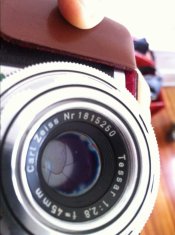
There's some separation on the Tessar 45 on my ZI Contaflex II. Mr. Jon Goodman who frequently makes wry (and quite funny) comments on these forums, and who used to repair Contaflexes et. al, said that lens-separation is pretty common among these models. Mine shows it just around the edges. I have not noticed any effect so far, even shooting in full sun (though not INTO the sun I'm conscious of the separation but not overly careful). The lens is still a firecracker, despite its elements' marital problems.
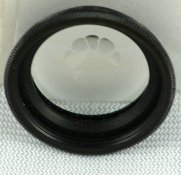
Here's an example from a roll of Ektar, processed by Walgreens.

Here's an example from a roll of Ektar, processed by Walgreens.

I had two Carl Zeiss lenses with separation: a Sonnar 50/1.5 in Contax rangefinder mount and a 150/4 for the Hasselblad. The separation was very bad: distinct "rainbows" that started at the lens outside and ended half-way towards the middle. Dealers and friends alike asked me why on earth would I use such lenses. I emailed a photo of the Sonnar 50/1.5 to Henry Scherer who said something like it was one of the worst cases of separation he'd seen.
However both performed fantastically, in black and white and color, pointed into the sun or away from it. I never noticed any effects at all. People couldn't believe it. I suppose Your Mileage May Vary.
However both performed fantastically, in black and white and color, pointed into the sun or away from it. I never noticed any effects at all. People couldn't believe it. I suppose Your Mileage May Vary.

Dan Fromm
Member
- Joined
- Mar 23, 2005
- Messages
- 6,971
- Format
- Multi Format
Whether separations make a difference for anything but price depends on the separation.
I have a 58/5.6 Rodenstock Grandagon with baad separations. Spectacular rings of fire, silvery spots, ... Looks like hell, shoots well.
Years ago I bought a 16/2.5 Zeiss Luminar. There was balsam puddled around the periphery of the front glass, examination with a magnifier found voids (bubbles) between the cemented pair. The lens had much lower resolution and contrast than a good 16/2.5 Luminar borrowed from a friend. Much worse.
I have a 58/5.6 Rodenstock Grandagon with baad separations. Spectacular rings of fire, silvery spots, ... Looks like hell, shoots well.
Years ago I bought a 16/2.5 Zeiss Luminar. There was balsam puddled around the periphery of the front glass, examination with a magnifier found voids (bubbles) between the cemented pair. The lens had much lower resolution and contrast than a good 16/2.5 Luminar borrowed from a friend. Much worse.
- Joined
- Sep 3, 2008
- Messages
- 1,791
- Format
- Multi Format
It's possible to DIY recementing, as an option. Edmund Optics among other places sells the appropriate UV-curing cements. The main trick is removing old cement/balsam, and realigning the elements while new cement sets.
It's possible to DIY recementing, as an option. Edmund Optics among other places sells the appropriate UV-curing cements. The main trick is removing old cement/balsam, and realigning the elements while new cement sets.
I recemented a Rapid Rectilinear on a Kodak folder, using balsam harvested locally - direct from the tree. The only "treatment" I used for the balsam was to leave it in a warm dark place for a few days, until the chunks of tree settled to the bottom.
Fungus is another often misapplied term - you see and hear it very often it seems, but in all the decades I've been using lenses I've yet to have a lens afflicted with fungus. YMMV.
Obviously, you don't buy lenses off Ebay often enough.

Or even from 'reputable' dealers... you should look at the pile of 300 f/2.8s (35mm) I went through during the last 6 months... enough fungus to start a mushroom farm.Obviously, you don't buy lenses off Ebay often enough.
Obviously, you don't buy lenses off Ebay often enough.
Apparently not. I don't shop at WalMart either.

Or even from 'reputable' dealers... you should look at the pile of 300 f/2.8s (35mm) I went through during the last 6 months... enough fungus to start a mushroom farm.
Dear Lord no! I buy lenses from miscreants and reprobates exclusively.

I once traded for a 9 1/2" Dagor/Compound, at a camera show. The Dagor has a gouge just about in the center of the rear element. That dirty rotten scoundrel relieved me of a pre-AI 50mm f:2 Nikkor-S, and he didn't even give me any India ink to black out the scratch! @#$$%@@#&%&##+&.

Dear Lord no! I buy lenses from miscreants and reprobates exclusively.
What are you talking about, E.?
I have never sold you any lenses!

There's some separation on the Tessar 45 on my ZI Contaflex II. Mr. Jon Goodman who frequently makes wry (and quite funny) comments on these forums, and who used to repair Contaflexes et. al, said that lens-separation is pretty common among these models.
Are you sure that it isn't coating damage rather than lens separation? I'm looking at the manual for the Contaflex II and it shows a normal Tessar, with a cemented lens group in the rear, not in the front.
Are you sure that it isn't coating damage rather than lens separation? I'm looking at the manual for the Contaflex II and it shows a normal Tessar, with a cemented lens group in the rear, not in the front.
I am not sure ... looks like lens separation and Jon seemed to think that's what it was.
This is all I know.

My Zeiss Ikon Super Ikonta 533/16 has this problem. The camera itself is aesthetically gorgeous but I really have to get it off to someone who knows these cameras well to get it back into operating order.

If you have Canada Balsam (or any good and light rosin) and patience and time, you can re-cement your own lens elements and recolor the edges at the same time. Here's a tutorial I wrote a couple of years ago: http://www.fotomozaic.ro/artikel.php?s=1&categ=21&idstory=412 I think I posted it here and at mflenses too, but can't be sure. As I've mentioned here and other places, I'm not a fan of UV cured cement. I've used that on watch crystals to set date windows and for other things. There are a couple of reasons I don't like it for lens repair, but to each his/her own.
If questions, please contact me by email (jon_goodman@yahoo.com). I'm only seeing the computer every couple of days. I'm working on improving our attic (radiant barrier foil, duct sealing, additional insulation and trying to make sense out of an absolutely crazy maze of wiring up there).
Jon
If questions, please contact me by email (jon_goodman@yahoo.com). I'm only seeing the computer every couple of days. I'm working on improving our attic (radiant barrier foil, duct sealing, additional insulation and trying to make sense out of an absolutely crazy maze of wiring up there).
Jon
I am not sure ... looks like lens separation and Jon seemed to think that's what it was.
Only the rear lens group is cemented in a normal Tessar like yours, so you can be sure that it's just coating damage. It can look like lens separation due to the thin-film interference pattern that is common in both cases. In one case the thin film of canada balsam is separating, and in the other it's the antireflection coating.
http://en.wikipedia.org/wiki/Thin-film_interference
You said earlier: "
There's some separation on the Tessar 45 on my ZI Contaflex II. Mr. Jon Goodman who frequently makes wry (and quite funny) comments on these forums, and who used to repair Contaflexes et. al, said that lens-separation is pretty common among these models.
Mr. Goodman probably made a mistake about your Tessar, and thought of the Pro-Tessar auxiliary lenses for the later Contaflex models. They have cemented lens groups in the front.
Jon, I know you are reading this!
I had not stopped to remember about the front element to be honest. You're right however. The Teleskop and other auxillary lenses did have front cemented lens elements and were pretty notorious for separation. Hope all is well in Sweden.
Jon
Jon
Hope all is well in Sweden.
At least my lenses look good. No signs of separation!
However, the balsam in one of my lenses, a RÜO Iricentor (six elements in two groups) has turned slightly yellow, but it's even and there are no bubbles or separation (yet). It's a rare lens, so if it gets worse I might recement the components. I read your excellent article about recementing the other day.
Well ... this is good news, I think. It hasn't affected image quality at all ... and the design of the Tessar with the sunken lens, it gives a small lens-hood effect, which should help if the coating keeps separating ... probably not much help for the OP so sorry about that!
| Photrio.com contains affiliate links to products. We may receive a commission for purchases made through these links. To read our full affiliate disclosure statement please click Here. |
PHOTRIO PARTNERS EQUALLY FUNDING OUR COMMUNITY:  |