
• Welcome to Photrio!
    Registration is fast and free. Join today to unlock search, see fewer ads, and access all forum features.
    Click here to sign up

Lens Identification - Guru Alert

St Ives - UK

A
St Ives - UK

  • 3
  • 0
  • 77
Across the Liffey

H
Across the Liffey

  • Tel
  • Feb 25, 2026
  • 1
  • 2
  • 58

Recent Classifieds

Forum statistics

Threads
202,444
Messages
2,840,915
Members
101,333
Latest member
shanhw1978
Recent bookmarks
0

Steve Hamley

Member
Allowing Ads
Joined
Sep 7, 2002
Messages
452
Location
Knoxville, T
Format
Multi Format
Folks,

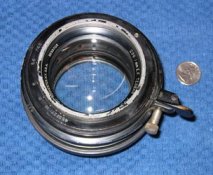
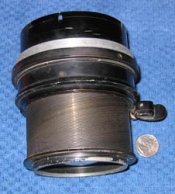
'm in a bit of a puzzle here trying to identify a lens. There are two jpegs attached of this unusual beast. It's a Bausch and Lomb f:4.5 Tessar marked "296.1mm E.F. Tessar f:4.5" with the usual Bausch and Lomb Rochester marking and a serial of 3233702. It is NOT marked Ic. It's in a large and heavy (really heavy) helical focusing mount, calibrated from 8 feet to infinity with distance markings at 8, 15, 25, 50, 100 and infinity. Unlike most Tessars, it stops down to f:45. The helical mount has about 49mm of extension.

I've plowed through the B&L literature on Seth Broder's site, and can't find anything listing such a precise focal length or the helical mount it is in. It seems obvious that it was attached to a fixed or non-focusing "something". If it's a projector lens, why the precise FL and the long distance scales? If it's an aerial lens, why the short distance scales?

Now why get so interested in an old uncoated Tessar? Well, other than curiosity, when compared to a 30cm f:4.5 coated Heliar, it has a far better transition to out-of-focus and shallower DOF than the Heliar, which would seem to violate the laws of optics given the difference in FL of 4mm or so. That would also possibly indicate the B&L was optimized for a different use than a standard view camera taking lens. It is quite sharp too, but just seems to have a smaller DOF which gives a nice 3D look.

So, any idea what this thing is?

Thanks,

Steve
 

Attachments

  • B&L-1a.jpg
    B&L-1a.jpg
    60.1 KB · Views: 156
  • B&L-2a.jpg
    B&L-2a.jpg
    50.8 KB · Views: 159
The precise focal length is usually needed for a rangefinder or perhaps an autofocus enlarger. Kodak made some large autofocus enlargers, so it could be for one of those, but I'd have thought they would have Enlarging Ektar lenses. There were also two Veritos made for the Kodak autofocus enlargers (yes, a soft focus enlarging lens).
 
Process lenses are also marked to actual focal length but those tend to be slower.

Some sort of copy lens?
 
I'd thought about a copy lens and maybe that's what it is, given the f:45 aperture and precise focal length. I hadn't thought about an autofocus enlarger lens although I had thought maybe a manual one, but then why the helical mount? I don't think it's for an autofocus enlarger because the helical mount has a focus lock screw (the silver knob) and the lever it attaches to is clearly a finger pad and has the black enamel worn off the edge from operation which is visible in the first jpeg. A local commercial pro that's 85 years old and has seen flash powder in use says he's never seen anything quite like it, and he's been around repro cameras and the like.

Thanks for the comments,

Steve
 
I have several taking lenses, especially from Schneider and Zeiss, which are marked with actual focal length.

It might be a taking lens for a rigid (box) camera, in which case the exact focal length would be needed to mark the distance scale.
 
It looks like some sort of aerial camera lens to me, though I'm not sure why a point of focus at 8' would be needed, unless the camera ship is a crop duster :wink:
 
John, aerial camera lenses are typically fixed focus, are collimated to the camera by screwing into/out of the cone or by changing the thickness of a shim between lens and body. I've dismantled both types, have never hit one with a focusing helical. At even odds, perhaps better, Ole has it right.
 
Dan,
Peter Gowland did make an aerial camera with helical focusing---I'm not exactly sure why.

I have seen several aerial lenses with the precise focal length painted or otherwise marked on the barrel and tessars were quite popular for aerial work, and yet the
8' preset focus would indicate that it isn't off an aerial camera.
Perhaps it was used on a horizontal copy camera? But then 100' of track bed is a bit hard to for me to comprehend.

It is an interesting mystery!
 
One more problem, I have 2 8x10 B&L tessar 1c lens, they are 1/2 that length. I don't think thats a 4.5 tessar.
 
John, I've also seen aerial camera lenses with the exact (to 0.1 mm) focal length marked. And process lenses with QC slips giving the exact focal length (again to 0.1 mm) or with the exact focal length marked on the lens. But I've never seen a lens for either application in a helical. Limited experience on my part, no doubt.

Peter Gowland must have had a good reason for putting a helical on his aerial cameras. I suppose we could ask him why he did it.

Cheers,

Dan
 
One more problem, I have 2 8x10 B&L tessar 1c lens, they are 1/2 that length. I don't think thats a 4.5 tessar.

Yes, it is a f:4.5 Tessar. It's marked as f:4.5 Tessar (but not 1c) but 1c Tessars certainly existed in this focal length - 12" - 300mm ranges. One just sold on eBay a day or two ago.

Cheers,

Steve
 
Folks,

'm in a bit of a puzzle here trying to identify a lens. <snip>


Now why get so interested in an old uncoated Tessar? Well, other than curiosity, when compared to a 30cm f:4.5 coated Heliar, it has a far better transition to out-of-focus and shallower DOF than the Heliar, which would seem to violate the laws of optics given the difference in FL of 4mm or so. That would also possibly indicate the B&L was optimized for a different use than a standard view camera taking lens. It is quite sharp too, but just seems to have a smaller DOF which gives a nice 3D look.

So, any idea what this thing is?

Thanks,

Steve
Here you get to the bokeh highly subjective description and a non technical nonsense on DOF. Sorry, voice of reason: 300 mm is 300 mm is 300 mm... There are no cameras especially constructed for "nice 3D look" of some lens - there you are just dreaming. Other than that, if you like the lens, use it:smile:
 
Goldfart,

I know physics, I have a degree in it. I know it shouldn't have less DOF than another lens of the same FL, but I'm not so stupid as to believe dogma over my eyes. The difference is obvious on the GG.

The original post was about what it was, not who can explain its optical performance.

Steve
 
The Heliar has residual uncorrected spherical aberration by design, which gives it an illusion of greater DoF than (most) other lenses.

I thought that was well known and easily understood? :tongue:
 
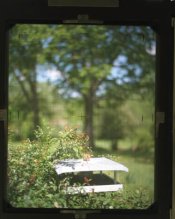
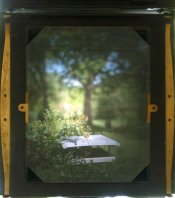
Not that much. Pictures attached, but do be aware that the GGs are different (brightness) as both lenses will not at this time fit on the same camera. The point of focus is the rock in both pics.

Cheers,

Steve
 

Attachments

  • Heliar.jpg
    Heliar.jpg
    56.5 KB · Views: 113
  • Tessar.jpg
    Tessar.jpg
    52.3 KB · Views: 123
Goldfart,

I know physics, I have a degree in it. I know it shouldn't have less DOF than another lens of the same FL, but I'm not so stupid as to believe dogma over my eyes. The difference is obvious on the GG.

The original post was about what it was, not who can explain its optical performance.

Steve

Relax Steve - if you know about the constant DOF then why to dream about some celestial exceptions from the rule? You yourself started to speak about the "optical performance" - I just told you that it is not technical to speak so. Now if you don't believe the "dogma" and you believe "your eyes" - isn't it a time to write a new optics' book?:smile: "The optics as seen - not believed" or something like that...:smile: eh, relax and keep to your degree :wink:
 
Not that much. Pictures attached, but do be aware that the GGs are different (brightness) as both lenses will not at this time fit on the same camera. The point of focus is the rock in both pics.

Cheers,

Steve

To see the unseen? Steve, where is "the rock" in the picture??:confused:
 
Steve, with all due respect I can't tell anything from the thumbnails you posted. GGs are fuzzy, small digitized images are fuzzy, ...

I don't know why, but this all brings to mind the assertion that pinholes have infinite depth of field. I never understood that; if nothing is in sharp focus, how can the zone of acceptable sharpness have depth?
 
Apologies due gentlemen, too much caffeine this morning, but geez I love it.

I tried my best to get thumbs that were useful, but that's the limitations of jpegs of postable size and digital cameras. The rock is the small brownish object in the center of the sheet-metal "roof" of the bird feeder.

Anyway, that some lenses of the same FL have a different DOF or transition to out of focus (sorry Dan, I know you have problems with unscientific evaluations, and so do I, but I'm open to suggestions) was known by my local commercial pro who's been in the business for a long time. He was not surprised by the statement. I guess when I get it shootable I could take a couple of color transparencies and mail them around. Maybe the optimization or cell spacing might cause this effect?

Cheers,

Steve
 
Photrio.com contains affiliate links to products. We may receive a commission for purchases made through these links.
To read our full affiliate disclosure statement please click Here.

PHOTRIO PARTNERS EQUALLY FUNDING OUR COMMUNITY:


Ilford ADOX Freestyle Photographic Stearman Press Weldon Color Lab Blue Moon Camera & Machine
Top Bottom