• Welcome to Photrio!
    Registration is fast and free. Join today to unlock search, see fewer ads, and access all forum features.
    Click here to sign up

Lens flare or film fogging?

Forum statistics

Threads
203,466
Messages
2,855,202
Members
101,855
Latest member
Minoltalan
Recent bookmarks
1

ww12345

Member
Allowing Ads
Joined
Aug 4, 2013
Messages
115
Format
35mm
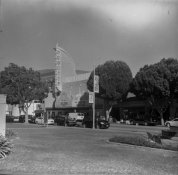
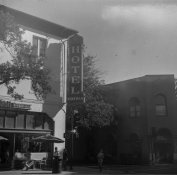
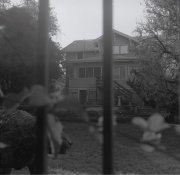
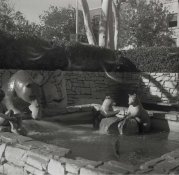
I recently purchased an Agfa Isolette I, and did a quick and dirty test of the bellows to see if they were leaky. They didn't appear to be, so I popped in a roll of film and did a test roll. The pictures came out better than I expected, but with an odd haze to them. I wondered if anybody here could tell if it was lens flare or film fogging (either from leaky bellows or during development). ImageUploadedByTapatalk1378079526.389250.jpgImageUploadedByTapatalk1378079540.454871.jpg
 
I'd double-and triple check the bellows. Especially the folds at the corners.

Don't ask how I know...
 
I'm going to guess there is an internal reflection involved. I say this because on the right photograph, I see some "textures" inside the top right portion where it is additionally exposed.

Because two photograph has the same portion "fogged", I'm going to guess there is a leak somewhere on the camera. Because there's some reduction in contrast, I'm going to guess your lens may have haze.

If you are testing a new equipment, there has to be only one element (the camera) that is in doubt. If you suspect the film was fogged before it went into the camera or fogged during development, it's going to be nearly impossible to test the subject camera.

Playing with old camera is fun but is also frustrating. I know because I do the same myself!
 
Frequently it is easier to diagnose if you can post a scan of the negative strip rather than a print, but I suspect a light leak.
 
Light leaks, are opposite where you'd think they are. Look at the bottom. Maybe where the bellows attach to camera body.

The reason one picture's leak is spread out more than the other is a measure of how long the camera was on that frame before you wound to the next shot. The leak happens at all time, not just when the shutter fires. So it can be dim, and still be a problem.
 
Agfa folders are famous for light leaks from the bellows, they used poor materials in their bellows and they tend to go so check again for light leaks, Agfa folders will almost certainly need new bellows,I have yet to come across one that didn't
Richard
 
Yeah, I didn't even realize that, but that haze is in roughly the same spot... Another thought occurred to me - the negative goes through the camera upside-down, is that correct? So if I'm looking for leaks, they should be on the bottom left of the bellows, right?

On another note, any idea on where to get new bellows without having to make them?
 
Richard is spot on, the Agfa bellows are notorious for developing light leaks, except for some pre WWII models that have nice leather bellows and some of the later top notch models (part of the Isolette Mk III with Solinar and Super-Isolette) that have improved bellows, too. Anyway, in most cases it is not absolutely necessary to exchange the bellows (in fact, as most Isolettes with Agnar or Apotar lenses are worth close to nothing I would consider new bellows only on the models with a Solinar lens). Instead you can seal the corners of the bellows' folds (that's were they usually crack) with some type of liquid black silicone sealant. It's not as beautiful as a new bellows but more in line with the value of the camera. This method works quite well for me and is rather durable. If your pictures still lack contrast after you have the leaks fixed and the lens cleaned ... well... the Apotar and Agnar lenses do have kind of lowish contrast, I would recommend to use a push on type shade at all times. The Solinar is much more contrasty and also quite sharp (with the others you have to stop down and there is a lot of sample variation). The Solinar does very well on modern slide film, and frankly, it's the only lens I personally would bother with on an Agfa Isolette, but that's ultimately a question of individual taste/preferences, of course.

 
Oh I hate to do this to you, but I think there is nothing wrong with you camera. (well maybe) But I remember when I lived in SLO, these scenes looked pretty much like they are photographed. Usually foggy in the summer, low contrast, bright highlights in the sky, pretty much like your pictures. Of course this was 15 years ago, but the theater and the hotel look about the same. My pictures were taken with a Leica III and a 50mm Summar, with some cleaning marks, so they looked about like yours. Maybe your camera, or maybe the subject matter. (just kidding) Like seeing those building are still standing yet. Sorry for the off topic comments.
 
Hey, cool to hear from someone from SLO (or formerly from SLO).

You might be right about the shooting conditions - this was shot around 5 in the afternoon, after a particularly warm day (80+ F).

However, I rechecked my bellows, and it looks like there are two or so tiny pinpoint holes on the corners of the bellows. Would this be enough to cause the film fogging/haze? If so, could I patch it with Star Brite Liquid Electrical Tape? Alternatively, could I find leather replacement bellows somewhere that wouldn't cost more than the camera?

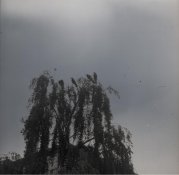
Here's another few shots - one shot in the early morning (the last shot).

ImageUploadedByTapatalk1378184058.025467.jpg

ImageUploadedByTapatalk1378184078.321474.jpg

ImageUploadedByTapatalk1378184088.905134.jpg
 
Oboy! Thanks. More trips down memory lane.
I've used liquid electrical tape, but it needs to be fairly thick as it is just a little transparent. Used it on a Toyo view bellows, followed with a little black paint. So far so good.
 
Cool! I'll give that a shot. Inside or outside the bellows? Does it matter?
 
The second shot on post 10 looks like half moon marks from a battle loading 120 film onto a spiral.
 
Yeah, that's what that is. :smile:

This was my first roll of developing 120 film, so I had a bit of trouble getting the film started.
 
Black fabric paint from the craft section of the local Walmart is an excellent bellows patching compound, and it's opaque. The paint is used for making custom designs on T-shirts. It's easy to check a lens for fogging. Open the camera, open the back, set the aperture wide open and hold the shutter open on 'B'. Hold the camera up and look through the lens at a light source. Any fogging will be very noticeable. Be prepared to take the lens apart to clean the inner surfaces.

I bought a couple of old pre-1940 folders, a Zeiss Ikon Nettar and a Voigtlander Bessa. They both had lenses very badly fogged on the inner surfaces.
 
Cool! I'll give that a shot. Inside or outside the bellows? Does it matter?

I don't think it will matter much. As long as the material used doesn't flake off on the inside and stick to your film or somewhere else you don't want. I found it easier to do it from the outside, but then I didn't really care about the appearance after I was done. (you have to be fairly close to notice though)
 
Photrio.com contains affiliate links to products. We may receive a commission for purchases made through these links.
To read our full affiliate disclosure statement please click Here.

PHOTRIO PARTNERS EQUALLY FUNDING OUR COMMUNITY:


Ilford ADOX Freestyle Photographic Stearman Press Weldon Color Lab Blue Moon Camera & Machine
Top Bottom