• Welcome to Photrio!
    Registration is fast and free. Join today to unlock search, see fewer ads, and access all forum features.
    Click here to sign up

Leica

MIT. 25:35

MIT. 25:35

  • 0
  • 0
  • 36
Lutheran Cemetery Angel

H
Lutheran Cemetery Angel

  • 0
  • 0
  • 36

Recent Classifieds

Forum statistics

Threads
202,948
Messages
2,848,026
Members
101,552
Latest member
rbaltman409
Recent bookmarks
1
There is a Mezuzah into each and every Leica camera, which preserves HCB's soul and helps with seeing in a legendary way.

Exactly! Maybe something about a Leica is exactly what's keeping you back from being a great photographer. If you don't get one you'll never know! *

*sarcasm (I will admit though I've never looked for the Mezuzah)
 
A number of manufacturers made great lenses but never produced SLR bodies to compete with the best. Include Leica, Contax and Konica in that group.

Au Contraire, mon frere. The Contax RTS III was every bit as sophisticated as the Nikon F4 (I mention the F4 because they were relatively contemporaneous), minus auto-focus. 5 FPS motor drive integrated in the body, TTL spot metering, 1/8000th second top shutter speed, flash sync up to 1/250-th, 99% viewfinder, to mention a few features. And add to that several unique features not found on the F4 such as the ceramic film pressure plate with vacuum to hold the film perfectly flat across the entire image area at the moment of exposure, and TTL OTF flash metering for non-dedicated flash units. Try using your Nikon F4 with a Broncolor studio strobe without a hand-held flash meter!
 
Au Contraire, mon frere. The Contax RTS III was every bit as sophisticated as the Nikon F4 (I mention the F4 because they were relatively contemporaneous), minus auto-focus. 5 FPS motor drive integrated in the body, TTL spot metering, 1/8000th second top shutter speed, flash sync up to 1/250-th, 99% viewfinder, to mention a few features. And add to that several unique features not found on the F4 such as the ceramic film pressure plate with vacuum to hold the film perfectly flat across the entire image area at the moment of exposure, and TTL OTF flash metering for non-dedicated flash units. Try using your Nikon F4 with a Broncolor studio strobe without a hand-held flash meter!

I love my RTSII but when I read this I desire a III more and more, darn it!
 
a Leica is something to brag with not something to take photographs with.Owning one will not make you another HCB.More money will not make better pictures;that said,Leica is top-notch equipment,reliablemechanics and brilliant opticsbut other name-brand products are not far behind.You don't need a Leica to make first-class photographs;all you need is dedication and lots of it

True, but; maybe with a little luck at least W. Eugene Smith.:wink: I've used Nikons since 1977 and doubt any camera will do any better than some of the shots I've taken with those.
 
I am aware that some Zeiss lenses were still made in Germany, but we are talking about the 85 mm f1.2 and the 55 f1.2 if memory serves me correctly, they are uberexpensive even today.

For the RTS, it's probably a great camera but not a system camera like the others we cited, of course a pro can get pro pics with a K1000 if he doesn't the flexibility of a system, not to deny it. I agree that Leicoltas and Minolta XDs are nice cameras too but I don't consider a R body better than a XD one, sorry about that.


Zeiss made an 85 and 50mm in Germany. They also made a 25mm, I believe 35mm, and 180mm in Germany. I owned both the 25mm and 180mm. Of course where the barrels were made is a moot point. Nikon, Canon and Minolta lenses were completely made in Japan and they were quality lenses.

The RTS ll had 7 types of focussing screens available, Data back, electronic cable release, cold weather remote power supply, Pro potato smasher flash that had a stroboscopic effect (I believe 5 flashes available), 5 fps professional motor drive, two lines of Zeiss lenses (if you want to separate German from Japan) plus Yashica lenses available and other accessories. I even heard of a polaroid back available from some aftermarket company.

What exactly do you consider a system camera?
 
I love my RTSII but when I read this I desire a III more and more, darn it!

That's why I caved and got an RTS III a couple years ago - they're just such awesome cameras, and they're going for a pittance compared to what they sold for new. I got mine for around $450. I can remember when even used they were going for $1800.
 
Zeiss made an 85 and 50mm in Germany. They also made a 25mm, I believe 35mm, and 180mm in Germany. I owned both the 25mm and 180mm. Of course where the barrels were made is a moot point. Nikon, Canon and Minolta lenses were completely made in Japan and they were quality lenses.

The RTS ll had 7 types of focussing screens available, Data back, electronic cable release, cold weather remote power supply, Pro potato smasher flash that had a stroboscopic effect (I believe 5 flashes available), 5 fps professional motor drive, two lines of Zeiss lenses (if you want to separate German from Japan) plus Yashica lenses available and other accessories. I even heard of a polaroid back available from some aftermarket company.

What exactly do you consider a system camera?

And don't forget that line of lenses ran from 15mm rectilinear and 16mm fisheye to 1000mm mirror lens on the extreme telephoto. Along the way were the 25mm, 35mm f1.4, 85mm f1.4, 100mm f2, 135mm f2, 18mm f2.8, and 200mm f2(!) lenses among the noteworthy primes, and the 35-70, 35-135, 28-85 and 100-300 zooms all considered to be some of the best available and certainly equal to the Canon L glass and Nikon top-of-the-line offerings.
 
Au Contraire, mon frere. The Contax RTS III was every bit as sophisticated as the Nikon F4 ...
Yes to be fair, the Contax III was the only model I can think of that actually had any original innovations. By the time the III came out the company had given up trying to sell bodies on the name alone. Did Contax innovate into the AF era, I forget?
 
They made at least one camera that was AF, maybe more. I think it's called the AX.
 
There was the AX, which had auto-focus even with manual focus lenses. And then there was the RX which had both depth-of-field and digital focus indicators in the viewfinder, making it easy to play with hyperfocal focusing without taking your eye out of the viewfinder. And the ST had the same ceramic pressure plate of the RTS III but without the vacuum.

After the AX, they came out with two dedicated AF bodies that were not backwards compatible with the manual focus lenses. There was the flagship N1, and its smaller, lighter sibling the NX. They had a short range of lenses - an 18-35, a 24-85, a 100-300, a 50 f1.4 and an 85 f1.4 IIRC. There may have been one or two others but those were the mainstays. There was also an N Digital which used the same AF lens mount. It was very well regarded in its day but it was too little too late (or too much, too late as they were quite expensive and lacked the breadth of system offered by their Canon and Nikon counterparts).
 
They made at least one camera that was AF, maybe more. I think it's called the AX.

The Contax AX is probably the most sophisticated SLR camera EVER made. The whole film plane, film spools, and even prism, move in and out to achieve AF with any MF lens, at a really fast speed, silently, in a display of ceramic technologies. I couldn't believe such a thing could be made!
 
That's right, I recall some weeks back looking through an old 1994 copy of Shutterbug and saw an ad for the RX...forgot about that one.
 
My understanding was most of the line of Contax SLR lenses were made in Germany at first and only later in Japan, not just a few select lenses. And some were only made in Germany and never in Japan. I have the 85/1.4, 35/2.8 PC, 60/2.8 Makro and a 180/2.8 all Made in Germany. And if you read the forums from 10-15 years back most people with experience using both said the QC was superlative and there's no difference between the German-made or Japanese-made lenses. That said the German ones did and do command a premium seemingly just from the words Made In Germany being on the lens.
 
The Leica R4,5,6 and 7 were all based on the Minolta XD7, they are good cameras, not deadly special and surely not in the league of the real pro cameras of the 80s, the Nikon F3, the Pentax LX and the Canon F-1N.

Exactly, particularly the holy, glorious, all-conquering, boundless, expressive, ever-expansive Canon New F-1.

Now, is it totally true that those Leicas are Minoltas in disguise, more correctly they are Minoltas that have different electronics, improved viewfinders and prisms, Leica assembly and QA, and an R-system mount. And sometimes i wonder, what's wrong with that? Those Minoltas which were used as "base platform" are really really good machines: XE-5, XD7. I want to get myself an XE-5, it is very nice. So let's take an XE-5, do the Leicolta modifications and it becomes an excellent machine.

The problem, IMO, is the price of the lenses. And of course the lens choice is limited compared to Canikon. As a 1982 Leica advert said: "When you demand the very best, your choice is somewhat limited."

As for the Contax RTS system, the Contax/Yashica system as a whole, I think it was a great idea, and its "sister" (cheaper) professional camera, the Yashica FR-1, is a nice camera as well. Yashica's lens factory (Tomioka) already had a good reputation.

Why did pros did not prefer the Contax RTS system in the 70s? I guess it's either to:

a) already having bought Nikon lenses and accesories
b) lens and accesories choice not as massive and/or comprehensive as in the Nikon (or Canon) system.

 
The Contax AX is probably the most sophisticated SLR camera EVER made. The whole film plane, film spools, and even prism, move in and out to achieve AF with any MF lens, at a really fast speed, silently, in a display of ceramic technologies. I couldn't believe such a thing could be made!

I picked up an AX fairly cheap merely because of a chipped plastic part for flipping the viewfinder closed, and otherwise working perfectly. Already having an RTS, RTSII and RX I certainly did not need one but could not resist due to my curiosity. It's an amazing machine. Big and bulky but luckily I have large hands. It's great to use even with many M42 lenses using a CY/M42 adapter. Auto focus using really old lenses! It really shines using my Contax 85/1.4 and 180/2.8 lenses especially.
 
The RTS ll had 7 types of focussing screens available, Data back, electronic cable release, cold weather remote power supply, Pro potato smasher flash that had a stroboscopic effect (I believe 5 flashes available), 5 fps professional motor drive, two lines of Zeiss lenses (if you want to separate German from Japan) plus Yashica lenses available and other accessories. I even heard of a polaroid back available from some aftermarket company.

What exactly do you consider a system camera?

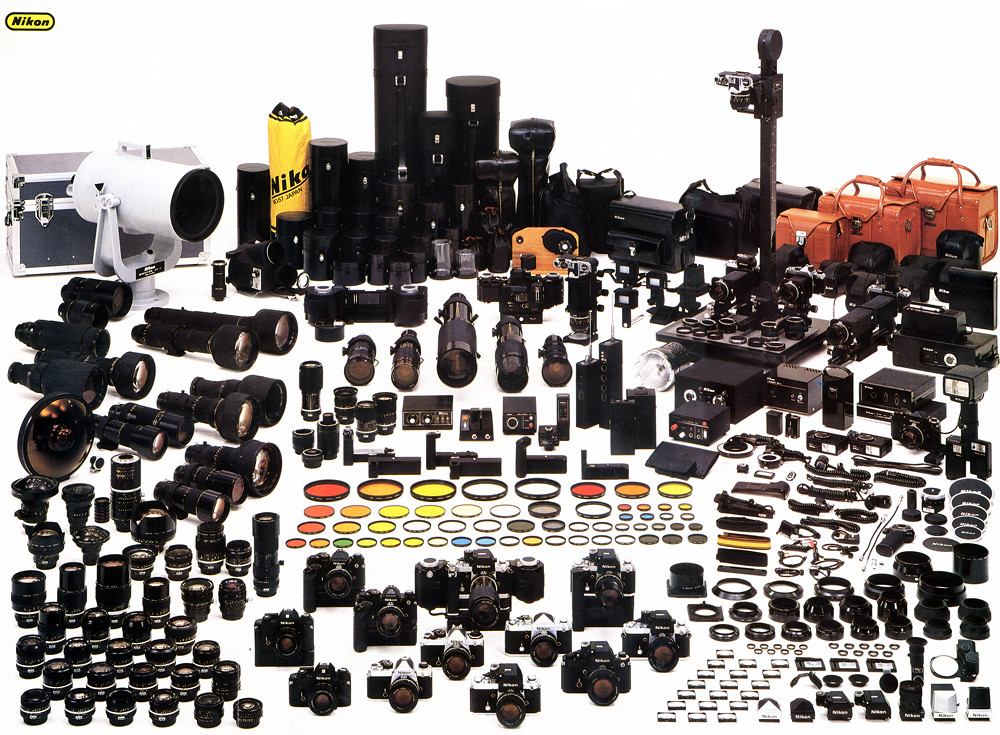
Friend, that system looks like more or less what was available in those days for the Pentax MX and later the Super A, this was the Nikon F2 system:

5068709289_81d8bccc97_b.jpg


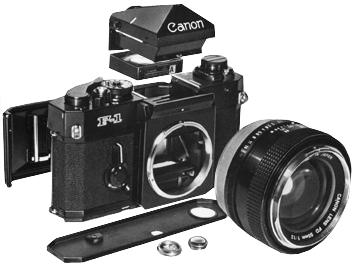
This was the first Canon F1 system:

1971_f1_l.jpg


This is how I imagine a system camera:

modular.jpg


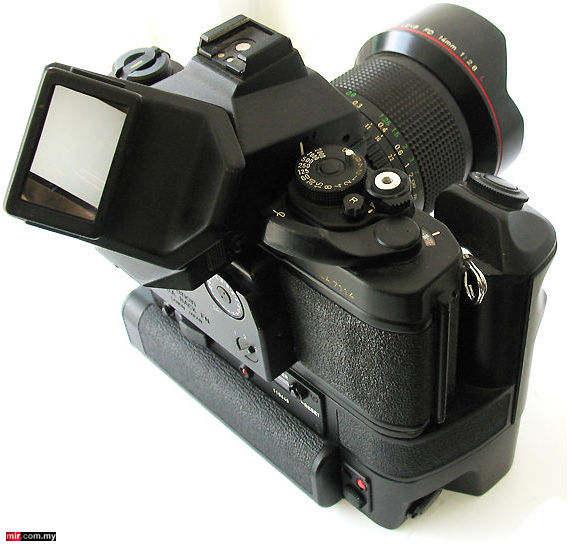
This is a view of the badass New F1:

NewF1LAOlympicSpeedC.JPG


Here you can find the list of the screens available for the New F1, they were 32 and offered centre metered, partial and spot metering:

http://www.mir.com.my/rb/photography/hardwares/classics/canonf1n/metering/screens/allscreens.htm

This is the LX with few gadgets:

Dead Link Removed

What was the camera you were talking about? The Pentax MX?
 
I still have that poster I got from Nikon back in the late 70's. I don't think much is lacking.

5068709289_81d8bccc97_b.jpg
 
F
This is a view of the badass New F1:

NewF1LAOlympicSpeedC.JPG

** Flavio drools, moans **

And from looking at the serial number, the camera is a 1984 LA Olympics edition.
 
** Flavio drools, moans **

And from looking at the serial number, the camera is a 1984 LA Olympics edition.

It is a LA...mine is a normal 1984 BUT I have the motordrive AND the action finder!

I also have the action finder for the LX, the only other camera who has a similar design...the LX is badass too!

This is normal with the 85 mm:

2wokfm0.jpg


Then it gets badass:

160ctiv.jpg


et5idv.jpg


Try to find something like that with a Contax!
 
It is a LA...mine is a normal 1984 BUT I have the motordrive AND the action finder!

I also have the action finder for the LX, the only other camera who has a similar design...the LX is badass too!
2wokfm0.jpg

I thought I read "LA" on the serial number which would be the special edition. I own the 1984 "olympics" edition and the serial starts with "LA". My other F-1N is a regular edition, has a different serial starting letter. Frankly I like the "regular" F-1N more, i prefer white lettering over yellow lettering.

I'm jealous about the action finder, though. Is the image big? Can you focus easily with it?

Now that I got my first Pentax (P 67), i'm starting to think I should look out for a LX or at least a near top-level model.
 
Yes to be fair, the Contax III was the only model I can think of that actually had any original innovations. By the time the III came out the company had given up trying to sell bodies on the name alone. Did Contax innovate into the AF era, I forget?

The Contax 139 came out in I believe 1978. It was the worlds first Quartz timed camera. I owned one. It had TTL flash and an electronic cable release which I don't remember any other camera having in 1978.

Contax had I believe the first SLRs that had integrated auto wind which proved to be problem free unlike added autowinders and motor drives.

Contax cameras were some of the first SLR's to be electronic and battery dependent. Some might prefer mechanical cameras but electronics were the future. All your DSLRs today are electronic.

The original RTS was Porshe designed. Having another company's design house design your camera body was pretty innovative.
 
Last edited by a moderator:
I thought I read "LA" on the serial number which would be the special edition. I own the 1984 "olympics" edition and the serial starts with "LA". My other F-1N is a regular edition, has a different serial starting letter. Frankly I like the "regular" F-1N more, i prefer white lettering over yellow lettering.

I'm jealous about the action finder, though. Is the image big? Can you focus easily with it?

Now that I got my first Pentax (P 67), i'm starting to think I should look out for a LX or at least a near top-level model.

Both of them are smaller than the normal finder, but still usable, the LX is better because the finder is actually split in two and you can use the lower part for other magnification lenses and stuff like that.

Oh, I also have one of these:

27x3pdz.jpg


But I don't want to make you die of jealousy!:whistling:
 
Don't forget: Zeiss negs & slides SPARKLE while Ninon do not! (Of course that wouldn't matter to a f**in' hack/pro who is the lowest species of photographer)
 
Last edited by a moderator:
Don't forget: Zeiss negs & slides SPARKLE while Ninon do not! (Of course that wouldn't matter to a f**in' hack/pro who is the lowest species of photographer)

Mate you're mistaken: that's the Leica glow!
 
Photrio.com contains affiliate links to products. We may receive a commission for purchases made through these links.
To read our full affiliate disclosure statement please click Here.

PHOTRIO PARTNERS EQUALLY FUNDING OUR COMMUNITY:


Ilford ADOX Freestyle Photographic Stearman Press Weldon Color Lab Blue Moon Camera & Machine
Top Bottom