
I just switched to a GE LED 100 Watt Reveal Equivalent 2850K blub, printed on Multitone VR and Slavich grade 2, Foma grade 3, looks to be very close match to standard a bulb, instant on and off. Workd as well in my D3 as Opemus, at least with 35mm in the next day or so will try MF and 4X5. I need to find a 75watt equivalent, the big box home improvement center only had 60 and 100 in the Reveal line.
-
Welcome to Photrio!Registration is fast and free. Join today to unlock search, see fewer ads, and access all forum features.Click here to sign up
You are using an out of date browser. It may not display this or other websites correctly.
You should upgrade or use an alternative browser.
You should upgrade or use an alternative browser.
LED bulb
-
A
- Thread starter Paul Howell
- Start date
Recent Classifieds
-
For Sale Kodak Step Tablets
- Started by Jon Shiu
-
Want to Buy Kodak Portra VC 160
- Started by Stankula
-
For Sale Arca Swiss Z1+ fliplock ball head
- Started by Guivd
-
Want to Buy Intellifaucet D250 K250 etc
- Started by Rafal Lukawiecki
Forum statistics
A 2850K LED bulb will do fine on grade 3 or lower but will fail to provide the proper contrast in the higher grades. You need a higher color temparature to get a full 0-5 contrast range: 4000K at least. In my tests a 2850k LED bulb with a grade 5 filter produces only a grade 3.5 contrast.
I use Osram Parathom 4000K 4w and 10w bulbs in my Focomat 1c and 2c and a large 6000K globe bulb from an unkwnown brand in my Laborator 138s. These all work perfectly fine and provide full 0-5 contrast grades.
Osram claims that the 10w bulb is an equivalent to 75w tungsten but in reality it gives way more light and thus much shorter exposure times. The 4w LED bulb is much closer to 75w tungsten.
I use Osram Parathom 4000K 4w and 10w bulbs in my Focomat 1c and 2c and a large 6000K globe bulb from an unkwnown brand in my Laborator 138s. These all work perfectly fine and provide full 0-5 contrast grades.
Osram claims that the 10w bulb is an equivalent to 75w tungsten but in reality it gives way more light and thus much shorter exposure times. The 4w LED bulb is much closer to 75w tungsten.
I'll give a try VC, 3 1/2 and 4, I print grade 2 and 3, don't even have any grade 4 on hand. I saw a few LED bulbs rated at 3000 and 4000, might order one. The 100 watt Equivalent is bright, had to stop down to F16, the reason I want to find a 75watt. Like not having to deal with the heat build up in long exposures.
Yes, not needing to worry about heat build up is a great advantage of LED. While high grades like 4 or 5 may not be needed for everyday printing you may need them in case you ever need to do split-grade printing. I would therefore recommend buying 4000K or higher anyhow; prices are the same (over here) and it's better to have them in case you'll ever need such high grades. A 75 watt equivalent will be only marginally less bright, better look for a 40 watt equivalent.
A 2850K LED bulb will do fine on grade 3 or lower but will fail to provide the proper contrast in the higher grades. You need a higher color temparature to get a full 0-5 contrast range: 4000K at least. In my tests a 2850k LED bulb with a grade 5 filter produces only a grade 3.5 contrast.
I use Osram Parathom 4000K 4w and 10w bulbs in my Focomat 1c and 2c and a large 6000K globe bulb from an unkwnown brand in my Laborator 138s. These all work perfectly fine and provide full 0-5 contrast grades.
Osram claims that the 10w bulb is an equivalent to 75w tungsten but in reality it gives way more light and thus much shorter exposure times. The 4w LED bulb is much closer to 75w tungsten.
I don`t understand. Old enlarger bulbs are 2800 K and they provide full range. At any rate, 4000 and 5000 K bulbs are available.

They have a completely different wavelengths spectrum than LEDs.I don`t understand. Old enlarger bulbs are 2800 K and they provide full range. At any rate, 4000 and 5000 K bulbs are available.
Doremus Scudder
Member
Okay, I'm hijacking this thread....
I have a problem with all this speculation that lower-color-temperature bulbs (of any kind, LED or tungsten) present problems getting higher contrast grades on VC paper. This notion crops up from time-to-time and is, I believe, simply false.
Assuming that the filtration is adequate and that the bulb in question emits at least some of the shorter (blue) wavelengths that the paper is sensitive to, all that should be needed to get maximum contrast from the paper would be a long enough exposure. In other words, if you have a #5 filter that effectively eliminates the "low-contrast" light from your light source, as it should, and you can make any print at all with the light being transmitted, it should be grade 5, period. Whatever light makes it through the filter should be "grade 5" light.
The fact that the filters were designed for use with tungsten light sources from 2400K-3400K supports this. I know I get all the contrast possible from my VC paper with a tungsten bulb and a Wratten # 47 filter or maximum magenta filtration from a dichroic head, so at least my halogen bulbs are emitting enough blue light. I would imagine that LED bulbs do as well. If they were not, then a #5 or a #47 filter would transmit no light and you couldn't make a print at all...
Best,
Doremus
I have a problem with all this speculation that lower-color-temperature bulbs (of any kind, LED or tungsten) present problems getting higher contrast grades on VC paper. This notion crops up from time-to-time and is, I believe, simply false.
Assuming that the filtration is adequate and that the bulb in question emits at least some of the shorter (blue) wavelengths that the paper is sensitive to, all that should be needed to get maximum contrast from the paper would be a long enough exposure. In other words, if you have a #5 filter that effectively eliminates the "low-contrast" light from your light source, as it should, and you can make any print at all with the light being transmitted, it should be grade 5, period. Whatever light makes it through the filter should be "grade 5" light.
The fact that the filters were designed for use with tungsten light sources from 2400K-3400K supports this. I know I get all the contrast possible from my VC paper with a tungsten bulb and a Wratten # 47 filter or maximum magenta filtration from a dichroic head, so at least my halogen bulbs are emitting enough blue light. I would imagine that LED bulbs do as well. If they were not, then a #5 or a #47 filter would transmit no light and you couldn't make a print at all...
Best,
Doremus
I have been using a LED bulb for a while now, a 3400K, warm bulb, I do not have problems getting G4 and 5 when I need to, using Ilford above lens filters, I have also tried the 2400k cool bulb, just to see if there was much if any difference, and again, I can get the higher grades without a problem, I tried printing the same negative on grades from 1 to 5, leaving out the 1/2 grades and you could clearly see the difference,I also tried the same using a Photocresanta bulb and there weas no difference that I could dectect between any of the bulbs, I was using a Meopta opemus 6 enlarger, with above the lens MG filters, I very rarely need 5, but sometimes 4 is useful, and I will continue to use a LED bulb, no more heat, I can touch the head and it is cool, and no more negative pooping,
Richard
Richard
- Greg Davis
- Deleted

The problem with all of the discussion in this thread about the LED bulbs is that the LED bulbs differ greatly with respect to the light they emit. Some of them emit a lot more light in the blue end of the spectrum than others. In some cases, the blue light they emit is only within a very narrow band of the spectrum, which said band may, or may not, correspond to the sensitivity of the blue sensitive "high contrast" emulsion in the paper.
Tungsten and halogen bulbs emit light in a very different way. Their spectrum may be concentrated toward a particular colour, but they are essentially continuous.
Tungsten and halogen bulbs emit light in a very different way. Their spectrum may be concentrated toward a particular colour, but they are essentially continuous.
Doremus Scudder
Member
The problem with all of the discussion in this thread about the LED bulbs is that the LED bulbs differ greatly with respect to the light they emit. Some of them emit a lot more light in the blue end of the spectrum than others. In some cases, the blue light they emit is only within a very narrow band of the spectrum, which said band may, or may not, correspond to the sensitivity of the blue sensitive "high contrast" emulsion in the paper.
Tungsten and halogen bulbs emit light in a very different way. Their spectrum may be concentrated toward a particular colour, but they are essentially continuous.
Indeed, this is the potential problem with LED bulbs. Comparing the paper sensitivity and bulb emission spectra (if available) should allow one to choose an LED bulb with adequate spectral distribution to get a full range of contrast on VC papers. Still, the only way I can see that one could expose a print with a good (i.e., not faded) #5 filter and end up with an exposed print that was much less than whatever an achievable grade 5 is for a given paper is if the filter were passing a lot of light outside the "grade-5 bandwidth."
My point is simply that if the #5 filter is doing its job correctly, the only print you should be able to make with it is a grade 5 print. All other wavelengths should be filtered out. Now, this may not be exactly the case, as some bleed is likely to occur with any filter, however, one would hope that the filter does its job to a high enough level of efficiency that bleed would be negligible except in the case where #5 wavelengths were simply not present, but the wavelengths that bleed through were. In that case, the exposure time would have to be extremely long.
Best,
Doremus

A measure of uncertainty seems to arise with the use of non-incandescent light sources. This is unwelcome in the darkroom where there are already too many sources of uncertainty. Perhaps we should be stocking up with a lifetime supply of replacement incandescent lamps before it is too late? (if it is not already too late)
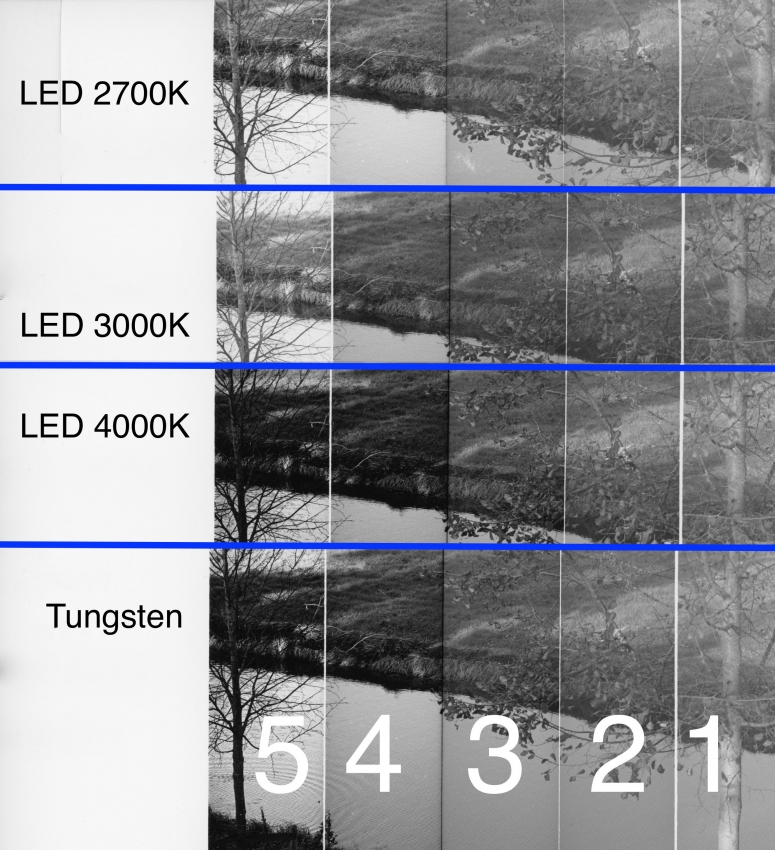
A comparison between a traditional tungsten bulb (Philips Photocrescenta) and LED bulbs - Osram Parathom 2700K, Philips 3000K, Osram Parathom 4000K. As you can see, only the Osram 4000K LED bulb equals the results of the traditional tungsten bulb.
Color temperature alone does not tell you what you can expect: as you can see the Philips 3000K gives less contrast (dark tones) at grades 4 and 5 than the Osram 2700K. You really need to test a specific LED bulb to find out how it will perform, since every LED bulb seems to have different characteristics regarding spectral coverage.
Color temperature alone does not tell you what you can expect: as you can see the Philips 3000K gives less contrast (dark tones) at grades 4 and 5 than the Osram 2700K. You really need to test a specific LED bulb to find out how it will perform, since every LED bulb seems to have different characteristics regarding spectral coverage.
Test LED Bulbs
- Ron789
- 3
A comparison between a traditional tungsten bulb (Philips Photocrescenta) and LED bulbs - Osram...
I don't know if you can get them where you are but I bought a 6500 kelvin LED bulb with a screw base to help assess colour temperature when colour printing. They may well be available to fit an enlarger.

i just converted all the bulbs in my home. the led bulbs I've seen come in .....
soft white= 2700k
bright white= 3700k
day light= 5000k
these are the most common bulbs i can find.
i also see the improvement since a couple years ago is no after glow and instant on n off is really instant.
soft white= 2700k
bright white= 3700k
day light= 5000k
these are the most common bulbs i can find.
i also see the improvement since a couple years ago is no after glow and instant on n off is really instant.
Doremus Scudder
Member
A comparison between a traditional tungsten bulb (Philips Photocrescenta) and LED bulbs - Osram Parathom 2700K, Philips 3000K, Osram Parathom 4000K. As you can see, only the Osram 4000K LED bulb equals the results of the traditional tungsten bulb.
Color temperature alone does not tell you what you can expect: as you can see the Philips 3000K gives less contrast (dark tones) at grades 4 and 5 than the Osram 2700K. You really need to test a specific LED bulb to find out how it will perform, since every LED bulb seems to have different characteristics regarding spectral coverage.
Test LED Bulbs
- Ron789
- 3
A comparison between a traditional tungsten bulb (Philips Photocrescenta) and LED bulbs - Osram...
Ron,
I'm interested in how you made these tests. First, what filtration did you use, dichroic or filters or...? Second, if you used a standard filter set (e.g., Ilford Multigrade filters), how old are they? Is there a chance that they have faded? Finally, how did you match exposures?
From your results, it would seem that the filtration is not really doing its job, allowing the emission distribution in the bulb to be the, or at least, a determining factor in final contrast. If gel filters like an Ilford Multigrade set in good condition pass so much extra bandwidth so as to allow changes in the light source to affect contrast, then they aren't really doing the job they should be doing and present a problem. Possibly more sharp-cut filters, like extreme dichroic filtration or the use of #47 and #58 filter and split-printing techniques are needed with LED light sources? Or, we need to be really particular about choosing an LED bulb for an enlarger light source...
For me, I'm sticking with my quartz-halogen bulbs!
Best,
Doremus

Has anyone seen an enlarger-friendly LED bulb with a 250 watt equivalent? My beseler uses a 250 and man, it's a godsend for lith printing and those long exposures. I dread the day I can no longer source those bulbs.
If an LED bulb doesn't give you a high enough contrast even with a grade 5 filter, I suspect that the bulb has rather weak blue emission, or strong green emission, relatively speaking. How about using an additional gelatin filter like Rosco 4730 (CalColor 30 Magenta) to take some green away?
I have an old set of DuPont VC filters somewhere, need to find them give a try, DuPont (GAF) with magenta in higher grades, 4 and 5. Have not used in a very (did I say very) long time.

You are making the assumption that the filter will provide the correct color temp regardless of the color temp of the light source. I'm not sure that this is correct even though, it seems logical as long as the short wave color temp is present in the source but, I think that's exactly where the theory falls apart.Okay, I'm hijacking this thread....
I have a problem with all this speculation that lower-color-temperature bulbs (of any kind, LED or tungsten) present problems getting higher contrast grades on VC paper. This notion crops up from time-to-time and is, I believe, simply false.
Assuming that the filtration is adequate and that the bulb in question emits at least some of the shorter (blue) wavelengths that the paper is sensitive to, all that should be needed to get maximum contrast from the paper would be a long enough exposure. In other words, if you have a #5 filter that effectively eliminates the "low-contrast" light from your light source, as it should, and you can make any print at all with the light being transmitted, it should be grade 5, period. Whatever light makes it through the filter should be "grade 5" light.
The fact that the filters were designed for use with tungsten light sources from 2400K-3400K supports this. I know I get all the contrast possible from my VC paper with a tungsten bulb and a Wratten # 47 filter or maximum magenta filtration from a dichroic head, so at least my halogen bulbs are emitting enough blue light. I would imagine that LED bulbs do as well. If they were not, then a #5 or a #47 filter would transmit no light and you couldn't make a print at all...
Best,
Doremus
Look up the color spectral outputs for various types of bulbs. Incandescent bulbs are very linear and predictable. CFL's are very spikey. LED's are a smoother than CFL's, but still aren't linear like incandescent bulbs. They can all appear to our eyes to have a very similar color temperature even if they are wildly different from each other due to the RGB receptors in our eyes. As long as the peaks in a light bulb match what our cones operate off of, the light will appear to have a smooth, high color temperature. You'll only really notice a difference when applying different colored filters to the light. And this is where the issue lies. Color temperature by itself doesn't mean anything. Just because two bulbs appear identical to our eyes doesn't mean they'll appear identical to film or paper. And how those peaks and valleys line up with various types of filters can make huge, and unpredictable, differences.
Now, keep in mind that there are about a million different ways to make an LED. You can make a high Kelvin bright daylight by adding yellow phosphors to blue LED's, or by combining equal amounts of light from red, green, and blue LED's. Or, you could add more than just red, green, and blue LED's, and get a more even spectrum, so long as you get the balance between them right. Beyond the effects of combinations, there are also about a million different ways to make the individual LED's themselves.
My point being it's best not to lump all bulb types into one category anymore. Back when all bulbs were incandescent, you could get away with it due to their linearity and predictability. But with modern bulbs, you really have to do your own tests with your bulbs and your filters to make any worthy conclusions.
Now, keep in mind that there are about a million different ways to make an LED. You can make a high Kelvin bright daylight by adding yellow phosphors to blue LED's, or by combining equal amounts of light from red, green, and blue LED's. Or, you could add more than just red, green, and blue LED's, and get a more even spectrum, so long as you get the balance between them right. Beyond the effects of combinations, there are also about a million different ways to make the individual LED's themselves.
My point being it's best not to lump all bulb types into one category anymore. Back when all bulbs were incandescent, you could get away with it due to their linearity and predictability. But with modern bulbs, you really have to do your own tests with your bulbs and your filters to make any worthy conclusions.
Ron,
I'm interested in how you made these tests. First, what filtration did you use, dichroic or filters or...? Second, if you used a standard filter set (e.g., Ilford Multigrade filters), how old are they? Is there a chance that they have faded? Finally, how did you match exposures?
From your results, it would seem that the filtration is not really doing its job, allowing the emission distribution in the bulb to be the, or at least, a determining factor in final contrast. If gel filters like an Ilford Multigrade set in good condition pass so much extra bandwidth so as to allow changes in the light source to affect contrast, then they aren't really doing the job they should be doing and present a problem. Possibly more sharp-cut filters, like extreme dichroic filtration or the use of #47 and #58 filter and split-printing techniques are needed with LED light sources? Or, we need to be really particular about choosing an LED bulb for an enlarger light source...
For me, I'm sticking with my quartz-halogen bulbs!
Best,
Doremus
Hi Doremus, Jim,
I printed these tests using an almost new set of Ilford Multigrade filters, above the lens, in a Leitz Focomat 2c. As you say: we need to be really particular about choosing an LED bulb for an enlarger light source. There is no generic advice that I can give, other than: do your own tests before applying a LED bulb. The problem with LEDs is that they don't necessarily give a continuous emission across the spectrum. 2 LED bulbs with the same colour temperature may still give very different results due to different emissions at specific wavelengts, green and blue being the important ones. I do beleive that high colour temp LED bulbs are more likely to work well because those typically emit more light in the higher end of the spectrum and that is what we need to get grades 4 and 5. For me, the Osram Parathom 4000K works great. I spilled a few bulbs that turned out to be unsuitable but those are now in use elsewhere in the house, no problem. Once you find a LED bulb that works well the benefits are paramount: no heat production, cheap to buy, a lifetime 100x (or so) longer than tungsten bulbs, very strong light output.
Good luck, Ron
- Greg Davis
- Deleted

The LED bulbs may have a tremendous life expectancy but is the light output (both in terms of absolute brightness and wavelength) going to stay consistent across the life of the bulb? If there is considerable variation then that is a variable I would rather not have. I am happy with halogen for the enlarger but I have replaced the bulbs throughout the rest of the house with LED and have been very pleased to see my electricity consumption drop dramatically.
I use ... a large 6000K globe bulb from an unkwnown brand in my Laborator 138s. These all work perfectly fine and provide full 0-5 contrast grades.
Hello Ron,
I would be interested in more information regarding the led bulb you mention for your 138s. Can you elaborate on the specs - wattage, approx size, etc. any chance seeing a photo of it mounted in the 138s.
Regards RD
Hi Doremus, Jim,
I printed these tests using an almost new set of Ilford Multigrade filters, above the lens, in a Leitz Focomat 2c. As you say: we need to be really particular about choosing an LED bulb for an enlarger light source. There is no generic advice that I can give, other than: do your own tests before applying a LED bulb. The problem with LEDs is that they don't necessarily give a continuous emission across the spectrum. 2 LED bulbs with the same colour temperature may still give very different results due to different emissions at specific wavelengts, green and blue being the important ones. I do beleive that high colour temp LED bulbs are more likely to work well because those typically emit more light in the higher end of the spectrum and that is what we need to get grades 4 and 5. For me, the Osram Parathom 4000K works great. I spilled a few bulbs that turned out to be unsuitable but those are now in use elsewhere in the house, no problem. Once you find a LED bulb that works well the benefits are paramount: no heat production, cheap to buy, a lifetime 100x (or so) longer than tungsten bulbs, very strong light output.
Good luck, Ron
i wonder?... i dont have any prisms but can someone run a test using different bulbs using a prism to split out the color bands?

You may not need a prism. A cd/dvd can act as one if you shine a light on it and hold it at the correct angle. You can see the spectrum of the light on the cd/dvd. Of course, it has to be lit only by the led bulb under test.i wonder?... i dont have any prisms but can someone run a test using different bulbs using a prism to split out the color bands?
| Photrio.com contains affiliate links to products. We may receive a commission for purchases made through these links. To read our full affiliate disclosure statement please click Here. |
PHOTRIO PARTNERS EQUALLY FUNDING OUR COMMUNITY:  |