• Welcome to Photrio!
    Registration is fast and free. Join today to unlock search, see fewer ads, and access all forum features.
    Click here to sign up

Latent Image Stability - Kodak T-Max 100 ?

Cut

D
Cut

  • 0
  • 0
  • 3
The Kite Surfer

A
The Kite Surfer

  • 3
  • 0
  • 27

Recent Classifieds

Forum statistics

Threads
201,949
Messages
2,832,523
Members
101,030
Latest member
kkiippyy
Recent bookmarks
0

Martin Aislabie

Subscriber
Allowing Ads
Joined
Nov 17, 2007
Messages
1,413
Location
Stratford-up
Format
4x5 Format
Do the current range of B&W films vary significantly in their latent image stability ?

I am embarrassed to say, I found an old sheet of exposed but undeveloped T-Max 100

The sheet must have been exposed more than 2 years ago

However, when I developed the sheet of film, I was surprised to find only the very very faintest image present.

Now the Neg is dry I can just about make out what the subject matter was but when it was wet it was virtually clear.

I know its my own silly fault for not being more careful in managing my film stock rather any showing up any short comings on behalf of Kodak

However, I also read recently that some exposed film had been found dating back from World War 1 and successfully developed.

This got me wondering about latent image stability in film

Thanks

Martin
 

David Lyga

Member
Allowing Ads
Joined
Nov 25, 2007
Messages
3,445
Location
Philadelphia
Format
35mm
I really find this hard to believe, Martin. I wonder if the exposure was very much underdone?

You do not state whether the edge printing density is adequate or if that, too, is faint. Martin I state all this because that edge printing is an actual 'exposure' done long ago by the manufacturer and if, as you surmise, this particular film must be processed rather quickly after exposure, then how come edge printing coming out adequately after future processing is rarely a problem? No, I think that either your developer was weak or that the initial exposure was inadequate. - David Lyga
 

Neal

Subscriber
Allowing Ads
Joined
Dec 3, 2004
Messages
2,029
Location
Chicago, West Suburbs
Format
Multi Format
Dear Martin,

While not optimum, a negative only 2 or 3 years from exposure should yield a perfectly good negative to print. Far more likely that the aperture or shutter were accidentally set incorrectly. Keep in mind that the manufacturers have a huge advantage over us. They set up machines to do precisely the same thing every day, over and over again. We're the ones that have to deal with errors that are far easier to make. I think we deserve kudos that we get it right as often as we do!

Neal Wydra
 

Konical

Member
Allowing Ads
Joined
Jun 1, 2003
Messages
1,824
Good Morning, Martin,

I think that David's entry above suggests the best way to analyze the situation. If the edge printing is, indeed, about what you would expect, the problem is almost certainly in the exposure. I'm guessing that such is most likely the case. There is the possibility of a flaw in the development stage; I recall one instance several years ago when I accidentally processed with a far-too-dilute developer solution and got images which were much too faint to be of use.

Konical
 

StoneNYC

Member
Allowing Ads
Joined
Aug 5, 2012
Messages
8,345
Location
Antarctica
Format
8x10 Format
Could it be that the developer you used was also from the same timeframe? :wink:
 

gone

Member
Allowing Ads
Joined
Jun 14, 2009
Messages
5,504
Location
gone
Format
Medium Format
Assuming that the developer and exposure were OK, and no light got to it, I wonder if excessive heat over 2 years might not be the problem.
 
OP
OP
Martin Aislabie

Martin Aislabie

Subscriber
Allowing Ads
Joined
Nov 17, 2007
Messages
1,413
Location
Stratford-up
Format
4x5 Format
Assuming that the developer and exposure were OK, and no light got to it, I wonder if excessive heat over 2 years might not be the problem.

Thanks - this is, I think, the most likely explanation

The edge markings done by Kodak when the film was cut are very pale as well

The exposure of the Negs exposed at the same time were fine - so its reasonable to assume this one was OK too.

I have been developing other Negs with the same batch of Dev - so that's fine too.

Martin
 
Joined
Sep 10, 2002
Messages
3,676
Location
Eugene, Oregon
Format
4x5 Format
Martin,

If heat or poor storage were the culprits, then you would see a lot of fog, not a clear neg with a faint image. If the edge markings are faint, I would suspect lack of developer activity or severe underdevelopment.

Latent image degradation does happen, but likely not enough to give you the results you got in two-year's time. You might lose a little shadow detail, but there should still be an image.

Did you develop other negatives in the same developer and get good results with them?

Best,

Doremus
 

RalphLambrecht

Subscriber
Allowing Ads
Joined
Sep 19, 2003
Messages
14,938
Location
K,Germany
Format
Medium Format
I really find this hard to believe, Martin. I wonder if the exposure was very much underdone?

You do not state whether the edge printing density is adequate or if that, too, is faint. Martin I state all this because that edge printing is an actual 'exposure' done long ago by the manufacturer and if, as you surmise, this particular film must be processed rather quickly after exposure, then how come edge printing coming out adequately after future processing is rarely a problem? No, I think that either your developer was weak or that the initial exposure was inadequate. - David Lyga

Good point David,latent image stability and reciprocity failure are closely related.a faint exposure is not as stable as a modest exposue.Still I'm unaware of hard data on Tmax latent Im age stability,maybe PE?.The rule of thumbapplies.Process as soon as possible but nohasty rush seems required.Iusually process within daysand try tonever wait for more than a week if possible.afew weeks and even a couple of monhs won't matter unless the exposed film waS stored poorly(hot or moist). would be good to get some data from film manufacturers.Simon?:wink:
 

StoneNYC

Member
Allowing Ads
Joined
Aug 5, 2012
Messages
8,345
Location
Antarctica
Format
8x10 Format
Good point David,latent image stability and reciprocity failure are closely related.a faint exposure is not as stable as a modest exposue.Still I'm unaware of hard data on Tmax latent Im age stability,maybe PE?.The rule of thumbapplies.Process as soon as possible but nohasty rush seems required.Iusually process within daysand try tonever wait for more than a week if possible.afew weeks and even a couple of monhs won't matter unless the exposed film waS stored poorly(hot or moist). would be good to get some data from film manufacturers.Simon?:wink:

Well considering you can take a roll of Tri-X that was exposed 50 years ago and still get a decent image from it developed today, I think the latent image issue has nothing to do with failure on Kodak's part. The only serious latent image failure issue on any modern film that I'm aware of is on PanF+ which is known and not hidden and discussed. So I can't see that TMax would have this issue to such a degree. But I would like to hear from PE
 

Bill Burk

Subscriber
Allowing Ads
Joined
Feb 9, 2010
Messages
9,477
Format
4x5 Format
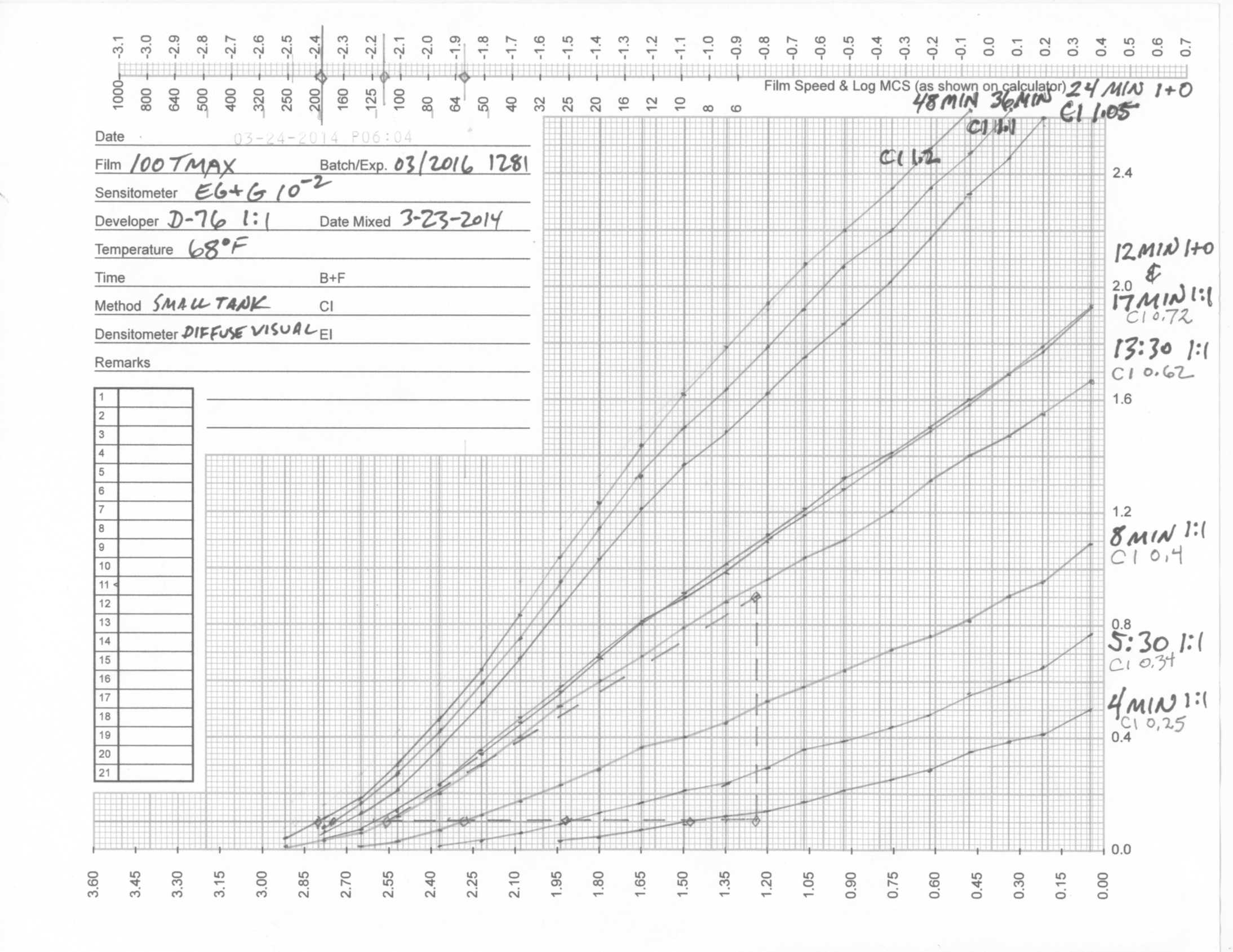
I recently ran a characteristic curve family for 35mm 100TMAX.

I had experienced relatively thin negatives of redwood tree scenes last year, which I attributed to not having performed these tests before I took those pictures. Since the graphs prove that I get full 100 film speed in these tests at 13 minutes and 30 seconds. I think my problem last year was that I didn't know the development times and I underdeveloped the film.

Note that my personal development time in small tank is longer than manufacturer's specification. If I had followed the directions, I would have ended up with a real speed of 64.

tmxfamily.jpg


p.s. I work for Kodak but my duties are not related to film. Photography is a hobby and the opinions and positions I take are my own and not necessarily those of EKC.
 
Photrio.com contains affiliate links to products. We may receive a commission for purchases made through these links.
To read our full affiliate disclosure statement please click Here.

PHOTRIO PARTNERS EQUALLY FUNDING OUR COMMUNITY:


Ilford ADOX Freestyle Photographic Stearman Press Weldon Color Lab Blue Moon Camera & Machine
Top Bottom