
• Welcome to Photrio!
    Registration is fast and free. Join today to unlock search, see fewer ads, and access all forum features.
    Click here to sign up

lack of high speed 35mm b&w films

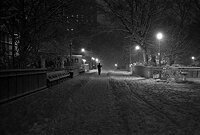
Tompkins Square Park

A
Tompkins Square Park

  • 8
  • 0
  • 81
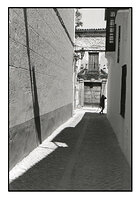
Siesta Time

A
Siesta Time

  • 2
  • 1
  • 63

Recent Classifieds

Forum statistics

Threads
202,860
Messages
2,846,710
Members
101,574
Latest member
JRSCollection
Recent bookmarks
0
The grain is similar in 35mm, 120 and sheet film for the same emulsion, you're confusing the degree of enlargement needed to make the same sized prints. The print from my HP5 LF negative pushed to 3200 was a section from a 30x24 enlargement equivalent to roughly a 10x8 print from 35mm.

Ian

Ahh I see the point you're making, thank you for the clarification. I don't usually crop my 6x6 shots and tend to make prints on 11x14 paper for both 35mm and 120, which is why I'm more interested in talking about 35mm. Grain size at the magnification necessary to enlarge a 6x6 negative isn't an issue, whereas it becomes a factor, again just in my experience, for 35mm.
 
Stone, this is 6x6?

you should also be asking if they are film scans or scans from prints
the way an image is made and viewed makes a difference ...
and if memory serves correct much of what he posts / has posted are film scans.
 
Last edited:
I guess the grain is more prominent in scans, so would be even more subtle in a print?
 
I guess the grain is more prominent in scans, so would be even more subtle in a print?
seems the other way around ...
scans can have a tighter quality to them ...
i took a painting class once where we had a mug shot
and we enlarged it on a xerox machine by 123% or something 15 times.
by the end it looked like a topographical map ( like grain)
chemical enlarged prints are the same thing you are stretching
the image when you enlarge it, with a scanner, it seems to duplicate
and interpolate the original image, so if the original image was a 3x5 light jet print or
enlarger print or a film scan, that is what it is replicating and interpolating.
maybe i am wrong in how i am describing it, or wrong altogether, but they seem like different things to me... ( YMMV )
 
Last edited:
seems the other way around ...
scans can have a tighter quality to them ...
i took a painting class once where we had a mug shot
and we enlarged it on a xerox machine by 123% or something 15 times.
by the end it looked like a topographical map ( like grain)
chemical enlarged prints are the same thing you are stretching
the image when you enlarge it, with a scanner, it seems to duplicate
and interpolate the original image, so if the original image was a 3x5 light jet print or
enlarger print or a film scan, that is what it is replicating and interpolating.
maybe i am wrong in how i am describing it, or wrong altogether, but they seem like different things to me... ( YMMV )
HiJohn
Scanning is not like wet printing where you have a contact, condenser or diffusion enlarger, there can be even more variations?
Like you have the wrong dust removal mechanism selected?
And grain is subjective to a degree.
I've had people like a shot of mine for the grain...(!)
 
I've used a lot of Delta 3200. I shoot at 1600, develop at suggested time for 3200. Rodinal will give you popcorn grain. Use DDX developer - they are meant to work together.

(there was a url link here which no longer exists)
 
I've used a lot of Delta 3200. I shoot at 1600, develop at suggested time for 3200. Rodinal will give you popcorn grain. Use DDX developer - they are meant to work together.

(there was a url link here which no longer exists)
I have no permission to view the page. Would you please upload some of the photos in this thread?

Thanks!
 
HiJohn
Scanning is not like wet printing where you have a contact, condenser or diffusion enlarger, there can be even more variations?
Like you have the wrong dust removal mechanism selected?
And grain is subjective to a degree.
I've had people like a shot of mine for the grain...(!)

I agree with you both on this. Scanners are fickle and it can be tough to defeat all of the automatic features.

One thing that is a real difference is that a scanner is a fundamentally linear device, that records tones from the negatives in linear fashion, while a silver gelatin paper has a curve just like the film does.
That will make a difference in how tones are represented, and how grain is displayed as a result of that difference.
I just thought I'd add that to the discussion, to try to illustrate a factual enormous difference between the two types of output.
 
I guess the grain is more prominent in scans, so would be even more subtle in a print?

I should clarify, these were sc***d on my Epsom V750 at 2400 DPI and sent off to be printed by a Lambda/LightJet for a B&W C-Print.

The image you are seeing is the film sc*n not a scan of the print. Although I do make B&W printed on silver gelatin, when this project / show was done, I was only doing C-Prints.

This image didn't sell by the way, should anyone want to purchase it :wink:
 
Kodak closed their R&D division some time ago. As far as Ilford, Fuji, Foma et al they have essentially done the same. There is no one left to invest capital in developing any new films. On the color side Ferrania is struggling to re-enter the color film business essentially using old technology. So the appearance of a new B&W film just ain't gonna happen.

Whether the film market continues to shrink or has become stable the reality is that total sales are not sufficient to warrant the expense of developing a new film.

We are! OK we do not moove foreward as fast as we wish but we are mooving. Today R&D is to a lesser extend oriented towards introducing new products but rather necessary R&D to replace lost components and keep everything working. Still this is R&D and sometimes this is even harder than introducing a new product was back 25 years ago when you could rely onto a full spectrum of components.

Mirko
 
Photrio.com contains affiliate links to products. We may receive a commission for purchases made through these links.
To read our full affiliate disclosure statement please click Here.

PHOTRIO PARTNERS EQUALLY FUNDING OUR COMMUNITY:


Ilford ADOX Freestyle Photographic Stearman Press Weldon Color Lab Blue Moon Camera & Machine
Top Bottom
