
• Welcome to Photrio!
    Registration is fast and free. Join today to unlock search, see fewer ads, and access all forum features.
    Click here to sign up

Kubrick's 50mm f/0.7

100 years ...

A
100 years ...

  • 0
  • 0
  • 19
Synchronized pool cleaners

A
Synchronized pool cleaners

  • 0
  • 0
  • 43

Recent Classifieds

Forum statistics

Threads
202,991
Messages
2,848,499
Members
101,586
Latest member
subicrn
Recent bookmarks
1

LJSLATER

Member
Allowing Ads
Joined
Jan 26, 2012
Messages
278
Location
Utah Valley
Format
35mm
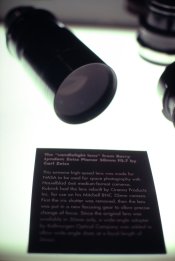
I thought some of you might get a kick out of this. Although many of us have heard of the fabled Barry Lindon Lens, I got to see it in person! The LACMA is having a Stanley Kubrick exhibit and I went specifically for the Zeiss 50mm f/0.7. I photographed it with my own high-speed lens, the Nikon 50mm f/1.2 wide open with an F2S and Fujichrome T64 pushed one stop. I should say I "tried" to photograph it; it was behind glass, no flash allowed of course, plus I skipped lunch in favor of a double old-fashioned at the museum's bar before seeing the show :whistling: So, the shot below is all you get.

The f/0.7 is surprisingly unremarkable in person. If I found it in a box somewhere, I probably would've assumed it was a projecting lens or something!

I plan to go back before the show ends. If I do, I'll think about biting the bullet and bringing a DSLR instead. But I probably won't :wink:
HKD_8581_stitch.jpg
 
He had 3 of these. Only 10 were built. Zeiss kept one and NASA had the others.

Nice!
 
That's a lot more impressive knowing that they originally were built to cover 6x6. Not that a 35mm coverage lens at that speed would be anything forgettable...
 
LACMA= Los Angeles County Museum of Art
 
I was just filming with my poor-man's version of that lens last weekend. This one is a Switar f/0.9. The dark disk is a series-size N.D. filter to allow wide-open shooting.
Switar13mm1.jpg
 
I must've!

Your illustration is much better than mine; I always forget about my iphone in my pocket.
 
wow, how was it possible to make such a lens for 6x6 when they don't even have anything smaller than one 2.8 for hassleblad/mamiya normally, is it just the expense or is it more difficult? I just find it strange, my Mamiya 7 would be so much better if there were a 1.8 option let alone a 0.70 option but it doesn't even have a 2.8, 4 is all you get.
 
wow, how was it possible to make such a lens for 6x6 when they don't even have anything smaller than one 2.8 for hassleblad/mamiya normally, is it just the expense or is it more difficult? I just find it strange, my Mamiya 7 would be so much better if there were a 1.8 option let alone a 0.70 option but it doesn't even have a 2.8, 4 is all you get.
Can you imagine the trouble required to get a M7 to focus something like that accurately? It just wouldn't work.
 
Fantasy aside, I wonder how it really PERFORMS at 0.7. Maybe Hasselblad was smart to limit theirs to 2.8. I once had a Canon .095 (for RF) and it was called the 'dream lens' for a good reason, just like an urban landlord will call a rundown apartment in a rundown building 'old world charm'.

Facts matter more than hype. Remember, it's the final picture that counts. - David Lyga
 
I think they erroneously claim it is originally for a Hasselblad. That lens is of a smaller diameter (seemingly at least) than the current Distagon 50/4, therefore physically impossible for it to be a faster f/stop.
 
Well, go look at the film Kubrick made with the lens: Barry Lyndon. It has a few obvious candle-lit scenes but there are some exterior shots in fading twilight that have some pretty impressive bokeh.
 
That lens has a back focus of 4mm. I don't know whether this would still work on a Hasselblad with focal plane shutter.
 
Well also, this was used for 35mm movie film, which isn't 24x35 because the image is made "vertical" on a spread out film strip rather than horizontally. So really it's an APS size area that needs to be hit, so that probably helps with the 0.70 right?


~Stone | Sent w/ iPhone using Tapatalk
 
I think they erroneously claim it is originally for a Hasselblad. That lens is of a smaller diameter (seemingly at least) than the current Distagon 50/4, therefore physically impossible for it to be a faster f/stop.

I'm also confused at it covering 6x6. 50mm on 6x6 is pretty wide. Maybe the sign meant to say "was based on", ie a 50mm 'normal' planar based on an 80mm 'normal' planar. But then it can't have been, it also says that the iris shutter was removed when kubrick converted it, if it was originally for hassy it would have had an iris shutter.
(ps, they've made hassy distagons at 50/2.8 and 40/4, not sure about 40/2.8. Zeiss have also just announced a Distagon 50/1.4 for Canikon, making it a retrofocus distagon apparently makes it better than a normal planar).

David Lyga said:
Maybe Hasselblad was smart to limit theirs to 2.8
I think i've read about Zeiss saying something to that effect. Can't find the original wording now, but it was something along the lines of, "yes, we can make faster, but we don't, we'd rather make high IQ"

AgX said:
That lens has a back focus of 4mm. I don't know whether this would still work on a Hasselblad with focal plane shutter.

It could work in the same way as the SWC, no mirror. If it was made for NASA it was probably made for either astronauts taking shots of earth from space, or taking night-shots of skies. Either way, it could have been built as an aerial camera, fixed hyperfocal so no need to focus.
 
Give me a 3.5 Elmar any day.
 
It could work in the same way as the SWC, no mirror. If it was made for NASA it was probably made for either astronauts taking shots of earth from space, or taking night-shots of skies. Either way, it could have been built as an aerial camera, fixed hyperfocal so no need to focus.

I did not refer to the mirror (maybe the mirror-lock up will not release automatically after exposure, I don't know), but to that 4mm to contain the distance from film to shutter and the shutter itself.
 
Well also, this was used for 35mm movie film, which isn't 24x35 because the image is made "vertical" on a spread out film strip rather than horizontally. So really it's an APS size area that needs to be hit, so that probably helps with the 0.70 right?

The depth of focus is only dependant on focal lenght and aperture, not on image size/format.

(I leave aside the issue of enlarging and circle of confusion.)


Furthermore Kubrick used the lens on a viewfinder camera. Focussing was most probably done done by means of tape.
 
I did not refer to the mirror (maybe the mirror-lock up will not release automatically after exposure, I don't know), but to that 4mm to contain the distance from film to shutter and the shutter itself.

Yeah, I didn't elaborate properly. What I meant was, the SWC has no mirror, so the 38 Biogon is fairly close to the film plane. How close, i don't know, but 2-20mm is probably the ballpark. The SWC has a leaf-shutter for taking the exposure, but I don't know if it has a rear focal-plane 'protection shutter' so the rear element isn't exposed when you change backs.
(afaik the regular hassy 500s have a focal-plane 'protection shutter', but that's more for protecting the film against light leaks when the leaf shutter is open for focussing. The SWC wouldn't have that problem so i don't know if they bothered putting them on).
Either way, 4mm sounds (to me) enough to at least get a 'protection shutter' in between the 50mm and the film, or you just have to be careful with exposed elements when you change backs. Otherwise it should work quite well in the same way as the SWC, no mirror, just a mount straight to a film back.
 
You are right, I used the wrong term. I guess the common term for such a shutter is "auxilliary shutter".
 
The depth of focus is only dependant on focal lenght and aperture, not on image size/format.

(I leave aside the issue of enlarging and circle of confusion.)


Furthermore Kubrick used the lens on a viewfinder camera. Focussing was most probably done done by means of tape.

Oh! So not movie size....

Also when I mentioned the size format, I was thinking of the comment someone made about the physical size of the glass, and I was saying of it were closer to an APS size area, the glass wouldn't have to be as big to pull off f/0.70 that's all.


~Stone | Sent w/ iPhone using Tapatalk
 
Oh! So not movie size....

Also when I mentioned the size format, I was thinking of the comment someone made about the physical size of the glass, and I was saying of it were closer to an APS size area, the glass wouldn't have to be as big to pull off f/0.70 that's all.


~Stone | Sent w/ iPhone using Tapatalk

Yes, movie size.

But not necessarily a TTL viewing and focusing movie camera.

IMDb says: Arriflex 35 BL
Mitchell BNC Cameras
Zeiss High Speed Lenses
 
I'm also confused at it covering 6x6. 50mm on 6x6 is pretty wide. Maybe the sign meant to say "was based on", ie a 50mm 'normal' planar based on an 80mm 'normal' planar.

I would think that, being as the lens was made exclusively for NASA, the specs would be a bit different than for open market stuff. NASA might well have been fine with vignetting as long as it was a fast enough lens for whatever the target mission was.
 
Photrio.com contains affiliate links to products. We may receive a commission for purchases made through these links.
To read our full affiliate disclosure statement please click Here.

PHOTRIO PARTNERS EQUALLY FUNDING OUR COMMUNITY:


Ilford ADOX Freestyle Photographic Stearman Press Weldon Color Lab Blue Moon Camera & Machine
Top Bottom
