

According to this section the 4 stops come straight from ISO6:1993, which is the current standard for B&W negative film. Between the point which defines film speed (labeled 'm') and the point labeled 'n' for average exposure there are four stops of exposure (∆ log H = 1.3). The standard says nothing about what happens left of point 'm', and that's where HP5+ and TMAX 400 seem to differ. AFAIK most exposure meters use this standard, and not some zone system "standard". Your personal shooting style may of course require a very different EI from box speed.Be careful, Rudi. There is no loop hole. Also note the 4-step requirement is part of the Zone System construct. It is not the ISO standard.
-
Welcome to Photrio!Registration is fast and free. Join today to unlock search, see fewer ads, and access all forum features.Click here to sign up
You are using an out of date browser. It may not display this or other websites correctly.
You should upgrade or use an alternative browser.
You should upgrade or use an alternative browser.
Kodak T-Max 400 Speed
-
A
- Thread starter Nathan King
- Start date

Recent Classifieds
-
For Sale Contax 46mm UV Filter, Cased, Boxed, Like New
- Started by davela
-
For Sale Beautiful Contax G2 Leather Case
- Started by davela
-
For Sale FUJI GX680III with 125mm f5.6 Fujinon and IIIN 120 back + spare 120 spool
- Started by Simon Benton
-
Sold Saunders VT-1400 11x14 Easel
- Started by Roger Thoms
-
For Sale Canon F1n with Power Winder, 50/1.4 S.S.C, and some extras [EU]
- Started by Laurent
Forum statistics
- removed account8
- Deleted
It doesn't have to be middle gray or anything. If you dial in EI 400 and use what your exposure meter tells you, you should end up with four stops of shadow detail with more than D=0.1 in your neg.Perhaps I misinterpreted what you were saying. I thought you were talking about locating the speed point 4 stops below metered (ie Zone System EI test). The point n in the ISO standard is not average exposure/middle grey.
When I look at Tri-X test strips contact printed through a Stouffer wedge, I see discernible gray well below the D=0.1 threshold, and think one could gain another stop or more of film speed by putting this part of the toe region to use (assuming one can accomplish this). You may not want to put your main subject into that region, but for barely discernible shadow detail it may work. We may laugh at folks recommending "shoot HP5+ at EI 3200, then stand develop in Rodinal", but they may know something we have ignored all along. I still don't think they get ISO speed 3200 with this procedure BTW.While it is possible the differences between the two films could be in the shape of the curve to the left of the speed point, I have a hard time believing that explains what OP is seeing. The curves would have to be very different at those exposure levels. I haven't found that to be the case.

I'm glad you say that. Stand development can enhance shadow detail without blocking the lights. So you can enhance the usable film speed, no matter what schoolbooks say.We may laugh at folks recommending "shoot HP5+ at EI 3200, then stand develop in Rodinal", but they may know something we have ignored all along. I still don't think they get ISO speed 3200 with this procedure BTW.
- removed account8
- Deleted

- Joined
- Feb 9, 2010
- Messages
- 9,549
- Format
- 4x5 Format
I'm still not following. Where do you get 4 stops from?.
Well we cleared up the 1.3 in ASA was NOT a meter calibration point. 1.3 is 4 1/3 stop anyway.
If I remember correctly the meter calibration point is 1.0 above the speed point.
Maybe 4 stops Rudeofus is thinking comes from Zone counting: V, IV, III, II, I.
But flare would raise exposure of any point metered as Zone I (4 stops below Zone V) about a stop... to Zone II.
So it's unlikely that a careful spot metered reading placed on Zone I would end up empty on the negative.
This could also be what Nathan King was seeing: Winding up with a thin negative could come from having a bright light source and using an averaging metering technique (like camera on automatic).
- removed account8
- Deleted

B&W films have different sensitivity to different colors of light. Developing longer won't really help the shadows. That requires exposure.
"I have a spot meter, but don't use it for 35mm" Nathan - are you saying then, in the example you are telling us about, you are using instead of the spot meter, the in camera meter? a subject you have photographed before that was properly exposed, exposing the T-Max400 the same way you did HP5? some other way.? How do you know for certain it is the problem is the film? If you don't have something to compare it against, it would be hard to validate it's the film.
"I have a spot meter, but don't use it for 35mm" Nathan - are you saying then, in the example you are telling us about, you are using instead of the spot meter, the in camera meter? a subject you have photographed before that was properly exposed, exposing the T-Max400 the same way you did HP5? some other way.? How do you know for certain it is the problem is the film? If you don't have something to compare it against, it would be hard to validate it's the film.
- Joined
- Feb 9, 2010
- Messages
- 9,549
- Format
- 4x5 Format
And actually as far as I remember the 1.3 was referred to as a highlight value, although admittedly I never ended up understanding why 1.3 log H should be the length of the base of the triangle.
I don't think of it as a highlight value, but relatively speaking it's towards the highlights.
It makes the base of the triangle long enough to give a meaningful measure of the straight-line portion... without risking catching part of the shoulder.
But the real magic of the choice of 1.3 (and making the side of the triangle 0.8) is how it makes two competing speed measurement proposals agree. The results are the same whether you measure speed by 0.3 Gradient or 0.1 Density... when your film is developed to fit that "ASA Triangle".
- Joined
- Feb 9, 2010
- Messages
- 9,549
- Format
- 4x5 Format
Developing longer won't really help the shadows.
You are right, once you get below a threshold exposure nothing will help.
But if you underdeveloped... Then developing longer will bring up the speed to where it should be. Soon as we establish the same degree of development for two different films, we can compare their speeds. It's not fair to say one film is slower than another, if you developed it to a lesser gradient than the other film.
If we can get to that point, and then Nathan King still feels more comfortable shooting a traditional grain film at 400 while shooting tabular grain at 250... Then I think we'll have an interesting discussion. Because it's entirely possible that the look of traditional grain film exposed with pictorially important shadows on the toe... is more pleasing than the look of tabular grain film exposed the same. I don't know, it would be fun to find out.
I do know that once you get off the toe (2/3 stop is enough to do that)... You are on the straight line so after you reach the point of sufficient exposure, I would expect the only difference to be grain structure.
Since I prefer to expose my 400 TMAX at 250, I know that it's good to give this film slightly more exposure.
kreeger! If you are talking about interior - Tungsten light... you might be onto something. Nathan, were there hot incandescent bulbs in your shots? One important difference in the spectral response of 400 TMAX is a sharp cutoff in red sensitivity as you approach infrared. This allows me to develop with an infrared viewer for an extended time without risk to fogging. But it may put the film at a speed disadvantage when exposed by Tungsten light - which has a great deal of near infrared... So a film more sensitive to near infrared might perform as if it were faster.
Indepent magazine formal comparative testing of theTmax at introduction showed then to have a sharper toe than eg Tmax 400 v Tx.
And threw in one liner both harder than HP5+.
If this were still true today then it would mean silver printing would be more difficult but there was a pseudo speed advantage of cubic v tabular.
So the choice if you cannot stand HP5+ may be Tx or 5222 eg cause the effective speed of 5222 is higher than ISO and it is finer grained than Tx or HP5+.
Myself I like Foma400 for grain and HP5+ for latitude.
And threw in one liner both harder than HP5+.
If this were still true today then it would mean silver printing would be more difficult but there was a pseudo speed advantage of cubic v tabular.
So the choice if you cannot stand HP5+ may be Tx or 5222 eg cause the effective speed of 5222 is higher than ISO and it is finer grained than Tx or HP5+.
Myself I like Foma400 for grain and HP5+ for latitude.
I'm still not following. Where do you get 4 stops from?
Compare the formulas for determining film speed and standard output sensitivity (SOS) in the digital world. The first formula says that if a certain brightness Hm creates a density D=0.1 (assuming development to standard contrast), you have reached film sensitivity Sf = 0.8 / Hm. The second formula says that if you reach medium gray exposure with a certain brightness level HSOS, your SOS speed calculates as SSOS = 10/HSOS. If these two speed numbers are supposed to yield comparable numbers for comparable sensitivity, a medium gray exposure should be 10/0.8 times stronger than the exposure to reach D=0.1. The number 10/0.8 = 12.5 equals 3.64 stops.
But an ideal characteristic curves doesn't drop vertically to D=0.0 below this point 'm', it should continue more or less as a sloped line. How long would such a line extend to the left? We know its slope is 0.8/1.3, and we know it drops by another 0.1, so a simple calculation tells you that it crosses the D=0.0 line 0.1 * 1.3 / 0.8 = 0.16 log2(H) left of point 'm'. All together, and with a perfectly straight characteristic curve, this gives you 3.64 + 0.16 = 3.8 stops below 18% gray. A characteristic curve with a pronounced toe will be flatter near that point 'm', which means it will cross the D=0.0 line even further left, giving you yet more area with barely discernible shadow detail.
- Joined
- Feb 9, 2010
- Messages
- 9,549
- Format
- 4x5 Format
Rudeofus,
I don't think it's right to use the digital speed standards when discussing film speed standards.
I see your point about the film characteristic curve offering detail to the left of the 0.1 speed point. It's worth thinking about.
I don't think it's right to use the digital speed standards when discussing film speed standards.
I see your point about the film characteristic curve offering detail to the left of the 0.1 speed point. It's worth thinking about.
I don't think it's right to use the digital speed standards when discussing film speed standards.
I intentionally used the one digital standard that uses medium gray exposure as reference, because in this exposure area digital and analog should be fairly similar. I have so far not seen an exposure meter that asks you whether you measure exposure for digital or analog media ...
- removed account8
- Deleted
I intentionally used the one digital standard that uses medium gray exposure as reference, because in this exposure area digital and analog should be fairly similar. I have so far not seen an exposure meter that asks you whether you measure exposure for digital or analog media ...
I've never got the speech synthesizer on my Weston II to work.
- Joined
- Feb 9, 2010
- Messages
- 9,549
- Format
- 4x5 Format
I intentionally used the one digital standard.
I can't relate to that, sorry. Says something about 18%, but film is more like 12% and I don't want to get into that right now...
If you'll accept 4 stops as discussion without relating digital and film standards, I can discuss 4 stops because I am familiar with a system that really uses 4 stops...
It's easy to grasp whole numbers and it's close enough. Zone System used 4 whole stops so I'll enjoy discussing what happens 4 stops below Zone V...
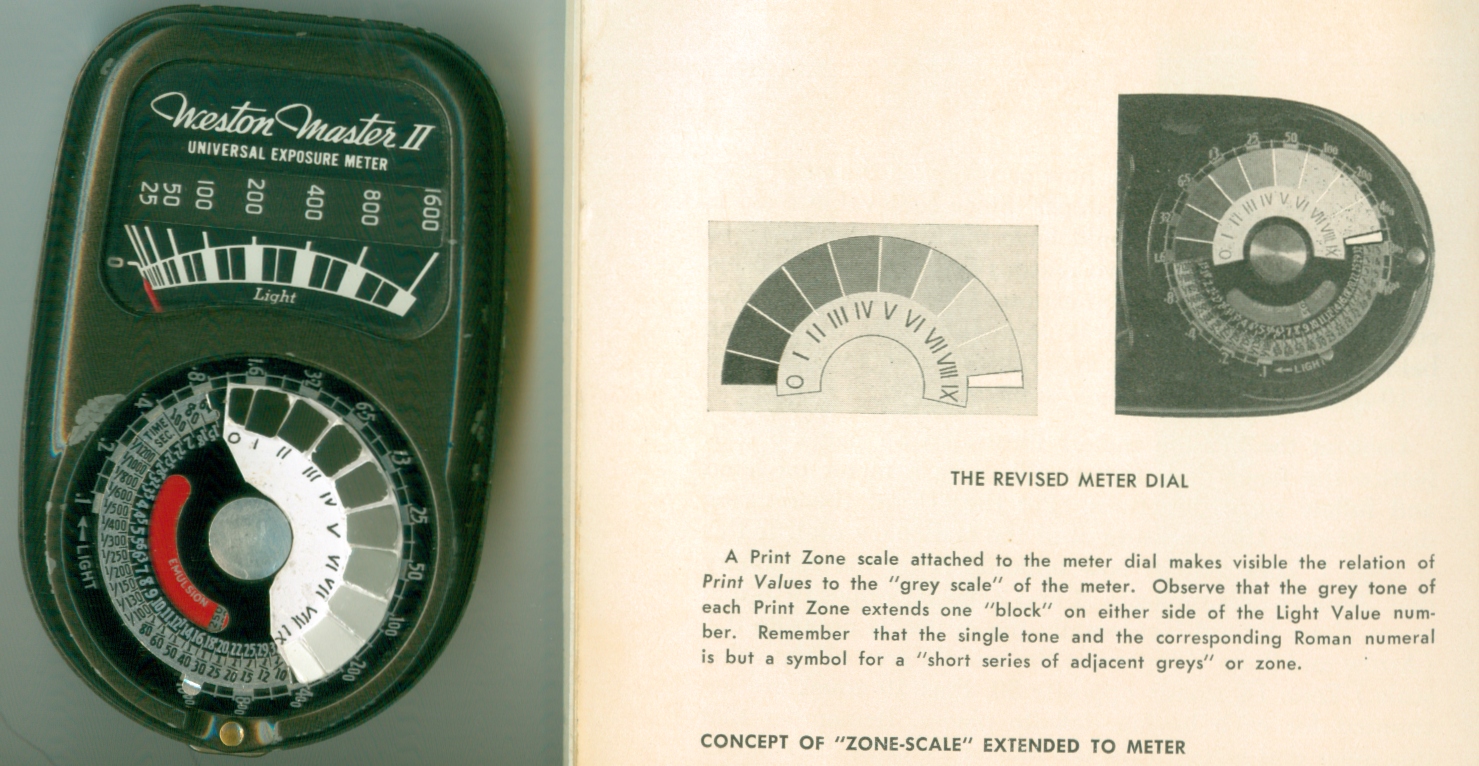
Today I was out with my Master II meter. You can see the meter calibration point (Zone V) and the speed point (Zone I) are 4 stops apart.
You can also see that Zone 0, Zone I and Zone II are barely distinguishable. There's not that much detail there.
When I visualize a scene using this meter, I explore different objects and see what the needle points to.
If I can envision a successful print having tones on that chip for something I'm pointing the meter at... Then I know the exposure is correct for the scene. Palm of my hand metered 25 today... in a shaded glen on an overcast day, camera pointed towards the direction of the sun. I placed that on Zone VI. The bark of a Eucalyptus Tree today, shaded side of the tree metered 6.5 and fell on Zone IV.
Emulsion Speed at 160 (for this specific meter it equates to EI 250 - models in Europe have scales that are different by 1/3 stop) for my preferred speed for Tri-X... Meter indicated the combination 1/80th second at f/5.6, I gave 1/3 stop more exposure: 1/60 at f/5.6
Would the flare not 'preflash' the shadow detail, ie be different from base fog?I always find it interesting to plot "complete" curves (to the best of my ability) and there is of course useable density below the speed point. The issue on that part of the curve is low contrast (ie detail), which can be virtually obliterated by flare. Still, the "first best print" studies and related speed methods showed the toe is in use. Even if you do a typical Zone System-style EI test, 0.1 netD isn't on the straight line.
OP
OP

B&W films have different sensitivity to different colors of light. Developing longer won't really help the shadows. That requires exposure.
"I have a spot meter, but don't use it for 35mm" Nathan - are you saying then, in the example you are telling us about, you are using instead of the spot meter, the in camera meter? a subject you have photographed before that was properly exposed, exposing the T-Max400 the same way you did HP5? some other way.? How do you know for certain it is the problem is the film? If you don't have something to compare it against, it would be hard to validate it's the film.
I use the fat spot of a Leica M6 for 35mm. I make sure that at least the majority of the "spot" is pointed at an area of relatively lower reflectance within the image. This has always given me great exposure with HP5. While I have not photographed identical scenes with both films, I have photographed scenes with very similar dynamic ranges and metered them in a similar way. I use a spot meter religiously with 6x7 medium format but don't for 35mm since the entire point of the small format is speed.
- removed account8
- Deleted
Hi MichaelYes it is like a pre-flash. Flashing raises threshold speed but reduces contrast.
thanks

Right. And actually as far as I remember the 1.3 was referred to as a highlight value, although admittedly I never ended up understanding why 1.3 log H should be the length of the base of the triangle.
Michael, from Simple Methods for Approximating the Fractional Gradient Speeds of Photographic Materials, "An interval of 1.30 was chosen in order that D2 would be approximately equal to the highlight denisty in the first-excellent negative of an average scene. The difference, D2 - D1 is called ΔD, is an approximate measure of the average gradient of the portion of the curve used to obtain a first-excellent negative. Consequently, it was recognized that ΔD might be a reliable means of predicting the logarithmic difference, ΔX,, between the speed at a density of 0.1 above fog and the fractional gradient speed. When ΔD is large, ΔX is small; when ΔD is small, ΔX is large."
- removed account8
- Deleted
Hi Stephen, good to hear from you.
I remember 1.3 was chosen so D2 would approximate a highlight density. What I never understood is why it wasn't a higher exposure and density. I can only assume it is because as Bill said they wanted to make sure it was on the straight line and films of the day shouldered sooner (perhaps paper curves were somewhat different as well, and I've never seen the details behind the first best print experiments). I'm sidetracking the thread though.
Real quick, it probably has to do with the shorter LER due to a higher flare factor; 1.50/1.60 LER compared to 1.80/1.90 LER today.
Last edited by a moderator:
- Joined
- Feb 9, 2010
- Messages
- 9,549
- Format
- 4x5 Format
Thanks Stephen,
So highlight density it is... I was speaking from a seat of pants feeling, not a researched position.
If I understand what you are saying: A standard scene 7 2/3 stop reduced by 1 1/3 stop today is 6 1/3 stop or 1.90...
Note: My Master II Zone Dial has 1 1/3 stop flare factored in, so what you see is what you get.
So highlight density it is... I was speaking from a seat of pants feeling, not a researched position.
If I understand what you are saying: A standard scene 7 2/3 stop reduced by 1 1/3 stop today is 6 1/3 stop or 1.90...
Note: My Master II Zone Dial has 1 1/3 stop flare factored in, so what you see is what you get.
If I understand what you are saying: A standard scene 7 2/3 stop reduced by 1 1/3 stop today is 6 1/3 stop or 1.90...
2.20 - 0.30 to 0.40 but yes.
Last edited by a moderator:

Increase the developing time.
no just live with the fact that it needs a bit more light and enjoy the tonality and the fine grain. I's a great film!thank you Kodak.Why on earth did you stop and let all that talent go?You'll never get it back. big pile of poo

no just live with the fact that it needs a bit more light and enjoy the tonality and the fine grain. I's a great film!thank you Kodak.Why on earth did you stop and let all that talent go?You'll never get it back. big pile of poo
If you like printing shadows try 250 ISO
| Photrio.com contains affiliate links to products. We may receive a commission for purchases made through these links. To read our full affiliate disclosure statement please click Here. |
PHOTRIO PARTNERS EQUALLY FUNDING OUR COMMUNITY:  |