• Welcome to Photrio!
    Registration is fast and free. Join today to unlock search, see fewer ads, and access all forum features.
    Click here to sign up

Kodak SO-370 Traffic Flow Film...???

Do Not Come Here

A
Do Not Come Here

  • 2
  • 1
  • 23
Heavy

H
Heavy

  • 9
  • 5
  • 94

Recent Classifieds

Forum statistics

Threads
201,921
Messages
2,832,056
Members
101,018
Latest member
andycapp
Recent bookmarks
1

Kirks518

Member
Allowing Ads
Joined
Oct 5, 2013
Messages
1,494
Location
Flori-DUH
Format
Multi Format
I was given 36 rolls of Kodak SO-370 B&W film, expired in 1978. I can only find one bit of info online about it (Here). I'm hoping there is a chance that PhotoEngineer (or someone else) may know something about this stuff.

Going under the assumption that nobody knows what the ASA is, how do I shoot tests to determine the ASA to shoot it at? And how should I try and develop it (HC-100)? Do I meter with a handheld (or in-camera) at say 100ASA, then shoot one at metered, then step down and then back up by one stop? Then develop in a 'generic' dilution (B or H), then for an average developing time? Because I don't know which exposure would be the correct one for the film (relating back to the unknown speed), would clip test of the leader compared to a properly exposed leader be the way to go?

From the link above, and embedded links in that, folks were pointing to ASA's anywhere from ASA 6 to ASA 4000, which is a huge range.

This may be fun! :confused:

Thanks!
 

trythis

Member
Allowing Ads
Joined
Sep 26, 2013
Messages
1,208
Location
St Louis
Format
35mm
I have only a little experience at this, but I tripod whatever camera, start at the lowest ISO I can, 6 or whatever, take a shot in Auto mode, move the ASA/ISO dial up a full stop and do that till the roll is finished..I like to put a number in the frame that represents the ISO shot to eliminate errors.

Developing, I take a strip of exposed film and dip 1/2" into developer and lower it every minute for 10 minutes, then rinse and fix. The depth that is as dark as it gets is my developing time.


I am sure there are better examples of how to do this and you will want to try different developers with anti fogging chemicals to perfect it.
 
OP
OP
Kirks518

Kirks518

Member
Allowing Ads
Joined
Oct 5, 2013
Messages
1,494
Location
Flori-DUH
Format
Multi Format
Peter, that's the link I linked to.

Now that I have a roll in front of me, this is what's on the box:

Kodak Traffic Flow Recording Film SO-370
Emul No 370 074
Cat 152 5138

Box itself is the typical Kodak Gold and Black. Cartridge is grey and just says the first line above.

Dunno if any of that helps.
 

removed account4

Subscriber
Allowing Ads
Joined
Jun 21, 2003
Messages
29,832
Format
Hybrid
typical rule pf thumb is cut the iso in half ( or add a stop of exposure ) for every 10 years stored.
so start your film test at iso 1000 ( if that ) and bracket. develop in whatever it is you like to develop
look at your results, and expose the rest ar the beat exposure.
it miht be pretty well cooked seeing it is high speed surveilance film but fun to play with
just the same. post your results in the expired film group ?
 
OP
OP
Kirks518

Kirks518

Member
Allowing Ads
Joined
Oct 5, 2013
Messages
1,494
Location
Flori-DUH
Format
Multi Format
I certainly will, but I didn't know there was an expired film group. Where would that be?
 

StoneNYC

Member
Allowing Ads
Joined
Aug 5, 2012
Messages
8,345
Location
Antarctica
Format
8x10 Format
Kirk, as others mentioned, just take one roll, shoot test frames from EI 1000 to EI 3 (sacrifice 10 frames).

What I have done in the past is take a white board and a marker, and put that into the shot, then at each frame I would write the exposure index I was shooting at on the whiteboard that way you know exactly what you shot in each frame and then you pick the best frame and you'll have your time.

Develop in HC-110(B) for 5 minutes since that's about average time for most films in that developer, it may also reduce fogging because many find that this developer helps reduce fog in older films.

Good luck!
 
OP
OP
Kirks518

Kirks518

Member
Allowing Ads
Joined
Oct 5, 2013
Messages
1,494
Location
Flori-DUH
Format
Multi Format
I've been looking around some more, and I'm wondering how similar this stuff would be to Kodak's Hawkeye Surveillance/Traffic film. The Hawkeye was B&W, and rated at 200ASA in HC-110, 400ASA in T-Max, and 250ASA in D76.

From my research, it seems that some traffic film was near IR, and others were very fine grain and extended sensitivity in reds or blues. Most are daylight films. I don't know how much of what I've found would relate to this film because of the 'generation gap', but it is interesting, and should be fun.
 

AgX

Member
Allowing Ads
Joined
Apr 5, 2007
Messages
29,972
Location
Germany
Format
Multi Format
The film in question is medium speed aerial film from the mid-60's.

No extended red or IR sensitivity.
 
Last edited by a moderator:

cmacd123

Subscriber
Allowing Ads
Joined
May 24, 2007
Messages
4,331
Location
Stittsville, Ontario
Format
35mm
Kodak uses the SO numbers for special runs of film. So basically unless you can find a data sheet, or someone who is familiar with the product, you are on your own. Might be for red light cameras, but not for sure.
 

AgX

Member
Allowing Ads
Joined
Apr 5, 2007
Messages
29,972
Location
Germany
Format
Multi Format
The film in question is a medium speed aerial film from the mid-60's.

No extended red or IR sensitivity.

NO it is not. I mixed up numbers...


If your film was indeed used for copying telephone meters it would have been used in a macro set-up with focus fixed at a plane-subject and employing integrated lighting. Thus a medium or slow speed film would be sufficient.

What puzzles me is that a SO-film was used for that. Maybe it is spectrally unsensitized for cost reasons, as such film would be sufficient for such kind of work.
 
Last edited by a moderator:
OP
OP
Kirks518

Kirks518

Member
Allowing Ads
Joined
Oct 5, 2013
Messages
1,494
Location
Flori-DUH
Format
Multi Format
NO it is not. I mixed up numbers...


If your film was indeed used for copying telephone meters it would have been used in a macro set-up with focus fixed at a plane-subject and employing integrated lighting. Thus a medium or slow speed film would be sufficient.

What puzzles me is that a SO-film was used for that. Maybe it is spectrally unsensitized for cost reasons, as such film would be sufficient for such kind of work.


I had major doubts about your first post, but was biting my tongue. :tongue:

I'm going to run an ASA test probably this weekend, if I can figure out how to do one. For some reason I can't wrap my head around how to dd a test to determine ASA. Do I just do this as trythis says in post #2?

I have only a little experience at this, but I tripod whatever camera, start at the lowest ISO I can, 6 or whatever, take a shot in Auto mode, move the ASA/ISO dial up a full stop and do that till the roll is finished..I like to put a number in the frame that represents the ISO shot to eliminate errors.

I would think that in auto mode, the camera will compensate for the change in ASA, and the results would all be the same. But then I think that because only one of the chosen ASA's will be the correct one, only that one will be exposed correctly. Is that the way it works?
 

trythis

Member
Allowing Ads
Joined
Sep 26, 2013
Messages
1,208
Location
St Louis
Format
35mm
I would think that in auto mode, the camera will compensate for the change in ASA, and the results would all be the same. But then I think that because only one of the chosen ASA's will be the correct one, only that one will be exposed correctly. Is that the way it works?

No, the camera adjusts the shutter speed in Aperture priority mode to handle ASA change, exactly like setting the exposure compensation dial up or down. Think of putting a roll of 200 ASA in and setting your camera to 6400 or (an A-1 can do this) ASA 12400. The camera will not expose the film as 200, it will change the auto settings or partial auto setting to match the film speed. This can be done manually by selecting an F stop and shifting the shutter speed up one full stop each shot as well. My way of doing it is lazy and its not a good way of you swap cameras with different meters half way through a roll or with using different roll tests. Stick with one camera. I use a Canon Eos 630 for this because it can exposure compensate ASA 6 down 5 full stops to to .1875 ASA if needed.

I like to use alphabet blocks with numbers or refrigerator magnet numbers for ASA info in the frame because they are 3D and shadows make them easier to read with difficult films.

This is best done with very consistent lighting, doing this outside can cause problems with clouds, or other light adjusting issues like the sun moving behind a tree , angle of the sun, etc.
 
OP
OP
Kirks518

Kirks518

Member
Allowing Ads
Joined
Oct 5, 2013
Messages
1,494
Location
Flori-DUH
Format
Multi Format
Gotcha, thanks. have no idea why I couldn't wrap my head around it.

I have an EOS 630 (also a few 620's & 650's), so I'll be using one of those then. I was wondering what body I had that would go down to 6 ASA, and you answered my unasked question. :smile:
 
OP
OP
Kirks518

Kirks518

Member
Allowing Ads
Joined
Oct 5, 2013
Messages
1,494
Location
Flori-DUH
Format
Multi Format
RESULTS

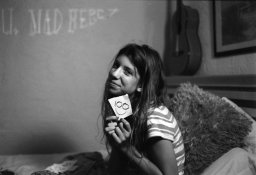
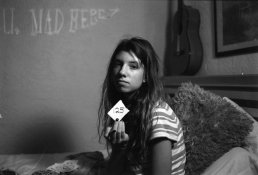
So last night I ran my test. I chose a 'scene' rather than a gray card, thinking that a scene would give me a better idea of the range, and how it would perform in the future.

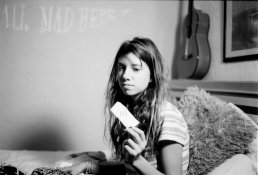
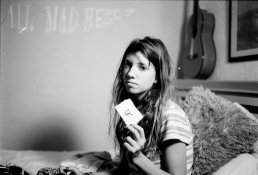
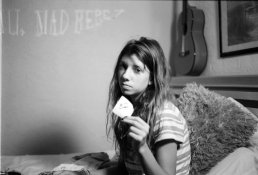
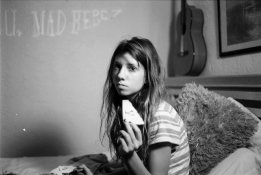
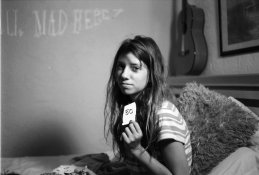
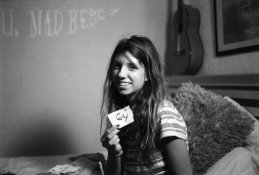
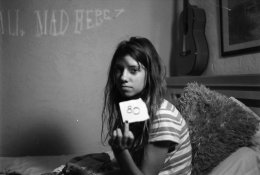
I did what trythis suggested, and used one of my Canon EOS 630's with a Canon EF 50mm 1.8, and started at ASA 6. I had my daughter hold up the number of the ASA in each respective photo. The ASA's used were; 6, 8, 10, 12, 16, 20, 25, 32, 40, 50, 64, 80, 100, 125, 160, 200, 250, 320, 400, etc., up to the max of 6400.

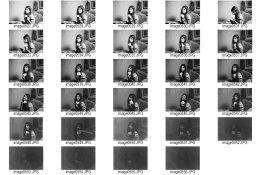
To figure out developing time, I also went with trythis's suggestion of 1/2" sections at a time in the developer. My chosen developer was Kodak HC-110 Dilution H (1:63). I used a single roll size stainless tank, and gerry rigged a film holder from clothespins to keep the film off the sides and bottom. I used the leader section, as it was (unusually) long (about 5"), and did it in the light. I decided I would go for as long as 14 minutes, with a stirring of the developer every minute, along with the lowering of the film into the developer. I looked at all Kodak film development times listed on the Mass Dev Chart, and decided that I wouldn't start the dip until the 5th minute. So I had developed gradations at 14 thru 5 minutes (first section in for 14 minutes, last section for 5 minutes). I compared the final leader to the leader of a properly developed roll, and initially decided on 12 minutes, but then went to 12:30 after some thinking during the developing stage.

I let the film dry overnight, and finally had a chance to scan them. I made a contact sheet in PS, which is below, as well as what I feel were the best. A link to the library of all the images is near the bottom.

If anyone was wondering, there is nothing on the rebate other than frame number and 'Kodak Safety Film'.

Can you guys/gals look at the images, and tell me which ASA you think gives the best results?

ContactSheet-001.jpgimage0527.JPGimage0528.JPGimage0529.JPGimage0530.JPGimage0531.JPGimage0533.JPGimage0534.JPGimage0535.JPGimage0536.JPGimage0537.JPGimage0538.JPGimage0539.JPGimage0540.JPGimage0541.JPG


And this is a link to all the images (except for the last 2 or 3 that were just black)

Thanks for looking, and for all the guidance you guys gave me with this. And a big shout out to trythis!
 

mike c

Subscriber
Joined
Jan 5, 2009
Messages
2,863
Location
Los Angeles
Format
Multi Format
Asa 40 to 62 looks close to me are you using flash on the camera or other?

Mike
 

cmacd123

Subscriber
Allowing Ads
Joined
May 24, 2007
Messages
4,331
Location
Stittsville, Ontario
Format
35mm
Amazing how youth lose the spirit of experimentation so quickly and fall back to their Phones.
 

trythis

Member
Allowing Ads
Joined
Sep 26, 2013
Messages
1,208
Location
St Louis
Format
35mm
Awesome series, glad that I was able to share what I have learned here for some successful experiments. To my tastes 125 is a bit dark, but depending on the goal of the photograph could look nice with some dramatic lighting. Iit has some pretty useful range.
 

StoneNYC

Member
Allowing Ads
Joined
Aug 5, 2012
Messages
8,345
Location
Antarctica
Format
8x10 Format
I like 64, maybe it's the hearts and smiles that's throwing me off though lol.

This is normal teenager BTW love it!
 

MattKing

Moderator
Moderator
Joined
Apr 24, 2005
Messages
55,260
Location
Delta, BC Canada
Format
Medium Format
Your test for film "speed" is a test for acceptable detail in the shadows.

So choose the one that gives you detail in the shadow area that you are happy with.
 
OP
OP
Kirks518

Kirks518

Member
Allowing Ads
Joined
Oct 5, 2013
Messages
1,494
Location
Flori-DUH
Format
Multi Format
I like the results from 64 to 100, and sort of like the 125. It's deciding on one that I'm having trouble with. I think I'm not film savvy enough to decide on which would be considered the best.

A generic developing question; If I were to reduce my developing times, would that give me better results in the higher ASA range (200 and up)? Or would it not matter?
 
Photrio.com contains affiliate links to products. We may receive a commission for purchases made through these links.
To read our full affiliate disclosure statement please click Here.

PHOTRIO PARTNERS EQUALLY FUNDING OUR COMMUNITY:


Ilford ADOX Freestyle Photographic Stearman Press Weldon Color Lab Blue Moon Camera & Machine
Top Bottom