• Welcome to Photrio!
    Registration is fast and free. Join today to unlock search, see fewer ads, and access all forum features.
    Click here to sign up

Kodak Series OA Safelight Filter

Lost

H
Lost

  • 0
  • 0
  • 21
Joints

H
Joints

  • 0
  • 0
  • 15

Forum statistics

Threads
203,529
Messages
2,856,065
Members
101,887
Latest member
alfie74
Recent bookmarks
0

gone

Member
Allowing Ads
Joined
Jun 14, 2009
Messages
5,502
Location
gone
Format
Medium Format
I bought a small Kodak Brownie safelight like this one

http://www.vintagephoto.tv/brownielamp.shtml

It has a Kodak series OA filter in it (the large flat one). Will this work for VC and fiber B&W printing in the darkroom, or do I need the more traditional amber or red filter?
 
Quick answer is no. You need OC for most modern VC paper. OA is only safe with old emulsion contact papers and a very few graded papers. You are better off with a red filter(med-dark red). This is especially true if you plan to use orthochromatic materials and x-ray films. Some of my papers require red safe light. I use a dark red filter with 15w bulb no closer than one meter from my developing tray.
 
I bought a small Kodak Brownie safelight like this one

http://www.vintagephoto.tv/brownielamp.shtml

It has a Kodak series OA filter in it (the large flat one). Will this work for VC and fiber B&W printing in the darkroom, or do I need the more traditional amber or red filter?

The OA filter is not usable with the usual materials we use in the darkroom.

You need an OC or red filter.

And given the age of that safelight (could be close to 100 years old) I would check the wiring carefully.
 
I thought as much. Thanks Rick. I'll see if I can find an inexpensive red or OC filter for it. That's what happens when you buy bargain stuff sometimes. The other stuff I need for it usually costs more than the whole thing if I had bought one w/ the right filter to begin with.
 
Mine doesn't look as old as the one in the link Matt, thank goodness. There's no wiring to speak of, just a bulb that screws into the housing. It's a small safelight, which is good as it is going in a bathroom. I'll go over to the classifieds and do a WTB for a filter. I'm sure I can cut down a larger one to fit.
 
Those are the same kinds of safe lights I use in my darkroom.

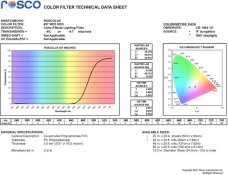
I use the original glass filter that comes with it, plus two layers of red gel. (Rosco #26) Just sandwich the sheets in there and trim to size.
I use a 25 watt equivalent, white LED bulb instead of a 15 watt incandescent. The LED doesn't generate as much heat.

With two layers of gelatin and the original glass, you'll get enough light from the brighter lamp. Just remember to keep the lights far enough away from the work area that you won't affect your papers and stuff.
 
I've got two of those spiral fluorescent "party bulbs" in red. They've replaced my "legit" safelights. Yes, I've tested them for fogging. And yes, I check them for chips in the red coating. My darkroom is amazingly bright with them. I have them in those metal clip-light reflectors and point them at the ceiling.

A year after I started using Foma 123, I read the instruction sheet when it fell out of the package - says "no red safelights". But I've had zero trouble with that paper or any other.

It's very cool to do lith printing and not really need the red torch!
 
A sheet of Rubylith will fix just about any safelight that's causing problems with VC paper. It can be bought at graphic supplies places, but I'm not sure if the modern digital systems are making it less available.
 
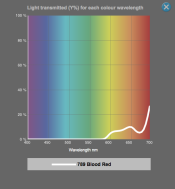
I've been testing some of the Lee lighting gels - Blood red seems to be a pretty good candidate as a suitable "safe light" filter.... Need to get a full sheet when time allows and do a full on test.
 

Attachments

  • Rosco27.jpg
    Rosco27.jpg
    47.4 KB · Views: 202
  • Lee789.png
    Lee789.png
    40 KB · Views: 198
If contact printing on slow chloride papers (AZO, Lodima, Fomalux, Lupex) is your thing, OA filters are the way to go. I'm happily using Lupex and Fomalux with direct 15 watt and indirect 25 watt safelights, each 5 ft from the work area, each with OA filters. The two papers don't fog with 32 minutes of exposure testing. But I find other benefits: First, the OAs' greenish-yellow registers details very brightly and acutely (think of the construction workers safety vests used these days). More bang for your lumens; I'm even thinking of reducing the Model B to 15 watts to save fading the filter. Second, 5.5-inch OC filters are not easy to come by now and are expensive when found, but OAs are readily and cheaply found on eBay - perfect for me. I recently bought three un-opened Kodak OAs for 10 bucks apiece. Obviously OAs are inappropriate for VC or bromide papers.
 
If contact printing on slow chloride papers (AZO, Lodima, Fomalux, Lupex) is your thing, OA filters are the way to go. I'm happily using Lupex and Fomalux with direct 15 watt and indirect 25 watt safelights, each 5 ft from the work area, each with OA filters. The two papers don't fog with 32 minutes of exposure testing. But I find other benefits: First, the OAs' greenish-yellow registers details very brightly and acutely (think of the construction workers safety vests used these days). More bang for your lumens; I'm even thinking of reducing the Model B to 15 watts to save fading the filter. Second, 5.5-inch OC filters are not easy to come by now and are expensive when found, but OAs are readily and cheaply found on eBay - perfect for me. I recently bought three un-opened Kodak OAs for 10 bucks apiece. Obviously OAs are inappropriate for VC or bromide papers.

.


Welcome to APUG Photrio!!
 
Photrio.com contains affiliate links to products. We may receive a commission for purchases made through these links.
To read our full affiliate disclosure statement please click Here.

PHOTRIO PARTNERS EQUALLY FUNDING OUR COMMUNITY:


Ilford ADOX Freestyle Photographic Stearman Press Weldon Color Lab Blue Moon Camera & Machine
Top Bottom