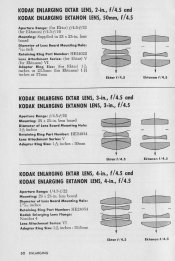
Steve - Interesting that you've come to a conclusion that the 100mm Enlarging Ektar is a triplet. From the literature on the website above, Kodak's own published information I've read, and a couple more websites (links below), the indication is that the 100mm Ektars were 4-element Dialytes and the lower market Ektanon lenses were 3-element Triplets.
https://www.photrio.com/forum/threa...or-5-how-do-they-compare-to-6-element.121867/
https://www.photocornucopia.com/1061.html
Having said that - don't believe everything you read or see on the internet...
I've never taken my 100mm Ektar apart to tell you if mine is different inside (i.e. whether yours has a missing element or not) or if the front 2 elements are cemented/stuck together and look like one element. So I'm no closer to clearing up that mystery.
In the Photrio link above, there's plenty of discussion about what's a good lens, how many elements it should have, and whether the Kodak Ektars meet the grade or not. I do a lot of 4x6 and 8x10 B&W prints off of 135/120 negatives and most often use my 100mm, f/4.5 Ektar and I switch to my 50mm, f/4.5 Ektar for 8x10s. I'm completely satisfied with the results. I tested my 50mm Leitz Focotar (probably about a 1958 version) and my Kodak 50mm Ektar head-to-head and the results were essentially identical. Both lenses appeared to have minute pluses over the other lens but my test prints lacked any rigorous scientific method and I therefore won't rank the lenses. Since there was no obvious difference, I kept using my Ektars. I'm certain there are other exhaustive tests that clearly demonstrate more modern lenses with improved optical technology will rate higher (as one would expect). However, as someone has pointed out before, Kodak was at/near the top of the photography heap when these lenses were designed and made. It stands to reason that they perform well against contemporary lenses.
My darkroom workflow, timing, technique, and almost exclusively 1940s equipment produces consistent results such that I don't find myself in need of a high-end lens of the most modern optical design. I don't do large format negatives, large enlargements (i.e. above 8x10), color printing; nor do I print for galleries, art collectors, or paying customers. Those factors may write off using an Ektar regularly or at all for many printers. I enjoy my Ektars and I enjoy my darkroom experience. Having perused many galleries and photographic prints for sale, I think my results competitively hold their own despite my seemingly obsolete choice of equipment.
In short, some folks like their Ektars and others think they're inferior. If you successfully clean yours up, I'd give it a go and see what you think.