• Welcome to Photrio!
    Registration is fast and free. Join today to unlock search, see fewer ads, and access all forum features.
    Click here to sign up

Kodak Projection Ektar 100mm f/4.5

Recent Classifieds

Forum statistics

Threads
201,769
Messages
2,829,848
Members
100,936
Latest member
rdbirt
Recent bookmarks
0

Steve Goldstein

Subscriber
Joined
Jul 8, 2007
Messages
1,815
Location
Northeastern US
Format
Multi Format
I recently came across one of these manufactured in 1946 and believe it's the same as the later 100mm f/4.5 Enlarging Ektar. The rear cell unscrews and appears to be fully cemented. So far I haven't figured out how to remove the front cell for internal cleaning. Does anyone have any disassembly info, or a cross-section drawing showing the lens elements?
 

Robbie Bedell

Subscriber
Allowing Ads
Joined
May 14, 2011
Messages
171
Format
35mm
Steve, The front of my my 100mm enlarging Ektar opens by unscewing the nameplate with a rubber stopper. I have found they unscrew quite easily. Sometimes the front element is reluctant to come out but tapping it over a soft surface has worked, so when the element comes out it has a safe landing. I am not sure about the process Ektar but the projection Ektar is a Tessar lens. I believe the 100 enlarging Ektar is a Heliar.
 

removedacct1

Member
Allowing Ads
Joined
Nov 12, 2014
Messages
1,875
Location
97333
Format
Large Format
I recently came across one of these manufactured in 1946 and believe it's the same as the later 100mm f/4.5 Enlarging Ektar. The rear cell unscrews and appears to be fully cemented. So far I haven't figured out how to remove the front cell for internal cleaning. Does anyone have any disassembly info, or a cross-section drawing showing the lens elements?

Check and see if there are any grub screws holding the front cell assembly locked down. Many lenses have set screws that lock the parts once screwed together.
 

C-130 Nav

Member
Allowing Ads
Joined
Nov 9, 2020
Messages
46
Location
Wichita, Kansas, USA
Format
35mm
Steve, I have a number of these lenses and they are my primary lenses for enlarging. They are well made and still perform well. Younger designs might perform better depending on your setup and usage. You are correct that both the back elements and the front elements unscrew from the body exposing the aperture. I found this our when one of my 50mm apertures stuck (one of the pins broke off inside) and disassembled it. Mine did not have any set screws but I can't say they all did or did not (the lens I disassembled was a 1944 version).

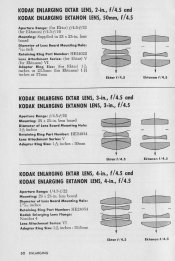
From what I've read, the 50mm and 75mm lenses were 5-element Heliars and the 100mm was a 4-element "Dialyte". A good compilation of the Kodak data regarding these lenses can be found at this website:

http://www.bnphoto.org/bnphoto/KodakEktarsDB6-Enlg.htm#

I've attached one photo of the lens cutaway from this website which is a scan of Kodak literature. There are other excerpts of Kodak data sheets on this website that can provide more data.
EnlgEktar-2-4.jpg

Hope this helps.
Dan
 
OP
OP

Steve Goldstein

Subscriber
Joined
Jul 8, 2007
Messages
1,815
Location
Northeastern US
Format
Multi Format
Thanks to you all. The rubber stopper did the trick to remove the front cell from the barrel. Unfortunately, the lens construction differs from that of an Enlarging Ektar - the front cell is cemented and what I thought might be dirt in the front cell is more likely balsam failure. I'll give it a bit more study to see if I can figure out how to remove the glass from the barrel for possible repair. From poking around on the web site linked by C-130 Nav I suspect this lens may be a triplet.

The good news is that it was cheap so I'm not heart- or wallet-broken.
 

C-130 Nav

Member
Allowing Ads
Joined
Nov 9, 2020
Messages
46
Location
Wichita, Kansas, USA
Format
35mm
Steve - Interesting that you've come to a conclusion that the 100mm Enlarging Ektar is a triplet. From the literature on the website above, Kodak's own published information I've read, and a couple more websites (links below), the indication is that the 100mm Ektars were 4-element Dialytes and the lower market Ektanon lenses were 3-element Triplets.

https://www.photrio.com/forum/threa...or-5-how-do-they-compare-to-6-element.121867/
https://www.photocornucopia.com/1061.html

Having said that - don't believe everything you read or see on the internet...

I've never taken my 100mm Ektar apart to tell you if mine is different inside (i.e. whether yours has a missing element or not) or if the front 2 elements are cemented/stuck together and look like one element. So I'm no closer to clearing up that mystery.

In the Photrio link above, there's plenty of discussion about what's a good lens, how many elements it should have, and whether the Kodak Ektars meet the grade or not. I do a lot of 4x6 and 8x10 B&W prints off of 135/120 negatives and most often use my 100mm, f/4.5 Ektar and I switch to my 50mm, f/4.5 Ektar for 8x10s. I'm completely satisfied with the results. I tested my 50mm Leitz Focotar (probably about a 1958 version) and my Kodak 50mm Ektar head-to-head and the results were essentially identical. Both lenses appeared to have minute pluses over the other lens but my test prints lacked any rigorous scientific method and I therefore won't rank the lenses. Since there was no obvious difference, I kept using my Ektars. I'm certain there are other exhaustive tests that clearly demonstrate more modern lenses with improved optical technology will rate higher (as one would expect). However, as someone has pointed out before, Kodak was at/near the top of the photography heap when these lenses were designed and made. It stands to reason that they perform well against contemporary lenses.

My darkroom workflow, timing, technique, and almost exclusively 1940s equipment produces consistent results such that I don't find myself in need of a high-end lens of the most modern optical design. I don't do large format negatives, large enlargements (i.e. above 8x10), color printing; nor do I print for galleries, art collectors, or paying customers. Those factors may write off using an Ektar regularly or at all for many printers. I enjoy my Ektars and I enjoy my darkroom experience. Having perused many galleries and photographic prints for sale, I think my results competitively hold their own despite my seemingly obsolete choice of equipment.

In short, some folks like their Ektars and others think they're inferior. If you successfully clean yours up, I'd give it a go and see what you think.

 

gone

Member
Allowing Ads
Joined
Jun 14, 2009
Messages
5,504
Location
gone
Format
Medium Format
Whether this was marketing copy or lens specifications I don't know, but it was always said that Kodak reserved the name Ektar for it's better/best lenses. In my experience, I had a Kodak Retina w/ a 50mm Ektar that was razor sharp, and a 203mm Ektar that made 4x5 transparencies you couldn't tell from my friend's 300mm Nikkor, other than from the obvious difference in focal lengths.
 

MarkS

Member
Allowing Ads
Joined
Mar 12, 2004
Messages
543
momus is correct about Kodak's use of the Ektar trade name- many different optical formulas carry it, but all represent EK's top quality lenses. When I worked for Kodak we had a few Enlarging Ektars around (and a few oddball Kodak lenses too). Our department had many enlargers, most carried Schneider and EL-Nikkor lenses. The old-timers told (newbie) me that the Kodak lenses were quite sharp but the modern lenses had more contrast. Quite plausible, although I never ran any tests.
 
Photrio.com contains affiliate links to products. We may receive a commission for purchases made through these links.
To read our full affiliate disclosure statement please click Here.

PHOTRIO PARTNERS EQUALLY FUNDING OUR COMMUNITY:


Ilford ADOX Freestyle Photographic Stearman Press Weldon Color Lab Blue Moon Camera & Machine
Top Bottom