• Welcome to Photrio!
    Registration is fast and free. Join today to unlock search, see fewer ads, and access all forum features.
    Click here to sign up

Kodak Process film, what is this film?

High Street

A
High Street

  • 5
  • 1
  • 64

Recent Classifieds

Forum statistics

Threads
201,874
Messages
2,831,555
Members
100,994
Latest member
SheWoDun
Recent bookmarks
0

marbrog

Member
Allowing Ads
Joined
May 23, 2006
Messages
41
Location
Sweden
Format
Large Format
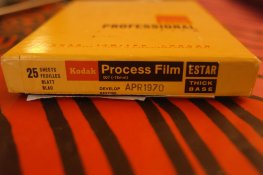
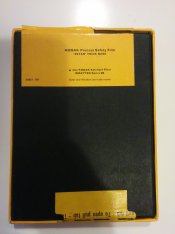
Hello, I got a hold of a box of film that I can't find any information on. It is marked only as 'Process film', and says to use a wratten filter 0B. It is also marked '4181'. I have been completely unsuccessful in trying to find anything, I guess it is ortho and B&W as it can use a safelight. Could it be a lith film?

_SAM1513.jpg
 

Ian Grant

Subscriber
Allowing Ads
Joined
Aug 2, 2004
Messages
23,409
Location
West Midland
Format
Multi Format
Process films were used in the Graphics and Printing industries, my list of safelight filters doesn't have an 0B listed but OA is greenish yellow too bright for modern papers except Contact papers but used for Graphics materials, and an OC is Amber/Brown recommend for VC papers etc. So it can probably be used with a normal darkroom safelight.

It's not lith film.

Ian
 

Mick Fagan

Subscriber
Allowing Ads
Joined
Sep 13, 2005
Messages
4,434
Location
Melbourne Au
Format
Multi Format
Interesting.

With regard to the letters "OB" I just went to my darkroom as this jolted something in my tiny brain. I have a glass plate Kodak OB safelight filter, looking though it, it looks a sort of dark green to very dark yellow. But as I'm viewing it under 60W tungsten lights in my darkroom and it's night time here, I have no other way to view the filter. To be honest I cannot remember just what this filter was used for, but it's a start.

So that is the safelight to work under, this is not a normal lithographic film as most of them I've ever used always had red safelight filters, with varying intensity of red. All Kodak film by the way and starting from around 1974 when I first worked in that environment (graphic arts that is).

Is there any more information on the other side of the box? Often there were codes on the sealing end wrapper, of which we can see one side in your picture.

Mick.
 

vpwphoto

Member
Allowing Ads
Joined
Feb 21, 2011
Messages
1,202
Location
Indiana
Format
Multi Format
LONG ago I developed such process/litho film in Dektol and got continuous tone. Not ideal, experiment with exposure / dilution of dektol and you might be able to have some fun.
The ISO is likely below 25. ... a place to start.

+1 on the RED.
 
OP
OP
marbrog

marbrog

Member
Allowing Ads
Joined
May 23, 2006
Messages
41
Location
Sweden
Format
Large Format
Thanks for the replies. I will try it out at EI 12 and paper developer.

I'm coming back from a long hiatus from photography, except for polaroids, it will still be a while until I can set up a darkroom.

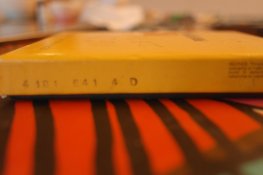
I took some pictures of the bottom and side where there are some codes printed.

_SAM1514.jpg
2015-02-20 13.46.36.jpg
 

Ian Grant

Subscriber
Allowing Ads
Joined
Aug 2, 2004
Messages
23,409
Location
West Midland
Format
Multi Format
looking in a Kodak reference book Process films were used for copying (often maps and drawings) they tend to be quite high contrast compared to regular films. Kodak made Ortho & Panchromatic Process films, the one in question is Ortho. Process films were designed for camera use so they are faster than line films it would have had a speed of around 32-50 EI in daylight half that in Tungsten light. (It won't have been slower than earlier versions). The recommended developers for older Kodak Process Ortho were D-153 or D-154 for High contrast and D-151 for continuous tone (in a Kodak Ltd, UK, catalogue 1940) or D-8 or D-11 (in a US Kodak Reference Handbook). A red filter was recommended.

I have a Wratten OA safelight filter and that's a greenish yellow, the OA & OB were recommended for Kodak Bromide and Bromesko papers, OO was for Velox and other contact papers also a fogging filter for contrast reduction ! (according to Kodak). the )/ There's a progression from OO, OA, OB,OC from Yellow to light amber (brown). Ilford recommend an OC with Multigrade papers.

Red is going to be safer.

Ian

 
Last edited by a moderator:

Chris Livsey

Member
Allowing Ads
Joined
Aug 10, 2008
Messages
635
Format
Medium Format
http://archive.org/stream/KodakDataBookVolume12/KodakDataBookVolume12_djvu.txt


'Kodak' Process 4181 / ('Estar' Thick Base)— Data Sheet FM-33 \ DPC (1+9) D-163 (1+3)
When using apochromatic objectives for highest resolving power, a blue-sensitive material such as the 'Kodak' B.10 Plate (Data Sheet PL-2) or 'Kodak' Process Sheet Film (Data Sheet FM-33) should be used.
The most suitable material to use for photography in the 350-400 nm region is a high-contrast material, such as Process Sheet Film ('Estar' Thick Base)
 

Chris Faust

Member
Allowing Ads
Joined
May 17, 2006
Messages
4
Location
St.Paul ,MN
Format
Medium Format
I used the 35mm version to make copy slides for lectures back in the day. To make it continuous tone you'll have to pre-flash the film. It will still be contrasty but you'll have an orthochromatic cont. tone film. . In the case of 4x5 stick it under an enlarger cranked up all the way and stop the lens down all the way (f22) emulsion up of course . Put the timer on 2sec and start there. After the exposure to white light you'll insert it back in the holder and make a daytime exposure. The ISO actually will increase to about 50. Test, test and test some more but this will be your basic recipe. The acutance and grain will be fine and very sharp. Use dektol 1:1. I always used a red #1A
 
Photrio.com contains affiliate links to products. We may receive a commission for purchases made through these links.
To read our full affiliate disclosure statement please click Here.

PHOTRIO PARTNERS EQUALLY FUNDING OUR COMMUNITY:


Ilford ADOX Freestyle Photographic Stearman Press Weldon Color Lab Blue Moon Camera & Machine
Top Bottom