• Welcome to Photrio!
    Registration is fast and free. Join today to unlock search, see fewer ads, and access all forum features.
    Click here to sign up

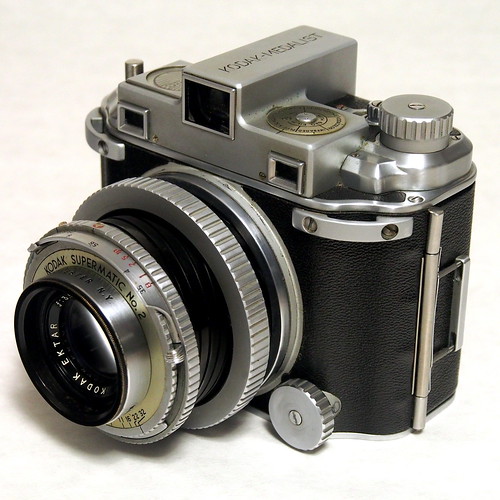
Kodak Medalist II

Manners street Lads

A
Manners street Lads

  • 0
  • 0
  • 16
Arkansas Ent

A
Arkansas Ent

  • 3
  • 2
  • 49

Recent Classifieds

Forum statistics

Threads
203,048
Messages
2,849,124
Members
101,622
Latest member
jh_caps
Recent bookmarks
1
The US Navy bought a lot of Medalists during the Second World War. The instruction book for the camera is illustrated with pictures of a man wearing an enlisted man's dress blues.
 
Having owned a Medalist 1 , I can say that the least of your concerns should be the lens ( assuming similar shape ). Peter
 
I wasn't aware there was a preferred lens for this model. Do you have more information on that?

Because cameras were intended for use in the corrosive sea water environment the later versions were supplied with this more resistant protection for focusing. The Medalist II was an attempt to sell to the consumer market, which explains the addition of flash as well as discontinuing the anodized finish on lens. Any version of the Medalist, if not damaged, and whether coated or not ( use lens shade), or anodized or not is a great camera.
My advice, download and print the manual. You must be aware of certain quirks that could send a Medalist n for repairs. After all,”there is a sensible way and the military way”.
Also, I have found the case absolutely indispensable: 1) while rugged, it is a heavy chunk to accidentally bump into something and 2) the camera fits better and steadier in the hand.
 
All this talk about this camera made me buy one. It's version 2 and shot my first roll on Sunday and here's a picture scanned. I'm not sure if I used ICE or not. There is also a problem with the film winder cocking the shutter. I get the click but it won't trip the shutter when I take the picture. I had to manually cock the shutter each time. Anyone here make that adjustment on theirs?
 

Attachments

  • img058.jpg
    img058.jpg
    249.5 KB · Views: 280
My 1946 Medalist II was OK in that advancing the film would cock the shutter. A 70 year old camera may have developed some quirks that will need to be seen to. I've had mine serviced by Michael Zacks just because of its age. He did a good job, but he isn't cheap. zackscamerarepair.com A Medalist is a reasonable way to get a 6x9 negative.
 
Can anyone here tell me if the Ednalite 6B hood will vignette on the Medalist II?
 
I have a Medalist and two Medalist II cameras. They're awesome. I LIKE they use 620 film. Hand respooling is no problem for me. If they were 120 film cameras, they'd be much more in demand and prices would be much higher.

I wish the primary viewfinder window was a bit bigger, but I love that it's separate from the rangefinder window and I can see them both by moving my eye slightly without moving the camera. The viewfinder is just glass and the rangefinder is just prisms and glass. No semi-silvered mirror to degrade with age. After the glass and prism are cleaned properly, the viewfinder and rangefinder are as bright and clear as they were when new. The viewfinder has some magnification and a fairly wide base, so it's dead-on accurate for the 100mm lens.

I'm fairly certain the Medalist II focusing helicoil is anodized, just as the Medalist was. The only difference I can detect between the two is Kodak didn't dye the Medalist II helicoil black during the anodizing process. Anodizing aluminum produces a very hard surface and the Medalist II passes a simple scratch test. (I'm not going to gouge it with a sharp knife, but the pointed tip of my multimeter doesn't scratch it like it does regular aluminum plate.) The better test is conductance. Anodizing produces a non-conductive surface and my Medalist II helicoils are non-conductive. I prefer the look of the black anodizing, but you're not giving up durability there with a Medalist II.

The lens coatings available when the Medalists were produced were very soft and unsuited for external surfaces. I think the internal glass/air surfaces were coated with the softer coating, but not the external front or rear lens surfaces. By the time the Medalist IIs were produced, Kodak had the more durable lens coating available and those lenses were "Luminized" and marked with the circled "L" on the front. Otherwise, the lenses are the same.

Both models are easy to load... once you know how. They require a specific sequence of steps. It's pretty intuitive once you've done it a couple of times. They're not fragile cameras as long as you don't get a ham-fisted, "I know cameras" attitude without reading the manual once through.

 
Mine won't fire the shutter after film advance so I have to manually cock it. Not sure it's worth having it fixed. Anyone else have that problem?
 
Occasionally, mine doesn't cock and has to be done manually.
Shutter has been sticking at slower speeds lately so it's time to have the camera serviced.
 
In the 60s while still in high school I worked part time for a retired Navy photo mate who had a small studio in LA. He shot weddings with 2 Medalists, he had used Medalist while in the Navy, the lens is excellent for the day. He shot color with one and B&W in the other. When I was in college he got a Mamyia press with a wide angle lens, still thought the Medalist was sharper then the 90mm on the Mamyia. Getting one is on my list, maybe someday.
Very interesting! I recently got a Medalist from a man down here in Southern California- manual that came with the camera (and camera bag) was signed by a Buck Wallace who lived in LA around 1945! Does this man happen to be the person you're referring to? Long shot I know, but thought I better ask just in case! :smile:
 
I almost acquired one of these a couple of decades ago, along with an impressive collection of accessories, but in the end I did not. The lens is great; the body chunky and heavy, but okay for its format size. I(n the end, I was unwilling to re-roll 120 film onto 620 spools in order to use the thing. I had used Ken Ruth for another job and discussed 120 modification with him. Although he was one of the few reliable people to do the modification, the cost and his general remarks were enough to put me off that job. I've always considered the Medalist to be a pinnacle of Kodak's company policy of manipulating film sales by tying some of its cameras to selling its odd-ball film formats.
 
Really great cameras. Actually, they are my favorite cameras of All time. Two nights ago I just put a new covering on my 1944 Medalist I and it looks pretty peachy. I also recovered my Medalist II with one of those black super-grip coverings and that was the best thing I could have ever done. It made the camera much easier to hold and use. Some folks would chastise me for doing that, but I use these cameras and I could care less about collectibility. I never plan on selling them anyway. Like those crazy 2nd Amendment nuts say, “They’ll have to pry them out of my cold dead hands”. I have a couple of different repair manuals and can completely strip them down and put them back together. They are a little tricky, but once you get the hang of it it’s pretty straight forward. I won’t even mention a word about the lens.
 
Vern Ruby, he had a shop on C street and Avalon, A, B and C streets were cleared for containers in the 80s? I had lost contact with him, learned that he retired to Reno of all places.
 
Photrio.com contains affiliate links to products. We may receive a commission for purchases made through these links.
To read our full affiliate disclosure statement please click Here.

PHOTRIO PARTNERS EQUALLY FUNDING OUR COMMUNITY:


Ilford ADOX Freestyle Photographic Stearman Press Weldon Color Lab Blue Moon Camera & Machine
Top Bottom