
John (and Brad):
I would point out that historically there were many, many different film formats, and that almost all of them have been discontinued, and George Eastman was around for many of those discontinuations.
I have no doubt that if Eastman Kodak could produce/put together trouble-free 120 film with all the old numbers, and make it available to Kodak Alaris for sale at a price that would make sense in the market, you would see it in a heartbeat.
The ULF special run by Ilford is a wonderful thing, but it is simply an excellent use of Harman's very flexible infrastructure. With the exception of, ironically, the backing paper they make available in quantity at that time only, Harman produces everything that they sell as part of that program. Relatively speaking, Harman's production machinery is tiny compared to Eastman Kodak's. The advantage of that is flexibility - thus the ULF program - but if Harman needs to produce anything in high volume, their per unit costs are huge compared to Eastman Kodak's. Eastman Kodak will do exactly the same thing for you (prepare film in your desired large size), except that the size of their machinery means that they have minimum order quantities that would be ridiculous for all but high volume commercial users.
The other irony is that that backing paper that Ilford makes available during the ULF run probably does not include numbers.
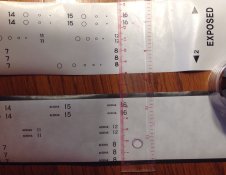
It wasn't too many years ago that Simon Galley reached out to us here on APUG to ask about a change that circumstances had forced upon Harman. Traditionally, the backing papers for Ilford 120 roll films were custom printed for each film - the paper for FP4+ was printed with FP4+ on it, the paper for HP5+ was printed with HP5+ on it, etc., etc. Unfortunately, the sources for backing paper were reduced to a single source, and the minimum order requirements from that source were such that if Harman continued to order backing paper that way, they would be forced to either greatly reduce the variety of 120 film, or order several years supply (for at least some of the films) at any one time - which they couldn't afford to do.
As a result, all Ilford 120 backing paper is now "generic", in that the only references to the film it is attached to are at the beginning and end, and they are added later.
Fortunately, any wrapper offset adjustments that Ilford had been required to make to their films to adjust to the materials produced by their backing paper supplier had already been made at that time, so the current backing paper and ink works for them.
I bring this up, because it illustrates how the economies of scale and new volume realities force decisions that in the past would never have happened. None of the remaining manufacturers of film have anything like the resources they once had to respond to problems, or offer new alternatives to customers. Where once they had the ability to make changes, and the volume to pay for those changes, they are now squeezed between financial and market realities.
I expect that the machinery that Eastman Kodak used to have to make their own backing paper was scrapped, after the volumes required sunk so much as to make it uneconomic to use, and because outside of the production of backing paper for photographic film, it had no commercial use. That is something to give you a bad taste, but it is simply reality.
One final irony: if Eastman Kodak hadn't had so much backing paper on hand, they probably would have encountered the wrapper offset problem with the outsourced product earlier, when they would have had greater resources available and a much greater ability to adjust the films to deal with it. Those resources aren't there now.