• Welcome to Photrio!
    Registration is fast and free. Join today to unlock search, see fewer ads, and access all forum features.
    Click here to sign up

Kodak 125 Plus X Best B&W Film All Time

Recent Classifieds

Forum statistics

Threads
201,943
Messages
2,832,442
Members
101,028
Latest member
Aruz446
Recent bookmarks
1

Athiril

Subscriber
Allowing Ads
Joined
Feb 6, 2009
Messages
3,062
Location
Tokyo
Format
Medium Format
None of the 100-125 ISO B&W films I've used over the years has "given up" or "surrenedered" the shadow detail, that's down to how we as photographers control our film's tonality by exposure and development. That includes FP4, Tmax and Delta 100, AP/APX100 and more recently Fomapan 100, lus a few rolls of Acros.

It's a case of learning how different films respond and making necessary adjustments to achieve the resul;ts you#re after. only the Foma films in my experience need significantly different development times.

Ian.

Right.

I'd like to suggest to anyone wanting such gradation to try Delta 400 for landscape, urban and architecture type images, etc. Expose as 100. Develop in Xtol Replenished at 24 celsius for 6.5 minutes, very gentle two inversions per minute after initial agitation. Looks like a different film entirely, not simply a contraction.

The extended red sensitivity of Delta 400 (with the other pan films apart from Delta 3200 do not have) also helps.
 
Last edited by a moderator:

Athiril

Subscriber
Allowing Ads
Joined
Feb 6, 2009
Messages
3,062
Location
Tokyo
Format
Medium Format
There is no "best". It all depends on what you are doing and what look you want. Plus X Pan was
appropriately marketed mainly as a studio portrait film. It had a very long sweeping toe designed to
give subtle midtones and highlight gradation. If you had a soft lighting ratio you would get gradation
in the shadows too. But with strong lighting you'd have to resort to compensating dev to dig deep,
and that would likely spoil the delicacy of the uppers. Not a very good film for direct sunlight conditions with deep shadows. The closest thing today in curve shape is Delta 100. FP4 has a much longer straight line, as does ACROS, though neither are true straight line films.

Looks like an S-curve to me, much more of an S-curve, with more toe than Plus-X.
http://www.ilfordphoto.com/Webfiles/2010712125850702.pdf
 
Joined
Jan 21, 2003
Messages
15,715
Location
Switzerland
Format
Multi Format
Underneath her dense, black shirt she is wearing a V neck T-Shirt. Somehow the very subtle tonal change due to underlying T-Shirt came through in print (not visible in this scan). Also note how well blacks of pants vs shirt vs deep dark red on bed cover are rendered.

Are all of those things really important for your photograph? Either way, FP4+ is a very capable film, and if you learn how to use its qualities to the fullest, you will be able to get damned near anything from that film.
 

cliveh

Subscriber
Allowing Ads
Joined
Oct 9, 2010
Messages
7,805
Format
35mm RF
With all due respect, people like Cartier Bresson, Gibson and Erwitt have made fine careers without being as technically oriented. Are their pictures no good because the film curve wasn't perfect?

Thank you Thomas, my point entirely.
 

Roger Cole

Member
Allowing Ads
Joined
Jan 20, 2011
Messages
6,069
Location
Atlanta GA
Format
Multi Format
My experience with FP4 would be that it would handle this just fine too. You might need different exposure, enough to push the shirt up off the toe and then print accordingly, but you could certainly do it and not blow out the highlights.

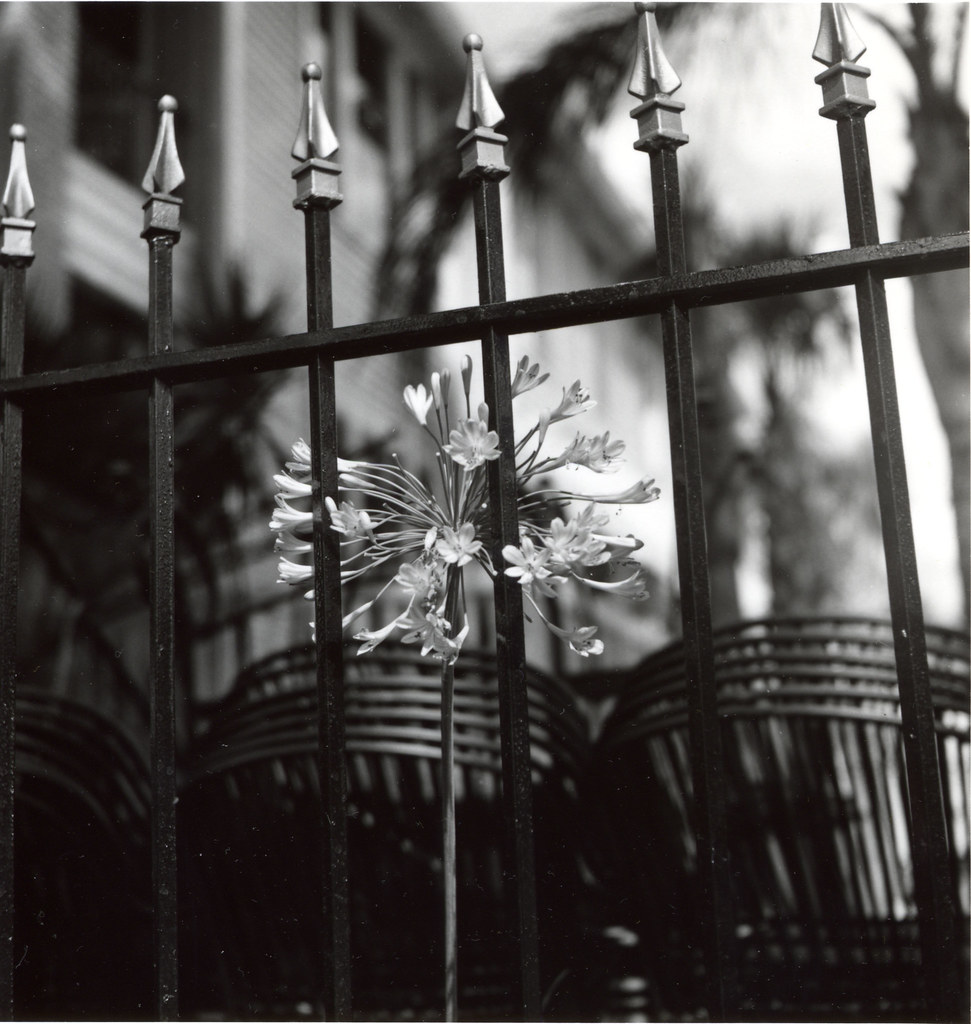
Here's a shot on 120 FP4+. Apologies for the dusty scan. Honestly, I had dried the MGIV WTFB on blotters, even though Ilford said it could stick. It stuck. I rewashed it and thought I had most of that stuff off, and it didn't show up on my too-dark monitor I had when I scanned this. I've since gotten a much better monitor and cleaned up the print. I need to re-scan it, but that will break the links I've posted to it in several places. In any event, I think it separates the dark fence posts from the other shadows quite well and really digs does fine on the dark values. Nothing special here and I didn't particularly take that into account. I'm not sure now what the exposure was. I tend to meter the dark areas then place on Zone IV, which is about a stop more than "normal practice" and would push most shadows off the toe, but it's just how I normally work. Box speed with that practice, developed in D76 1+1.


Fence And Flower - NewOrleans by Roger Cole, on Flickr
 

Bob Carnie

Subscriber
Allowing Ads
Joined
Apr 18, 2004
Messages
7,735
Location
toronto
Format
Med. Format RF
When I started Silver Shack I did a film test with Agfa Headquarters Canada, Kodak Canada and Ilford Canada supplying me film and chemistry. 1992 era
The goal was to shoot the different subject scenes on each film and develop in all the major devs, including pyro.
Paper was supplied and I made 11 x 14 inch prints of all the different variations.. The goal was to show all the differences of film type and developers.

I hired a photographer who was decent and did this test, and then made prints. As you may well consider I am talking about a lot of negs.
Before I got to the printing side of things I invited the PPOntario group of photographers to my lab and their visit was
to be the launching point of my tests and I was going to show them all the differences...


To my horror,, as I printed I started to come to the conclusion that the differences at this size was not as great as one would think.
I spent three hours trying to convince a room of pros the differences and I am sure a lot walked away with a poor impression of me maybe
thinking I was a MASTER bullshit artist.

This thread reminds me of Magic Bullet SEEKING and as Thomas stated earlier in the thread , it would be impossible to tell the difference between his plus X print and Fp4 print.
 

wblynch

Member
Allowing Ads
Joined
Feb 9, 2009
Messages
1,697
Location
Mission Viejo
Format
127 Format
You guys are comparing prints, not films. One must assume a printer has his vision and methods worked out, printing to the same paper and development techniques. By that time you have left the negative far behind.

Not to say the posted examples are not beautiful.

In the end we lovers of Plus-X are out of luck.

It's like losing your best girlfriend and dating her sister. It just won't be the same.

 

Roger Cole

Member
Allowing Ads
Joined
Jan 20, 2011
Messages
6,069
Location
Atlanta GA
Format
Multi Format
I liked Plus-X a lot too. But I don't hang negatives on my wall, or show them to my friends. Ultimately it doesn't make any difference how different the negatives are if I can produce a very similar print without heroics. And I generally can. I like FP4+ just fine.
 

Ian Grant

Subscriber
Allowing Ads
Joined
Aug 2, 2004
Messages
23,413
Location
West Midland
Format
Multi Format
You guys are comparing prints, not films. One must assume a printer has his vision and methods worked out, printing to the same paper and development techniques. By that time you have left the negative far behind.

Not to say the posted examples are not beautiful.

In the end we lovers of Plus-X are out of luck.

It's like losing your best girlfriend and dating her sister. It just won't be the same.
Yes swapping a tired old girlfriend for a new one, and better :D

In practice I find printing from different makes.types of film differs very little but I can compensate for slight differences very easily.

Ian
 

cliveh

Subscriber
Allowing Ads
Joined
Oct 9, 2010
Messages
7,805
Format
35mm RF
I think my preference is often influenced by the packaging colours. The PlusX box looked like it contained a colour film, but the FP4 box looked like it contained a black & white film that had been kept in cool conditions.
 
Joined
Jan 21, 2003
Messages
15,715
Location
Switzerland
Format
Multi Format
This is, in my opinion, thinking about it backwards.

The way I am able to make good prints is that it all begins with the paper and the paper developer. Once you have figured out what they are capable of, then (and only then) do you start creating negatives that suit the paper. I have no scientific method to do this other than trial and error, but that is the methodology I employ.
This raises the quality of the final output by a mile, and the negative is a really integral part of that work flow. But it has to suit the paper. The developed negative is, in my book, much more a function of how we expose the film and how we develop it, rather than the in-built qualities of the film itself.
Some people cried when Tri-X 320 disappeared in roll film. I figured out a way of replicating the tone curve of TXP using TMax 100, and came up with two prints that are virtually indistinguishable. Imagine that. It took a two stop under-exposure, and push processing in Xtol 1:1 to get there, but I did it.

What's the moral of this little story? The film itself is, in my opinion, not that big of a deal. There are differences, make no mistake about that, and if you develop the film according to the massive development chart on Digitaltruth.com then the differences will show up a lot more than if you really learn how to use the film and develop it to a certain contrast that fits the paper, and by then the differences are much smaller.
The ultimate truth: It matters a whole hell of a lot more what YOU DO than WHAT materials you use.

There is no 'best' film. They are all best and they are all worst. It depends on our skill and what we do with it what comes out the other end. Don't cry over spilled milk. Hunker down and do something about it instead. Work that Plus-X hard, and work that FP4+ hard, push their limits, exceed their limits, find out what happens. Learn something. Then go make negatives that fit your paper.

You guys are comparing prints, not films. One must assume a printer has his vision and methods worked out, printing to the same paper and development techniques. By that time you have left the negative far behind.

Not to say the posted examples are not beautiful.

In the end we lovers of Plus-X are out of luck.

It's like losing your best girlfriend and dating her sister. It just won't be the same.
 

cliveh

Subscriber
Allowing Ads
Joined
Oct 9, 2010
Messages
7,805
Format
35mm RF
The way I am able to make good prints is that it all begins with the paper and the paper developer. Once you have figured out what they are capable of, then (and only then) do you start creating negatives that suit the paper.

The ultimate truth: It matters a whole hell of a lot more what YOU DO than WHAT materials you use.

I would suggest your first statement above, while having some validity is out of context with chronological events. You can’t print before you have created the negative. However, I agree with the second statement completely.
 

Roger Cole

Member
Allowing Ads
Joined
Jan 20, 2011
Messages
6,069
Location
Atlanta GA
Format
Multi Format
I think he means your approach has to begin with the paper and developer you plan to use. You decide which you like, then find a film and developer and time/temperature/agitation/phase of the moon/whatever that produces negatives that are a good fit, even though you obviously have to expose and develop the negative before you make the print. This does make a lot of sense.
 

markbarendt

Member
Allowing Ads
Joined
May 18, 2008
Messages
9,422
Location
Beaverton, OR
Format
Multi Format
I would suggest your first statement above, while having some validity is out of context with chronological events. You can’t print before you have created the negative. However, I agree with the second statement completely.

Actually the idea of planning backwards from the result is normal. Ansel was a big champion of that too. I'm sure Ansel wasn't first either.
 
Joined
Jan 21, 2003
Messages
15,715
Location
Switzerland
Format
Multi Format
Actually the idea of planning backwards from the result is normal. Ansel was a big champion of that too. I'm sure Ansel wasn't first either.

That's precisely what I meant.

Basically, if you don't understand what your paper and paper developer does, developing negatives becomes like target shooting without a target.
 

cliveh

Subscriber
Allowing Ads
Joined
Oct 9, 2010
Messages
7,805
Format
35mm RF
That's precisely what I meant.

Basically, if you don't understand what your paper and paper developer does, developing negatives becomes like target shooting without a target.

But for me the target is in the field of view, there after it is merely a craft done at leisure.
 
Joined
Jan 21, 2003
Messages
15,715
Location
Switzerland
Format
Multi Format
But for me the target is in the field of view, there after it is merely a craft done at leisure.

And I'm talking about making the very best print that I possibly can. To make a print that is convincing, in my book, gets infinitely easier if the negative is targeted at a specific goal. Less waste in the darkroom too. It takes a lot of guesswork out of the printing stage.

I'm editing this post to attempt a clarification, but leaving what I wrote above. I understand what you mean about having a target, and that to you primarily it's about the moment of exposure. Nothing wrong with that at all, and I'm not harping on it. Do what you like, and satisfy yourself; hopefully that is why we're all doing this insanely expensive thing for a passion anyway.
But, think about this for a minute: Why did it take such a genius of a printer such as Sid Kaplan to print Cartier-Bresson's work? Why was someone of his (undeniable) razor sharp expertise to print those negatives? Because HCB was not interested in anything other than the moment of exposure, or capturing the moment.
I can't afford just shooting for days, roll upon roll, and then have someone go through all of the film, contact sheet them, and print the good ones. I have to do it all myself. But I also have (I think) extremely high standards when it comes to print quality. For me it's a combination of the frame, and how it's conveyed in the print. The combination of those two makes a really great print for me. So, what's my point? I can't afford wasting sheet after sheet in the darkroom to get the print perfect. There's no way. So I have found a way of making it easier for myself. By figuring out what the paper and paper developer is capable of, what its limitations are, and strengths as well, I can design the negative by exposing it a certain way, and subsequently processing it a certain way (varies with exposure and contrast in the scene) so that it fits those qualities of the paper. That's what I mean with 'target'. It has nothing to do with subject matter, it is just a goal of what I need the negative to be in order to print with the least amount of waste in the darkroom.
I have a real need to do this, and real needs breed creativity and inventiveness about how we do things.
 
Last edited by a moderator:

markbarendt

Member
Allowing Ads
Joined
May 18, 2008
Messages
9,422
Location
Beaverton, OR
Format
Multi Format
But for me the target is in the field of view, there after it is merely a craft done at leisure.

You have no idea what you want when you go out?

No idea of what subject?

No idea of where you might put it?

If you don't have an idea of how a shot will be used, does having film in the camera even matter?
 

wblynch

Member
Allowing Ads
Joined
Feb 9, 2009
Messages
1,697
Location
Mission Viejo
Format
127 Format
I never know what I want or what I will shoot. Why should I?

My life is not pre-planned.
 

Roger Cole

Member
Allowing Ads
Joined
Jan 20, 2011
Messages
6,069
Location
Atlanta GA
Format
Multi Format
No one is saying to pre-plan your life or your shooting.

This is NOT complicated. But if you know the paper you plan to print on and the look you want, you can work out the kind of film and type and method of development most likely to give you a negative which can easily yield that look you want. That film is then what you load in your camera. You still don't know what you'll see or how you'll frame it or even what exposure decisions you will make (though knowing something about how you want it to look should inform such decisions, at least.)

This is a simple concept, and it seems it's being twisted into something very different just for the sake of argument, or else it's just not as clear to everyone as it seems to some of us.
 

wblynch

Member
Allowing Ads
Joined
Feb 9, 2009
Messages
1,697
Location
Mission Viejo
Format
127 Format
Basically I don't tell anyone what they should expect or enjoy out of photography and I don't expect to be told.

Understand it or not there are many of us that never print our photos and have other ways of enjoying them. The negative plays more of a direct role for those uses.
 
OP
OP
Andre Noble

Andre Noble

Member
Allowing Ads
Joined
Dec 29, 2004
Messages
361
Location
Beverly Hill
Format
Medium Format
Attached is not a very demanding situation for any of the films which have been mentioned. FP4 is capable of whatever you see from Plus-X.

Well on the print every single nuance in the blacks and deep shadows is visible. I guess I agree with Drew, every film IS different. The nuances i appreciate in this photo may completely be un recognized in a photographer who is captivated by some other aspect of a print.

It's like losing your best girlfriend and dating her sister. It just won't be the same.

Better to date her (of legal age) daughter.
 
Last edited by a moderator:

cliveh

Subscriber
Allowing Ads
Joined
Oct 9, 2010
Messages
7,805
Format
35mm RF
Quite true. Ansel certainly helped "codify" the process into a system, but E. Weston, Strand etc before him were doing the same thing.

The notion of "planning backwards" may sound overly contrived to someone less concerned with printing, but it is the approach most good printers use - even if they don't realize it.

I've gone on about this in other threads, but it's worth repeating (in my opinion) that treating the negative (ie exposure in the field and planned development) as something separate from the print constitutes a fundamental misunderstanding of what things like the zone system are really for. In order to make the best negative you can for a particular image, you must think like the printing paper, and then think about how you will expose the paper (ie burning, dodging etc), rather than just blindly doing the math (eg "highlights falling on zone XI = N-3 for grade 2"). This will work ok for scenes of average luminance ranges, but not as well for more complicated situations. Of course it sounds more complicated than it is - and decisive moment-people may balk, but with experience it all happens very quickly in the field. Planning backwards is the essence of visualization.

I'm not sure there is necessarily a reconciliation of what Thomas and Cliveh are each saying. I think the philosophies are different. This is evidenced by the fact Cliveh routinely posts to technical threads to point out that the image is more important than the technical details of making negatives and prints. Unless someone is concerned solely with the science of photography, Cliveh's point is a valid, if obvious one. Clearly if an image is crap, there isn't much point to going further. But if we assume we are beginning with a worthwhile image, the characteristics of different films, papers, developers, and yes, sometimes even H&D curves, are indeed important considerations to someone attempting to make a print that communicates the image in an expressive way.

Your point is very valid and I believe you are identifying the main dichotomy of philosophies within fine art photography.
 
Photrio.com contains affiliate links to products. We may receive a commission for purchases made through these links.
To read our full affiliate disclosure statement please click Here.

PHOTRIO PARTNERS EQUALLY FUNDING OUR COMMUNITY:


Ilford ADOX Freestyle Photographic Stearman Press Weldon Color Lab Blue Moon Camera & Machine
Top Bottom