
-
Welcome to Photrio!Registration is fast and free. Join today to unlock search, see fewer ads, and access all forum features.Click here to sign up
- Home
- Forums
- Analog Workflow Forums (100% Analog/Traditional)
- Darkroom
- Color: Film, Paper, and Chemistry
You are using an out of date browser. It may not display this or other websites correctly.
You should upgrade or use an alternative browser.
You should upgrade or use an alternative browser.
Kodachrome in 4x5??
-
A
- Thread starter nyoung
- Start date

Recent Classifieds
-
For Sale 4 vintage 35mm metal film canisters: Ilford, Kodak, Ansco, Adox
- Started by Jon Shiu
-
Sold SOLD! RW Vacuum Fidelity Elite 4x5 (5 units) & 8x10 (4 units) Film Holders
- Started by B.S.Kumar
-
Sold Cable Release Adapters for Leica, Nikon, Yashica, Rollei
- Started by Jon Shiu
-
Sold Stoesser Pin Registration Punch
- Started by Roger Thoms
Forum statistics

10x8 as well not sure for how long but mid to late40's onwards, AA & Weston shot 10x8 Kodachromes
Ian
Ian

Was it Kodachrme 25 though.
Definitely not  It was plain Kodachrome. I think it was about 12 ASA, Ron (PE) would know more.
Ian
It was plain Kodachrome. I think it was about 12 ASA, Ron (PE) would know more.Ian

'A Half Century of Color' by Dr Louis Walton Sipley (1951) states that Kodachrome became available in sheet form in September 1938, sizes from 2.25 x 3.25" up to 11 x 14". It was in tungsten as well as daylight. Speed isn't mentioned, but I think Ian's correct, it was much lower in it's first incarnation.

Lee L
Member
- Joined
- Nov 17, 2004
- Messages
- 3,288
- Format
- Multi Format
There's a timeline for Kodachrome production on wikipedia. Can't vouch for its accuracy. It says sheet film Kodachrome was available from 1938 to 1951 in daylight balance (ASA 8) and Type B (3200K ASA 10).
http://en.wikipedia.org/wiki/Kodachrome
When Kodachrome II came out, Ernst Haas bought a refrigerator or two to store all of the original Kodachrome he could find.
Lee
http://en.wikipedia.org/wiki/Kodachrome
When Kodachrome II came out, Ernst Haas bought a refrigerator or two to store all of the original Kodachrome he could find.
Lee
So 'Panic buy because the Yellow Men want to destroy us' has earlier origins than most of us thought :-D

Kodachrome clearly wasn't needed because the fast fading Ektachrome was available in sheet film sizes.
No. The sheet film Kodachrome was ASA 10 speed. I think it used the K-11 process. It was last seen in the early 1950s. Kodachrome 25 appeared around 1970 and was the first to us process K-14. The Ektachrome from the late 40s and early 50s was ASA 8 and used process E-1.
No. The sheet film Kodachrome was ASA 10 speed.
see post #6
- Joined
- Dec 10, 2006
- Messages
- 388
- Format
- Medium Format
Thanks for all the input. I think my "argument" is settled. A photographer I was talking to yesterday spoke of having shot 4x5 Kodachrome transparencies in the 1970s. As near as I can tell from the info here, that would have been impossible.
Hey check this archive out, tons of 4x5 kodachrome
http://www.shorpy.com/4x5-large-format-kodachromes
Amazing to see the world back then in such vivid color when we typically associate (in our minds) that time period in muted colors or in grainy documentary B/W.
http://www.shorpy.com/4x5-large-format-kodachromes
Amazing to see the world back then in such vivid color when we typically associate (in our minds) that time period in muted colors or in grainy documentary B/W.
Thanks for all the input. I think my "argument" is settled. A photographer I was talking to yesterday spoke of having shot 4x5 Kodachrome transparencies in the 1970s. As near as I can tell from the info here, that would have been impossible.
Unless Kodak were doing a field trial to check out the re-introduction of Kodachrome sheet. Not impossible, there was a field trial by at least one lab in the UK maybe 10 years ago of a Kodak colour RA4 paper on fibre-base, (which was not adopted, needless to say.)

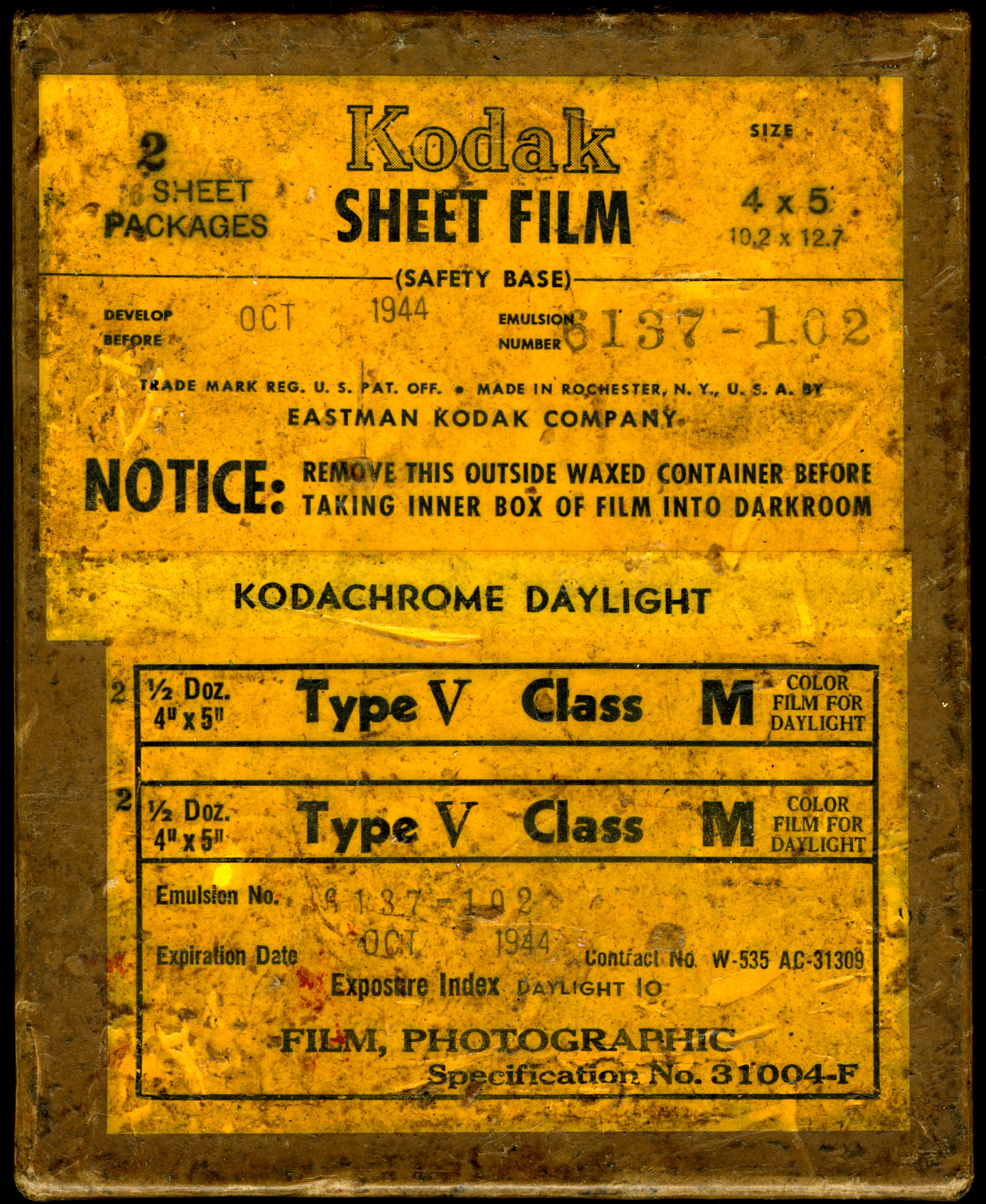
Larger than life...

A companion product, Kotavachrome, was offered in sheet form to make prints. It also came in rolls. Kotavachrome was the Kodachrome product coated on a white plastic base which gave the customer the possibility of having prints made from their slides. It had a very distinct appearance being on white plastic and having the Kodachrome relief image on the surface. It was glossy with an attitude.
Kotavachrome was never sold outside of Kodak, but many of the empty boxes were recycled inside the plant for other purposes and I have seen them sitting around on shelves being used for storage. I had one and seem to have thrown it out, and now only have a Kodachrome 5x7 box in my collection.
PE
Kotavachrome was never sold outside of Kodak, but many of the empty boxes were recycled inside the plant for other purposes and I have seen them sitting around on shelves being used for storage. I had one and seem to have thrown it out, and now only have a Kodachrome 5x7 box in my collection.
PE
I have some of those Kotavachrome prints...they are amazing! All of the ones I have are dated between 1955-1956, do you know how long it was made? Talk about glossy!
I have no idea, but prints were available from 35mm early on and it was discontinued with the concent decree. Kodak had to sell materials without process included and they were no longer able to maintain a chain of photo stores.
PE
PE
1946 Kodachrome data
I have a copy of Henry M. Lester's Photo-Lab-Index. Section 16 is Color Data.
Pages 16-4 through 16-10 have quite a lot of data on Kodachrome. Kodachrome and Kodachrome Type A were from "8mm and 16mm motion-picture films; 35mm and Bantam (828) rolls for miniature still cameras."
Kodachrome Professional Color Safety Film, Daylight Type and Kodachrome Professional Color Safety Film, Type B were available in "Sheet film in all standard sizes up to 11x14".
There is tons of information in this book. I hate to photocopy this and post all of this since it is copyrighted.
I have a copy of Henry M. Lester's Photo-Lab-Index. Section 16 is Color Data.
Pages 16-4 through 16-10 have quite a lot of data on Kodachrome. Kodachrome and Kodachrome Type A were from "8mm and 16mm motion-picture films; 35mm and Bantam (828) rolls for miniature still cameras."
Kodachrome Professional Color Safety Film, Daylight Type and Kodachrome Professional Color Safety Film, Type B were available in "Sheet film in all standard sizes up to 11x14".
There is tons of information in this book. I hate to photocopy this and post all of this since it is copyrighted.

Unless Kodak were doing a field trial to check out the re-introduction of Kodachrome sheet. Not impossible, there was a field trial by at least one lab in the UK maybe 10 years ago of a Kodak colour RA4 paper on fibre-base, (which was not adopted, needless to say.)
That's a shame IMO, Martin - FB would give a new dimension to colour printing. I have many old colour FB prints in the family archives and I think they're much nicer than plastic prints of today. Washing prints would've been a real chore though
 All IMO, of course.
PE, the Kotavachrome you mentioned would have been interesting too, but I think Kodachrome's tendency to fade in sunlight would have been a real liability unless it was dealt with. Again, all IMO.
From Photo-Lab-Index, page 16-04:
"Prints are also suplied by Eastman Kodak Company. Three sizes are made from 35mm and Bantam transparencies under the name of Minicolor prints, and a large number of sizes are made from Kodachrome Professional films under the name of Kotavachrome.
Kodak Minicolor prints are enlarged from either 35mm or Bantam sized Kodachrome transparencies by a standardized process in the Kodak Labratories in Rochester. They are made only from Kodachromes in 2 x 2 mounts with the standard central openings. Enlargements are avaiable in three sizes. The '2X' is about 2 1/4 x 3 1/4. On these the corners are rounded and there are no margins. The larger size '5X' affords a print 5 3/8 x 7 4/5 and prints are returned in mounts--for horizontals, 8 3/8 x 10 1/4 and for verticals, 8 3/8 x 11 9/16, the picture opening, or area measuring 5 x 7 1/2. The largest size, '8X', is approximately 8 x 11, and is returned mounted in a folder.
The quality of a Minicolor Print naturally depends on the quality of the Kodachrome transparency from which it is made. A good properly exposed transparency whic will project well should yield a good color print.
The 'feel' of a Kodak Minicolor Print, particularly in the smaller size, is that of a playing card, strong, attractive, and resilient. The print support, or base, however, is not paper or card, but white pigmented cellulose acetate.
Kotavachrome Professional Prints are reproduced from Kodachrome Professional Film Transparencies and must be made by Kodak Laboratories by the Kodachrome process in the following sizes: 8 x 10, 11 x 14, 14 x 17, 16 x 20, 20 x 24, 24 x 30, 30 x 40. They will be made from all sizes of Kodachrome Film Transparencies except 45 x 107mm 6 x 134cm, and 11 x 14 inches. The maximum enlargement from any transparency is limited to six diameters. Transparencies may be cropped. If this is desired, it is necessary to indicate clearly by an overlay accompanying the transparency.
Duplicates of transparencies, either enlarged or reduced on film, are also supplied by Eastman Kodak Co."
"Prints are also suplied by Eastman Kodak Company. Three sizes are made from 35mm and Bantam transparencies under the name of Minicolor prints, and a large number of sizes are made from Kodachrome Professional films under the name of Kotavachrome.
Kodak Minicolor prints are enlarged from either 35mm or Bantam sized Kodachrome transparencies by a standardized process in the Kodak Labratories in Rochester. They are made only from Kodachromes in 2 x 2 mounts with the standard central openings. Enlargements are avaiable in three sizes. The '2X' is about 2 1/4 x 3 1/4. On these the corners are rounded and there are no margins. The larger size '5X' affords a print 5 3/8 x 7 4/5 and prints are returned in mounts--for horizontals, 8 3/8 x 10 1/4 and for verticals, 8 3/8 x 11 9/16, the picture opening, or area measuring 5 x 7 1/2. The largest size, '8X', is approximately 8 x 11, and is returned mounted in a folder.
The quality of a Minicolor Print naturally depends on the quality of the Kodachrome transparency from which it is made. A good properly exposed transparency whic will project well should yield a good color print.
The 'feel' of a Kodak Minicolor Print, particularly in the smaller size, is that of a playing card, strong, attractive, and resilient. The print support, or base, however, is not paper or card, but white pigmented cellulose acetate.
Kotavachrome Professional Prints are reproduced from Kodachrome Professional Film Transparencies and must be made by Kodak Laboratories by the Kodachrome process in the following sizes: 8 x 10, 11 x 14, 14 x 17, 16 x 20, 20 x 24, 24 x 30, 30 x 40. They will be made from all sizes of Kodachrome Film Transparencies except 45 x 107mm 6 x 134cm, and 11 x 14 inches. The maximum enlargement from any transparency is limited to six diameters. Transparencies may be cropped. If this is desired, it is necessary to indicate clearly by an overlay accompanying the transparency.
Duplicates of transparencies, either enlarged or reduced on film, are also supplied by Eastman Kodak Co."
I have some of those Kotavachrome prints...they are amazing! All of the ones I have are dated between 1955-1956, do you know how long it was made? Talk about glossy!
Kodak used two early reversal print systems: Minicolor and Kotavochrome.
However, both used the same print material, which was introduced in 1941, for the Minicolor system.
Remember that in the 1940's "serious" photography was done using cameras 4x5 and larger. View cameras in the studio and Speed Graphics for field or action. "Miniature" formats such as 35mm or 2 1/4 x 3 1/4 were only used when conditions warranted or if enlargements would be minimal. Kodachrome Professional was sheet film.

lxdude
Member
No. The sheet film Kodachrome was ASA 10 speed. I think it used the K-11 process. It was last seen in the early 1950s. Kodachrome 25 appeared around 1970 and was the first to us process K-14. The Ektachrome from the late 40s and early 50s was ASA 8 and used process E-1.
K25 and K64, using the K-14 process, came out in 1974. Kodachrome II, ASA 25, and Kodachrome X, ASA 64, both using the K-12 process, preceded them. The K-12 process and KII came out I think about 1961. I'm not sure if KX came out at the same time, but I think it was a little later.
| Photrio.com contains affiliate links to products. We may receive a commission for purchases made through these links. To read our full affiliate disclosure statement please click Here. |
PHOTRIO PARTNERS EQUALLY FUNDING OUR COMMUNITY:  |