
• Welcome to Photrio!
    Registration is fast and free. Join today to unlock search, see fewer ads, and access all forum features.
    Click here to sign up

Kentmere Fineprint VC FB contrast problem

Recent Classifieds

Forum statistics

Threads
202,669
Messages
2,843,828
Members
101,449
Latest member
ChrisRL008
Recent bookmarks
0
I've no idea, but I'm glad it's not just us who've found this unusual behaviour! I wonder if developing for longer might help? I don't have any of this paper around at present, but with the late lamented Agfa MCC we found that giving an extra minute or so smoothed out the curves a bit.

Regards
Richard
 
Are you using a cold light head in your enlarger? Disregard the rest of this if you are not.

Kentmere warns in their PDF technical specifications that Kentmere Fineprint VC FB will not respond well to cold light heads at the outer ranges of Ilford contrast filters. Read the PDF for their wording. I wrote them when I was starting to use their paper, nine months ago, and said that I rarely went beyond a 3 filter. They said I would probably not have a problem.

Now I want to start split grade printing using the extreme filters, 00 and 5. Thinking I would have to switch papers I read Ilford's specs for their multigrade fiber. They are a little more specific saying that some cold lights work and others do not. “It is also suitable for use with cold cathode (cold light) light sources designed for variable contrast papers. Other cold cathode (cold light) and pulsed xenon light sources may give a reduced contrast range.” Not knowing which I have I am about to start testing.

I am using a 12x12 inch Aristo cold light head on a Durst 138S with an RH Designs StopClock Vario timer.

John Powers
 
No, I'm using normal bw head (opal bulb in Opemus 5) with plastic Ilford Multigrade filters. They're quite new, so there should be no aging problem. I'm developing in Neutol WA (1+15, enough time, fresh).

I just got new enlarger on ebay that has color head with halogen light source, so I'll be doing whole calibration again. It would be interesting to see if it'll make any difference.

I'll try to leave it in developer for some more time too.

I checked my values again and G5 had contrast similar to G2. So if nothing helps, I'll simply won't use G5 at all. I'm not doing split-grade, so I usually don't have to use extreme grades anyway.
 
Your new colour head will have a higher colour temperature than the opal bulb, thus more blue light. You should find you can get higher contrast with that.

I'm using an Opemus 6 with colour head and a Durst 138S with opal bulb and filters - there is a clear difference in the top end of the contrast range.
 
In a recent PhotoTechniques Magazine article by Fred Newman that reported on comparasons of several FB variable contrast papers, Kentmere did not do well responding to filters beyond a #3. He wrote: " Their (Kentmere Fineprint VC and Arista II VC FB) contrast range was limited, going from about a soft grade 1 to a hard grade 3-the shortest range of any of these (tested) papers. I measured the IDmaxes at 1.84 for the Arista, and 1.88 for the Kentmere."

Perhaps your results are just anomalies of a paper not responding to the filter at all in the way you assumed it would be because it simply isn't designed to.
 
I did some quick tests a few months ago and found it needed 2 mins in Ansco 130 @ 22C. 1 min was too little and 3 mins made no real difference to the 2 min test as far as I could see - but that was at grade 2 so not sure if it relates directly to G4/5. Didn't notice any problem with the grades, but then, I don't think I have ever gone outside G1-G3 with it.

Now I have a densitometer, I will be doing a proper test with the Kentmere and MG-IV FB so I'll take a closer look at the higher grade responses/dev time etc then...

Cheers, Bob.
 
jovo said:
Fred Newman ..... He wrote: "
Their (Kentmere Fineprint VC and Arista II VC FB)
contrast range was limited, ..."

Limited and becomes non-existent as density decreases.
Kentmere's papers suffer most but Ilford's don't do much
better. That makes of those VC papers single grade +/-
papers as density in the print declines from max to min.

Compounding the problem are light sources and filters.
Both can contract grade range where it does exist;
in the more dense portions.

Study the grade curves and you'll see graphically
what I've been talking about. Fuji has addressed the
problem with their Rembrant VC papers Grades 2 and 3.

Also check out the Beautiful Graded paper curves, both
Kentmere's and Ilford's. Dan
 
I used Kentmere fineprint for the first time last night, contact printing 8x10s, and was able to do split printing with No. 5 and 0 filters with no problem. My light source is a bulb in a Beseler 23c.
 
I tried Kentmere fineprint VC last night and also observed some erratic contrast behavior.
I was printing with Durst 805 condenser enlarger with traditional opal bulb.
Contrast filters are ilford, and may be aged.
I printed the same neg also with Agfa MCP and Ilford MGIV RC and FB using Ilfords new cooltone developer (gorgeous with all these papers, esp. MCP...)

Agfa and Ilford printed very consistently, contrast filters worked normally, with very little need for exposure compensation from grade 1.5 to 3.

Kentmere was a different story. To reach same contrast I needed to use at least 1 grade harder filter. Between filters 1-2 the contrast increased very sublty, then making a huge leap with filter 2,5. At the same time exposure time needed was decreased by approx. 2/3 stop. Grade 3 printed even faster, still being flatter than usual grade 3. I haven't experienced this large differences in nominal grades of VC papers before. I used Ilford after kentmere with its results as consistent as always so it shouldn't be the process.

Is there a compatibility issue with Kentmere fineprint and (perhaps aged) Ilford multigrade filters? I like Kentmeres tone and especially its bright base, so I'd like to find means to work with it as easily as ilfords papers.
 
Ok, I got to test them with new enlarger.

I was using color head and single filtration. Contrast is now increasing with higher grades, but very slowly from grade 2.
 
nyx said:
Ok, I got to test them with new enlarger.

I was using color head and single filtration. Contrast is now increasing with higher grades, but very slowly from grade 2.
This is what I found using the recommended "equal exposure" filter values described in the Kentmere documentation with Ansco 130. Looking at the recommended values, the values do seem very close compared to the widely spread MGIV recommended values. The curves I plotted had very little difference from grade 2 to 4 and then a big jump to grade 5 which had much the same curve as G5 in MGIV-FB.

I have not had a chance to retest using Ilford MGIV filtration values on the Fineprint, which I suspect will give better separation. Ditto forgetting about "equal exposure" values and using the Kentmere "raw" grade filtration.

Good news is that the split-filter method works fine with a very shallow G000 (i.e. full yellow filtration gives a very soft grade indeed) and a nice steep G5 with full magenta...

Cheers, Bob.

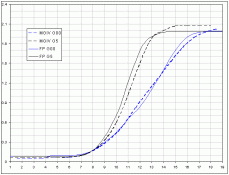
[edit: added a plot of Fineprint FB and MGIV-FB for grades 00 and 5 (roughly speed-matched to allow easier comparison). As you can see, the grade G5 seem practically identical in slope and MGIV G00 is very slightly softer. Fineprint has slightly higher dmin and slightly lower dmax; whether you will see this in a print is moot. Without the speed-matching performed on the graph, Fineprint is slightly faster than MGIV - maybe a third of a stop. X-axis numbers are arbitrary - 1/2 stop steps on my transmission step wedge.]
 

Attachments

  • MGIVFPmatch.gif
    MGIVFPmatch.gif
    12.3 KB · Views: 322
Last edited by a moderator:
ekjt said:
Is there a compatibility issue with Kentmere fineprint and (perhaps aged) Ilford multigrade filters? I like Kentmeres tone and especially its bright base, so I'd like to find means to work with it as easily as ilfords papers.
Comparing Ilford's recommended colour head filter values for MGIV and Kentmere's recommended values for Fineprint, they are quite different, so I suspect Ilford filter packs are not very compatible.

E.g. for my Durst head:
Code:
    Ilford   Kentmere
G0  88Y/06M  40Y/00M
G2  45Y/24M  10Y/45M
G4  10Y/69M  00Y/60M
Cheers, Bob.
 
Thant's an interesting post Bob. I agree with your finding regarding the relative speed of Ilford MGIV and Kentmere, it matches my experience.
 
Bob F. said:
Comparing Ilford's recommended colour head filter values for MGIV and Kentmere's recommended values for Fineprint, they are quite different, so I suspect Ilford filter packs are not very compatible.

I am studying the same datasheets at the moment with similar conclusions.
Anyway, in their manual Kentmere suggests Ilford filters. Can anyone here compare the spectral properties of contrast filters vs. dichroic filtration?
In the RH designs datatable, they have measured contrasts with ilford filters for Kentmere fineprint VC, and I understand they obtained harder contrast n Fineprint with corresponding ilford filter when compared to MGIVFB. Opposite to my experience with my filters. My final prints were exposed with filter 1.5 for MGIVFB and Agfa MCP and had to be exposed at 2.5 with kentmere to get equal contrast.
Now the filter packs I have are old (but still serve well with other papers at least in the middle grades). Can any Kentmere user suggest a brand of contrast filter which would work consistenty with Fineprint VC with grades 1-3 and with minimal exposure compensation required.
I am also planning to get an analyzer pro very soon (I tested one some years ago, and now I might have money to buy it) which I am planning to use mostly with contrast filters and a condensor head.
 
I just read this thread and am quite concerned. I just purchased a large amount of kentmere VC paper and after reading all this I'm leary of what my results will be like.Everyone has talked about filters and color heads. I have a Zone VI VC head for my enlarger which used two different color tubes to gain contrast. has anyone had problems with these or have heard about anyone having the same problem with these.

thanks
mike
 
nyx said:
No, I'm using normal bw head (opal bulb in Opemus 5) with plastic Ilford Multigrade filters. They're quite new, so there should be no aging problem. I'm developing in Neutol WA (1+15, enough time, fresh).
I just got new enlarger on ebay that has color head with halogen light source, so I'll be doing whole calibration again. It would be interesting to see if it'll make any difference.
I'll try to leave it in developer for some more time too.
Unless you print from colour negatives or tranparencies, go for an enlarger with a VC light source. I`ve never had a problem with my Durst Modular 70 which works equally well with Ilford, Kentmere and the Agfa papers that I tried.
I found Ilford Multigrade developer to yield excellent results with all types of B&W papers. I habitually add an extra 30 seconds or so when developing prints.
 
michael9793 said:
I just read this thread and am quite concerned. I just purchased a large amount of kentmere VC paper and after reading all this I'm leary of what my results will be like.Everyone has talked about filters and color heads. I have a Zone VI VC head for my enlarger which used two different color tubes to gain contrast. has anyone had problems with these or have heard about anyone having the same problem with these.

thanks
mike
I can't address your particular head, but if it works fine with other papers such as MGIV, then I would expect it to work well with Kentmere. You may have to do some experimenting to find what values you need to dial in for the different grades, but as you can see from the graph I posted above, the two papers appear comparable in terms of their minimum and maximum contrast capabilities. The values in between will most likely require different values of yellow and magenta however. I've not bothered to do that for my enlarger (dichroic head) as I normally use the split-grade technique which only uses full yellow and full magenta filtration...

Cheers, Bob.
 
Bob F. said:
I can't address your particular head, but if it works fine with other papers such as MGIV, then I would expect it to work well with Kentmere. You may have to do some experimenting to find what values you need to dial in for the different grades, but as you can see from the graph I posted above, the two papers appear comparable in terms of their minimum and maximum contrast capabilities. The values in between will most likely require different values of yellow and magenta however. I've not bothered to do that for my enlarger (dichroic head) as I normally use the split-grade technique which only uses full yellow and full magenta filtration...

Cheers, Bob.

Thanks Bob,

My heads are two tubes that give you the Green and Blue filtration. I also use the split grade technque. Having just purchase a Stop clock timer I now will have another thing to learn in this process.
mike
 
I use a Sanders/LPL 4550 XL enlarger. It has a diffusion head with quartz-halogen lamp and YMC filtration. When printing with the Kentmere VC fiber paper I found that the tonality went "south" with a filter selection larger than between 2.5 and 3. In fact it reacted so poorly that I thought that I had depleted my developer and quickly mixed up a new batch. When this failed to create an improvement, I called Freestyle and was informed that one should not use this paper beyond 3. Now I did not get into technical details with them concerning filter types. color temperature etc. but they seemed pretty confident in there response. I now use this paper for printing in the 0 to 3 range with good results.
 
I found pretty much what everybody else states. I was looking for an alternative to Agfa MCC, and after using up a box of 50 sheets of the Kentmere I dismissed it and tried other papers. The ADOX Fineprint VC paper has tonal qualities comparable to the Agfa, and responds very well to filters throughout the full range. Its tone is colder, but that may not be a bad thing.
I still have some of the Kentmere that I'd happily give away if anyone is interested. I cut it down to 1/4 sizes from 11x14.

- Thom
 
huggyviking said:
I found pretty much what everybody else states. I was looking for an alternative to Agfa MCC, and after using up a box of 50 sheets of the Kentmere I dismissed it and tried other papers. The ADOX Fineprint VC paper has tonal qualities comparable to the Agfa, and responds very well to filters throughout the full range. Its tone is colder, but that may not be a bad thing.
I still have some of the Kentmere that I'd happily give away if anyone is interested. I cut it down to 1/4 sizes from 11x14.

- Thom

The ADOX is a superb paper and yes, I do agree it has tonal qualities like the now gone Agfa MCC. Better still it is a non developer incorporated paper so I'd imagine it will respond well to all developers and have a very long shelf life.
The RC version 'easyprint' is significantly faster, contrastier and cooler in tone while still having a truly incredible D-max for an RC paper - ideal for rapid repro work etc. The fact that it is significantly cheaper than Ilford's papers is another great selling point to cheapskates like myself!

Lachlan
 
Last edited by a moderator:
Agfa MCC it is not, nether is it Ilford, Forte, Bergger, or Kodak, but it is an extremely good paper capable of a wide range of contrasts and tones for those that are prepared to learn it’s characteristics; and match these to their image requirements. You may not like the results it gives, but that doesn’t make it a bad product, just one that is unsuitable to your present requirements.
 
I totally agree with Dave, I've standardised on Kentmere Fineprint as my cold/normal tone fibre paper and really like it. I don't seem to have any problem getting a full range of grades from it. Certainly up to grade 4. I can't remember having to print at grade 5.

Mike
 
Photrio.com contains affiliate links to products. We may receive a commission for purchases made through these links.
To read our full affiliate disclosure statement please click Here.

PHOTRIO PARTNERS EQUALLY FUNDING OUR COMMUNITY:


Ilford ADOX Freestyle Photographic Stearman Press Weldon Color Lab Blue Moon Camera & Machine
Top Bottom