
-
Welcome to Photrio!Registration is fast and free. Join today to unlock search, see fewer ads, and access all forum features.Click here to sign up
You are using an out of date browser. It may not display this or other websites correctly.
You should upgrade or use an alternative browser.
You should upgrade or use an alternative browser.
Just got an EG&G Sensitometer
-
A
- Thread starter ic-racer
- Start date
Recent Classifieds
-
For Sale Ilford 5X7 Paper Lot
- Started by davela
-
For Sale Omega Audible Repeating Timer II
- Started by davela
-
Want to Buy Widelux
- Started by Jeff Bennett
-
Sold ULF Camera 7X11, 8X10 Eastman Improved #2
- Started by jimgalli
Forum statistics


Yes and it is such an elegant and beautiful design.
- removed account8
- Deleted
- Greg Davis
- Deleted

I think I can zerox you a copy of the user's manual on Monday. In fact, I probably should scan it and post it on this site; any problems with this Sean or other admins?
Resurrecting an old thread, but did you ever get to photocopy the manual? I recently acquired an EG&G sensitometer and would really aprpeciate if you could provide the manual.
Thanks!

That was some time ago; I will look around and see if I can locate it.
That's the best I can offer...
That's the best I can offer...
- Joined
- Aug 22, 2006
- Messages
- 1,532
- Format
- Multi Format
Resurrecting an old thread, but did you ever get to photocopy the manual? I recently acquired an EG&G sensitometer and would really aprpeciate if you could provide the manual.
Thanks!
Even if Kino doesn't find his manual, there's not really that much to it. At the outfit where I worked, circa 1980 (?) we bought one new (along with an EG&G radiometer as a means of ongoing screening of the output). I personally exposed probably thousands and thousands of sensi wedges on it for various tests.
Basically there are several buttons to set flash duration, so pick one close to the duration you use. You would typically tape a step wedge to the glass on top (the step wedge sets a fixed exposure relationship between steps). For the exposure you go in a darkroom, lay the test film on top of the step wedge, and momentarily close the lid (press down); this pushes the small switch and fires the flash. (You know it fired cuz you can hear the "click" as well as the the "pop" sound of the flash.) The original foam on the underside of the lid blocked light well enough that you could, for example, expose a number of wedges on a strip of film without worry of fogging. As a note the carriage had cutouts at each end to allow guiding several different sizes of film - just to make sure you could center the film over the wedge.
The machines, when new, came with a calibration certificate for each exposure setting, so you could, if desired, actually do film speed testing (you would also need well-controlled film processing and a densitometer).They also came with a set of "attenuators" to equalize exposures at the different speed settings (the capacitors were high precision, perhaps hand-selected, to give close matches). So if you wanted to test high speed reciprocity failure in a film you could make several exposures, using the different exposure durations with the appropriate attenuator. Of course today that's probably not possible because the machines don't likely match the last EG&G calibration, and most seem to be missing the attenuators (from what read on forums).
If you needed to reduce the light output for a faster film you pull out the film platten (lift the whole assembly straight up) and lay an appropriate neutral density filter down in the "light well" (this is the same place where the attenuators go).
Something useful to do with your step wedges is to have a couple of reference points on them. We'd tape a couple of small arrows cut out of black tape on the side of certain steps. Otherwise can sometimes be hard to know exactly which step you're reading. Especially if you do further testing by contact printing a film wedge onto paper.
That's pretty much the basics of using it (if I missed anything hopefully other users will chime in). I don't recall if there was schematic in the manual - in either case I'm no help there. Best of luck with your unit.
Ps, I'm kind of presuming that you already know something about sensitometry. If not there is some info online, Kodak used to have a primer called "Sensitometry Workbook," (or similar). And, as I recall, the RIT book , "Basic Photographic Processes and Materials," has a much more complete section on sensitometry.
What he said...
Ps, I'm kind of presuming that you already know something about sensitometry. If not there is some info online, Kodak used to have a primer called "Sensitometry Workbook," (or similar). And, as I recall, the RIT book , "Basic Photographic Processes and Materials," has a much more complete section on sensitometry.
I love the one that Kodak put out that has Street Mimes illustrating toe and shoulder! It's just too surreal!
However, this will do in a pinch:
https://www.kodak.com/content/products-brochures/Film/Basic-Photographic-Sensitometry-Workbook.pdf
Last edited:
What he said...
I downloaded the manual. However the print is very busted. Would it be possible for you to look for your scan?
Sorry, my library is boxed at the moment. It will re-emerge when I finish my darkroom OR when I die; which ever comes first...
Here are some follow up questions. I am a little confused and could use some help from the more experienced members.
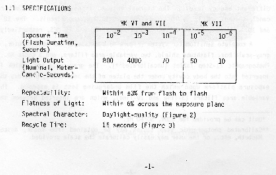
I have attached a screenshot of the specification section from the manual. It seems like 1/100 has an illuminance of 800 while 1/1000 has 4000? Does that sound right?
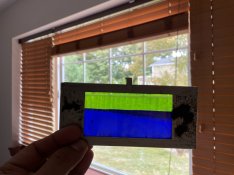
Also, the filter over the flash bulb seems to be half blue, and half green. Is this normal?
Thanks!
I have attached a screenshot of the specification section from the manual. It seems like 1/100 has an illuminance of 800 while 1/1000 has 4000? Does that sound right?
Also, the filter over the flash bulb seems to be half blue, and half green. Is this normal?
Thanks!
Attachments

... when I finish my darkroom OR when I die; which ever comes first...
Darkrooms are never finished while dying is assured.
- Joined
- Aug 22, 2006
- Messages
- 1,532
- Format
- Multi Format
Also, the filter over the flash bulb seems to be half blue, and half green. Is this normal?
Wouldn't be normal for anything I'd ever have done. Someone may have rigged it like that to test X-ray films. (For some reason X-ray sensitometers seem to come in those colors; as I recall ic-racer seems to have known something about that.) Or maybe it was an EG&G option.
At one time, circa 1980, we spent some time doing tricolor exposure tests on color film, using the specific Wratten filters dropped down in the light well. But you would also need red to go with it, so it seems clear that this is not the purpose.
Last edited:
- removed account8
- Deleted
The EG&G sensitometer output is proportional to the product of the capacitance and the voltage squared. The duration is related to the capacitor's equivalent series resistance (ESR).
Each of the settings on the EG&G switches to a totally different capacitor. There are 3 or 4 depending on the design. Each of the capacitors has its own capacity and internal resistance and has a unique combination of light output and duration.
In other words, it is a very simple circuit, each capacitor dumps its whole charge. Much different than a modern thyristor circuit that controls duration electronically.
The multicolored filter is not mentioned in the manual.
Each of the settings on the EG&G switches to a totally different capacitor. There are 3 or 4 depending on the design. Each of the capacitors has its own capacity and internal resistance and has a unique combination of light output and duration.
In other words, it is a very simple circuit, each capacitor dumps its whole charge. Much different than a modern thyristor circuit that controls duration electronically.
The multicolored filter is not mentioned in the manual.
The EG&G manual, has a good explanation of how to use the device and make curves. Too bad it is using old units. It would be nice to re-type the text and convert over to the units used in the Kodak Sensitometry Workbook. It would make both documents easier to understand.
- Joined
- Aug 22, 2006
- Messages
- 1,532
- Format
- Multi Format
Mr. Bill, what about the other question shutter it has regarding the specs he posted… unless I’m missing something how can the exposure be higher for a shorter duration?
Hi, I can't say much about the innards, but I expect that ic-racer is probably right about it - different sets of caps, etc.
- removed account8
- Deleted
I believe they choose the flash capacitors based only on duration of output. The included filter set was then designed to provide the constant light output at the film plane. So, the device, when used per the instructions below, does provide constant output for all the settings.
My EG&G only came with the clear filter, so I made the other two using some trial and error to get the light output correct.


My EG&G only came with the clear filter, so I made the other two using some trial and error to get the light output correct.
The variable area filters (3-line and 19-line) inserted between the flashtube and the gray-scale box, allow the user to balance the light output of the 10-2, 10-3, and 10-4 circuits within 10%. The 3-line and the 19-line filter can be considered equivalent to ND 1.7 and ND 1.0 filters, respectively, and are used to normalize the light output of the 10-3 and 10-2 second circuits to that of the 10-4 second circuit.
Last edited:
- removed account8
- Deleted
I believe they choose the flash capacitors based only on duration of output. The included filter set was then designed to provide the constant light output at the film plane. So, the device, when used per the instructions below, does provide constant output for all the settings.
My EG&G only came with the clear filter, so I made the other two using some trial and error to get the light output correct.
View attachment 284119
View attachment 284120
This is very helpful. So, I am going to need some more help in deciphering this. I have cut out the filters from the frame. It indeed looks like someone stuck them with tape and a piece of glass to keep everything flat. Currently, there is one more piece of clear plastic that *seems* to be factory. For your case, was the frame empty, or was there a clear piece of plastic (like material)?
My unit did not come with the filters. Since you had made a set for yourself, would you be so kind to share the process, schematics, measurements so I can make one as well? Also, how did you determine the correct light output?
It will be easiest to use Neutral Density sheets than to try and make the original style filters. And, in fact, if you did make the filters, you still need to adjust the output with Neutral Density sheets for different ISO films. Otherwise the important data will fall outside of the stepwedge area.


This is the calibration sheet from EG&G. I used the attenuators but added ND to balance the exposure for differently rated films so the speed point would fall around the same point of the step tablet. While there are a number of different settings on the sensitometer, in actual use, it is basically limited to just one in order to avoid short duration reciprocity failure.

- removed account8
- Deleted
Stacking NDs shouldn't be a problem.
Stacking NDs shouldn't be a problem.
There will be light loss and scatter between the filter and air and reflections between filters. This shouldn't matter to most people as the speeds will be relative anyway. It's a minor factor but I think it's good to be aware of it. I had the gel filters tested when I had my sensitometer calibration just in case.
Last edited:

- Joined
- Feb 9, 2010
- Messages
- 9,584
- Format
- 4x5 Format
The physical filters are a better idea. I always wonder of the gel ND in my "well" whether it's truly neutral, what its density is etc.
The amount of light at a hundredth of a second is reasonable for film, a little extra filtration is needed to get a full graph.
The thousandth is much more light, I assumed it had something to do with the architecture and electronics of the unit to meet the highest specification for time accuracy.
But I find a thousandth of a second extra light gives enough light to test paper (I have to ignore the fact it's outside the region of reciprocity law failure for paper).
The blue/green filter looks home-made.
The amount of light at a hundredth of a second is reasonable for film, a little extra filtration is needed to get a full graph.
The thousandth is much more light, I assumed it had something to do with the architecture and electronics of the unit to meet the highest specification for time accuracy.
But I find a thousandth of a second extra light gives enough light to test paper (I have to ignore the fact it's outside the region of reciprocity law failure for paper).
The blue/green filter looks home-made.
| Photrio.com contains affiliate links to products. We may receive a commission for purchases made through these links. To read our full affiliate disclosure statement please click Here. |
PHOTRIO PARTNERS EQUALLY FUNDING OUR COMMUNITY:  |