• Welcome to Photrio!
    Registration is fast and free. Join today to unlock search, see fewer ads, and access all forum features.
    Click here to sign up

Just a basic question about exposure, please don't flame me.

Tree with Big Shadows

Tree with Big Shadows

  • 2
  • 0
  • 38
Everal Barn

A
Everal Barn

  • 0
  • 0
  • 38

Forum statistics

Threads
203,453
Messages
2,854,932
Members
101,850
Latest member
psimon
Recent bookmarks
0
These are all mechanical and if they haven't been checked for precision of the shutter speeds recently, they can go out of spec, especially as some of your cameras cab be over 40 years old.
The M6 was CLA'd a year ago and the FM2 also. The rest, no. I think the constant is my technique.
 
It might be.
A question: how are you viewing the pictures and how are you judging the exposures: by looking at the negative or a positive, be it a s***n or a print?
 
It might be.
A question: how are you viewing the pictures and how are you judging the exposures: by looking at the negative or a positive, be it a s***n or a print?
By looking at the negatives. The "bad" ones are thin. The ones where there was more light (but still sort of dim house lights) are thicker. I guess I'm saying that when the light levels get to a certain point and there are no bright lights in the scene, I get a really thin negative.
 
I timidly suggest what you experience might be due (in a very subdued way) to vignetting and flare.

When you use your lens at full aperture, the real aperture seldom is the theoretical one. At full aperture you have vignetting (which you will notice near the borders, and gradually and less intensely toward the center frame) and maybe you have a higher percentage of flare, light going astray in the optic system, which also makes your blacks less black.

Not something easy to notice though: vignetting is visible mostly when you take pictures of uniform subjects (a uniform sky, a uniform wall) otherwise it is not easy to spot. Flare is something that you can notice especially with old lenses, and especially in pictures with a high subject brightness range, some parts of the scene are strongly lit, some others are very dark, flare gives you shadows which are less deep than what you expected.

Basically at full aperture you should experience a little degree of reciprocity failure and some unintended brightening of deep shadows.

Further details about the circumstances in which you experience that would be useful.

EDIT: some bullstuff OT: at the moment Italy is second in the medal list, with 2 golds, 3 silvers, and 2 bronzes. Second after Australia, and before China which is third. I know this is shamelessly off-topic but I have to celebrate that because I never saw that in my life and it's going to last probably for no more than half an hour :smile:
 
Thanks! You're doing it right. :smile:
 
You know, I don't know.
The exposure times I'm talking about are f/2, ISO 400, 1/4 second ss. That sort of ballpark. Not minutes or anything...just a pretty dark house. Example. I can take a shot right under the kitchen table of some object and the exposure is f/2 for 1/30 or 1/60...something like that. When I do, though not optimum, I can get an image that's expected.
If I swing the camera around and shoot something away from the light I get 1/2 second or 1/4 second for SS and that's when things fall apart. I've thought that maybe I'm inadvertently underexposing so I've purposefully shot an extra stop of shutter speed and that didn't help.
The shots look underexposed even though the meter says "one stop over"


in a situation like this you have to consider the meter to be advisory at best.

In fact, in most situations, that is the case. Their word is not final, can never be final. You have to use the worlds most sophisticated data processing device in addition to this meter -- this device is located between your ears.

So, truth:

Meters are stupid electronic devices -- they have limitations, they are dumb, they don't know what they're looking at. They think the entire world is 18 percent gray. No picture is, and the situation you describe is definitely not.

So what you need to do is look at the situation you are shooting, consider what the meter tells you, take a shot following that, then take another shot at double the exposure, and maybe another one at double that. This is especially true in the situation you are describing since the situation sounds pretty dark and what your meter is doing is trying to give you an end-result that also looks pretty dark, but you want more than that.

So do all this - experiment around, take notes, learn what your equipment will do in situations like this, and learn.

Same goes for taking pictures of folks with dark skin, by the way. Unless you want them to look like people-shaped holes in your film, ur gonna have to adjust what the meter says.
 
in a situation like this you have to consider the meter to be advisory at best.

In fact, in most situations, that is the case. Their word is not final, can never be final. You have to use the worlds most sophisticated data processing device in addition to this meter -- this device is located between your ears.

So, truth:

Meters are stupid electronic devices -- they have limitations, they are dumb, they don't know what they're looking at. They think the entire world is 18 percent gray. No picture is, and the situation you describe is definitely not.

So what you need to do is look at the situation you are shooting, consider what the meter tells you, take a shot following that, then take another shot at double the exposure, and maybe another one at double that. This is especially true in the situation you are describing since the situation sounds pretty dark and what your meter is doing is trying to give you an end-result that also looks pretty dark, but you want more than that.

So do all this - experiment around, take notes, learn what your equipment will do in situations like this, and learn.

Same goes for taking pictures of folks with dark skin, by the way. Unless you want them to look like people-shaped holes in your film, ur gonna have to adjust what the meter says.
Thank you. I guess I knew that but didn't really give it enough thought.
 
You may want to consider a book, Perfect Exposure by Roger Hicks. You can easily find it on the used book sites like ABEBOOKS.com. I bought a copy at $.99 plus $3.99 shipping, which was the best four bucks I've ever invested in basic photographic advise.

Looks like inflation caught up. Now the lowest priced is $3.49. Still would be a good investment. It could be the best eight bucks you invest in basic photographic advise.
 
Last edited:
You may want to consider a book, Perfect Exposure by Roger Hicks. You can easily find it on the used book sites like ABEBOOKS.com. I bought a copy at $.99 plus $3.99 shipping, which was the best four bucks I've ever invested in basic photographic advise.

Looks like inflation caught up. Now the lowest priced is $3.49. Still would be a good investment. It could be the best eight bucks you invest in basic photographic advise.
Thanks Brian, I'm aware of Roger, but wasn't aware of this book. Sounds like something that would benefit me.
Edited to add: I snagged a brand-new copy for seven dollars shipped!
 
By looking at the negatives. The "bad" ones are thin. The ones where there was more light (but still sort of dim house lights) are thicker. I guess I'm saying that when the light levels get to a certain point and there are no bright lights in the scene, I get a really thin negative.

You're shooting a dark area, so when you print you'd want it to look dark, right? So the neg does need to be thinner or it would print as lighter than it was. There's thin and then there's too thin. Have you tried printing these thin negs?
 
You're shooting a dark area, so when you print you'd want it to look dark, right? So the neg does need to be thinner or it would print as lighter than it was. There's thin and then there's too thin. Have you tried printing these thin negs?
No, not yet. I see what you mean though.
 
Expose at your meter reading as usual, then take additional shots -- adding twice as much light each time (double the exposure time) -- try three or five more times and see when you get better negatives (or transparencies).

Great! That will give you a base of real-world information to build on.


exactly what i was thinking !
 
Are these films being commercially developed or printed? Automatic printers can give a poor set of dark tones if there is a highlight in the frame. I would also suspect under exposed (box speed or faster) and over developed under these circumstances.
No, at this point i'm just judging the negatives and sc**nning them. I'm certain that I've underexposed them...that's the crux of it. You know how underexposed film has that murky blacks, grey-blacks -over-grainy look?

I've done the suggested test for varying exposures:

metered exposure

Metered exposure x 2

Metered exposure x 4

Metered exposure x 8

I'm going to develop in the next day or two and evaluate the negatives.
 
When you've done that, can you show us the negatives?
 
I'm trying to reconcile something in my mind. I'm not a veteran film shooter, I've only taken up shooting film for less than a year but as I progress, a question has come to my mind.

I had assumed that whatever conditions I shoot in, dark house vs outside on a sunny day, that exposure is exposure. That is, as long as the shutter lets in enough light, then all is equal the results should be equal.

What I have noticed is that there is an amount of light, a threshold of sorts where my images start to look very grainy with milky blacks. Above that threshold the exposure equality that I mentioned pretty much is in effect but at some reduced light level, it just doesn't work. I could leave the shutter open for twice as long and the images just don't hold up.

I hope I explained it correctly. I'm just wondering about it, that's all.
Keep that thought because it is theoretically correct.Exposure is the product of light intensity(controlled by the aperture)and time(controlled by the shutter)or E=I*t;a reduction or increase in one can be compensated by a reduction or increase of the other;that's called exposure reciprocity;Nevertheless,very dim or very bright conditions ma y force you to use very long or very short exposure times which in turn cause reciprocity failures where the above equation fails and typically underexposure is the result.So, exposure is exposure unless it isn't.But you have to run into very long exposures(several seconds to minutes)or very brief exposures <1/10,000s to get problems.Other than that, your reasoning is correct.
 
Keep that thought because it is theoretically correct.Exposure is the product of light intensity(controlled by the aperture)and time(controlled by the shutter)or E=I*t;a reduction or increase in one can be compensated by a reduction or increase of the other;that's called exposure reciprocity;Nevertheless,very dim or very bright conditions ma y force you to use very long or very short exposure times which in turn cause reciprocity failures where the above equation fails and typically underexposure is the result.So, exposure is exposure unless it isn't.But you have to run into very long exposures(several seconds to minutes)or very brief exposures <1/10,000s to get problems.Other than that, your reasoning is correct.
Thanks Ralph, that was very clear.
 
Well I thought I'd come back and report what I found on this.

Basically I guess you could say that I was underexposing, that was the problem all along.

I exposed some shots of the same dark areas in my house at: metered speed (1/4s), then 1/2s, then 1s, 2s, and finally 4s.
I found that the shots looked good at any point after the 1 second mark in that situation. When I exposed at AT LEAST for 1s I got what appear to be well exposed shots with none of the milky shadows and insane grain. I'd even go so far as to say they look like shots shot in "normal" room light. You'd never know that they were in really low lighting.

Now that I look back, I realize that I've made this mistake in many places that I've shot in and the remedy was to at least double if not quadruple the exposure time.

Thanks for helping, I appreciate it.
 
RP, that sounds exactly right - your meter is assuming you want a "normal, daylight" sort of shot. Shoot in a dark room and meter will expect an average room. Basically, a meter is saying that a gray card sitting in that room will need x-amount of exposure to be reproduced as middle gray - when in reality, a gray card in a dark room would be very dark grey. Move the camera so a bright window or light comes into view, and the meter compensates for this and everything else gets darker in the final. Keep the same exposure and the window "flares" out and can even wash out your shadows.

You really have to envision how you want the final print to look; if you want the room to seem as dark as it was when shot, take that into account. If you want it to seem lit with average daytime light, the meter should be close. Want the window blown out, you have to meter without it. Want to hold the window detail, you'll need a combo of exposure and development.

I hate to say it, but a decent digital SLR with manual controls is a very fast way to learn some of this stuff. We used to have to wait for film dev'd or prints to start learning just what we did right or wrong (or blow through a lot of polaroid). It can be a good way to learn about metering vs. ISO, shutter and aperture vs. scene conditions. Just keep in mind the digital may not hold nearly the highlight and shadow detail the film will.

Final thought - as you dial this stuff in, you'll find your negs can hold more dynamic range (shadow detail through highlight detail) than paper or scans can. Negs under the loupe can have far more shadow detail than final prints. At some point you'll need to start seeing how much you have to "compress" dynamic range into the film to get good prints, usually by blowing through some paper and chemistry and comparing negs to prints. Many of us work towards negatives that a print full range of detail on #2 or 2.5 paper grade, without lots of effort, dodging, burning, etc.

 
RP, that sounds exactly right - your meter is assuming you want a "normal, daylight" sort of shot. Shoot in a dark room and meter will expect an average room. Basically, a meter is saying that a gray card sitting in that room will need x-amount of exposure to be reproduced as middle gray - when in reality, a gray card in a dark room would be very dark grey. Move the camera so a bright window or light comes into view, and the meter compensates for this and everything else gets darker in the final. Keep the same exposure and the window "flares" out and can even wash out your shadows.

You really have to envision how you want the final print to look; if you want the room to seem as dark as it was when shot, take that into account. If you want it to seem lit with average daytime light, the meter should be close. Want the window blown out, you have to meter without it. Want to hold the window detail, you'll need a combo of exposure and development.

I hate to say it, but a decent digital SLR with manual controls is a very fast way to learn some of this stuff. We used to have to wait for film dev'd or prints to start learning just what we did right or wrong (or blow through a lot of polaroid). It can be a good way to learn about metering vs. ISO, shutter and aperture vs. scene conditions. Just keep in mind the digital may not hold nearly the highlight and shadow detail the film will.

Final thought - as you dial this stuff in, you'll find your negs can hold more dynamic range (shadow detail through highlight detail) than paper or scans can. Negs under the loupe can have far more shadow detail than final prints. At some point you'll need to start seeing how much you have to "compress" dynamic range into the film to get good prints, usually by blowing through some paper and chemistry and comparing negs to prints. Many of us work towards negatives that a print full range of detail on #2 or 2.5 paper grade, without lots of effort, dodging, burning, etc.
Thanks very much for that detailed comment, I can see I have a lot to consider now.
 
In the 1950s the film speed ratings were doubled, not for any change in the film, but for a different way of determining the rating. Film makers claimed technical reasons for this change, but it may have also been advertising hype. This sounded great for the uninformed photographer even though it resulted in negatives that verged on underexposure. Many modern negatives benefit from increased exposure. Also, in the good old days of selenium cell light meters, accurate light readings at low light levels was difficult. The meters in the OP's Leica and FM2 should suffer less from this characteristic.
 
I noted the same with my M6, tend to overexpose in very contrasty conditions and conversely underexpose indoors. One can compensate by experience or use a handheld meter like my Sekonic L308S. I use the Sekonic when shooting MF (Bronica) and get more consistent exposure but a part of that is I reckon more due to taking more time to scan the scene for contrast and take incident readings. Its just a facet of the exposure value assuming a typical scene contrast.
 
Thanks very much for that detailed comment, I can see I have a lot to consider now.

I think you'll find it becomes second nature fairly quickly, especially if you're even just "mildly obsessed" with the whole process.

I resisted this for some time, but getting a basic grasp of the zone system is really something that (in the pre-PC age I'd say "separates the men from the boys") separates the point & shoot amateur from - well, from the "advanced hobbyist-to-professional"? How about "the photographer that consistently gets negs that will produce a final print that matches his/her visualization of the scene when they hit the shutter button".

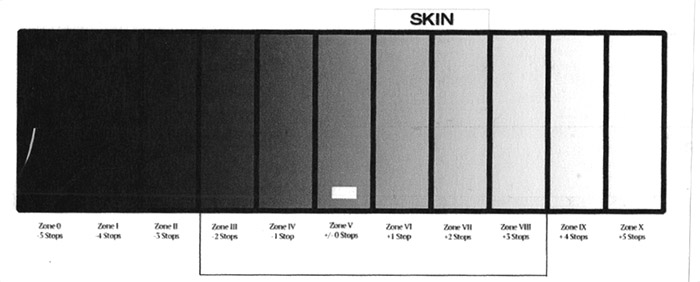
I printed out a strip like this, laminated it, and stuck it in my camera bag. Middle gray is marked, the general DR of film is marked, and average skin tones are marked. It was really handy to have as a reminder of where to place exposure and have a clue about highlight development. I'm no Ansel Adams, but the Zones are a good way to grasp how film will hold your scene. (A spot meter is handy too, but a phone app meter is kinda-spot-ish).

zones.jpg
 
M Carter said:
getting a basic grasp of
the zone system is really something that (in the pre-PC age
I'd say "separates the men from the boys") separates the
point & shoot amateur from - well, from the "advanced
hobbyist-to-professional"? How about "the photographer
that consistently gets negs that will produce a final print that
matches his/her visualization of the scene when they hit
the shutter button".

I'm sure lots of zs users prefer to believe this, but it really is simply not true or universally applicable.

the zs is excellent for people who like to use the zs. and utterly useless for people who don't. and partially useful for those who have read a bit of Adams or picker and found it partially useful.
 
Photrio.com contains affiliate links to products. We may receive a commission for purchases made through these links.
To read our full affiliate disclosure statement please click Here.

PHOTRIO PARTNERS EQUALLY FUNDING OUR COMMUNITY:


Ilford ADOX Freestyle Photographic Stearman Press Weldon Color Lab Blue Moon Camera & Machine
Top Bottom