• Welcome to Photrio!
    Registration is fast and free. Join today to unlock search, see fewer ads, and access all forum features.
    Click here to sign up

Jobo and Diluted Developer

Recent Classifieds

Forum statistics

Threads
201,943
Messages
2,832,429
Members
101,027
Latest member
yukinosita_yuk
Recent bookmarks
0

RedSun

Member
Allowing Ads
Joined
Aug 27, 2012
Messages
680
Location
New Jersey,
Format
Multi Format
I normally use Jobo and normal working developer to process film. If I use diluted developer, say 1:1 D-76, even Rodinal, should I worry not using enough developer?

As a rotary processor, Jobo uses much less chemical than the regular inversion tank. I remember someone says to use large reel and more chemicals since the tank uses less chemical, particularly if diluted.

What is your experience?
 

Sirius Glass

Subscriber
Joined
Jan 18, 2007
Messages
50,835
Location
Southern California
Format
Multi Format
What is your experience?

I am much happier with the results of full strength replenished XTOL in a JOBO processor or just a metal tank.
 

pentaxuser

Member
Joined
May 9, 2005
Messages
20,352
Location
Daventry, No
Format
35mm
Rodinal might not be a problem as it is diluted so much anyway. Some say that 5mls is OK as a minimum so with a 135 film and 140 mls of developer that's still slightly more than 25:1

The alternative if it must be rotary processing is to use more than 140mls of Rodinal developer. At 250mls 5mls gives you 50:1

However there are those that say that acutance developers like Rodinal lose their edge effect with rotary processing. You'd need to try and see the results. I haver never rotary processed with any developer so cannot say from experience what he results are.

I am unsure of what Kodak says is the minimum stock amount for D76. Once again if you fill the tank to its inversion capacity this may give you the leeway you need.

pentaxuser
 
OP
OP
RedSun

RedSun

Member
Allowing Ads
Joined
Aug 27, 2012
Messages
680
Location
New Jersey,
Format
Multi Format
I just read the Jobo book on using the diluted developer. It gives an example of using diluted D-76. It says if you use the same min quantity, but diluted chemical, then the film will be under-developed. Then it says, to add at least 30% more if using diluted.

I figure it is always on the safe side to use enough chemicals. The purpose of using diluted is more on the performance, not on saving the developer. Developer is so cheap.

Kodak says to use 100ml D-76 for one roll of 135/36. Then the smallest Jobo tank uses 140ml. Then there is so risk here of not having enough developer.

Of course, you can always use up to the full tank capacity with diluted. You may be better off using un-diluted. Unless you really want to use diluted on purpose.
 

pentaxuser

Member
Joined
May 9, 2005
Messages
20,352
Location
Daventry, No
Format
35mm
Kodak says to use 100ml D-76 for one roll of 135/36. Then the smallest Jobo tank uses 140ml. Then there is so risk here of not having enough developer.

Thanks for reminding me. I had a feeling that a min of 100ml of D76 was quoted in Kodak's literature.

This means that in a Jobo, using rotary and the min quantity of 140 nothing less than stock will do.

Now here's the strange thing. John Tinsley in his book of rotary processing quotes the use of ID11( allegedly but generally agreed to be the same developer) at 1+1 with great success. So that's no more than 70mls of stock.

There are potentially several ways to reconcile this anomaly.

1. Tinsley either didn't do what he says he did or had inferior results from so doing.

2. ID11 in terms of minimum stock quantities is in fact a different material from D76

3. Kodak is in fact wrong( they can't do much right in other respects according to a lot of APUGers so why not in this respect as well :D)

It is only my opinion but I suspect that 3 might be the best explanation.

You might like to try D76 at 1+1 and an ID11 at 1+1 both at 140mls to see if there is (a) any difference and (b) any difficulties with the negs

You might also want to consult Ilford's ID11 literature. I have just done this and can see no mention of a similar Ilford spec of 100mls of stock. Indeed Ilford says that ID11 can be used for rotary processing at 1+3 which means that at 140mls a stock quantity of 35mls is acceptable


With a minimum quantity of 100mls it means that for rotary processing at 1+3 you'd need the 120 tank for a 135 film and 400mls of liquid which seriously defeats the object of using rotary processing and in fact at this ratio you couldn't even use the 135 Jobo tank.

So I might have set a few cats amongst the pigeons here but hopefully constructively as in my book it leads me to question whether the Kodak spec on 100mls is correct.

If it is then you might want to convert to ID11 which might hasten what several here believe to be the inevitable end of Kodak anyway so it could be a conversion with a clear conscience :D

pentaxuser
 

Huub

Member
Allowing Ads
Joined
Dec 4, 2007
Messages
256
Format
4x5 Format
When using diluted developer in a Jobo processsor you have to make sure you use enough developer. Kodak recommends 100 ml developer for either D76 or Xtol per 135 or 120 film or 4 sheets of 4x5. When you run the risk of undercutting this amount, just use more liquid. So instead of 140 ml in 1+1 D76 per film, use 200 ml and you will be fine.

At the other hand: it has been my personal experience that this amount of 100 ml is generous, at least with Xtol. I generelly develop in 1+2 Xtol to achieve a development times above 5 minutes for N-2 and every now and then i run in the problem of 1 sheet to much: what to do when you have 5 sheets of 4x5 to develop: do an extra run for just one sheet or develop 5 sheets, still using 100 ml of stock solution? I haven't found any averse reactions ic. underdevelopment when developing 5 sheets and even 6 sheets in 100 ml. Most of them print nicely on grade 2.5 or so. But then: i don't use a densitometer, so i am not sure about this and your experiences may differ.

Using a rotary processor with Rodinal can be tricky. Contrast tends to mount fast, very fast with this developer. I used this combo with 4x5 Agfa APX100 when it was still available and could only get my contrast to printable levels when using solutions like 1+100 and 1+200 voor N and N-1, using at least 4 ml per set of 4 sheets.
 
OP
OP
RedSun

RedSun

Member
Allowing Ads
Joined
Aug 27, 2012
Messages
680
Location
New Jersey,
Format
Multi Format
Things are fluid.

On the D-76 package, it says capacity is 1 gallon = 16 135/36 film. So it is about 4 rolls/liter, or 250 ml/roll. I think that is perfect with small inversion tank.

The min fluid level for the smallest Jobo tank is 140ml (single reel tank). Clearly that is not enough with diluted solution.

When I develop my film, I never want to run the risk of not having enough developer. For single roll film, I normally use the 2-reel tank. I would use close to the min amount of solution. For BW developer, I re-use it another time and extend slightly the develop time. For color developer, I replenish it.

I think if I'm going to use the diluted developer, I would double the min amount, or fill the entire tank. So I end up using the same amount of chemical as the un-diluted developer. Of course diluted developer is one-shot.

I still need to test if I really need to use the diluted developer.
 

Rolfe Tessem

Subscriber
Allowing Ads
Joined
Jan 16, 2006
Messages
251
Location
Egremont, MA
Format
Multi Format
Just to clarify -- when using a Jobo you need to consider the minimum stock solution required per roll -- such as the 100ml of Xtol referenced above. This is irrespective of any dilution you use, so if you are using it 1:1, then you are using 200ml of solution per roll. You also need to consider the maximum that the tank will hold when horizontal without overflowing. In my experience, this is not a published number but you can easily determine it experimentally. So, to use the above example, if you are doing two rolls in a two roll tank, you need to be sure the tank will hold 400ml when on its side without overflowing and losing solution.

That is the principle -- there are are numerous Jobo tank and reel combinations, so you just need to be sure the principle holds for your specific situation. In general, extreme dilutions are not possible while maintaining the minimum stock per roll. I use the 2500 series tanks on an ATL-1000 and 1:1 dilutions are usually possible. Rodinal 1:25 is always possible -- 1:50 is sometimes problematic.
 
Last edited by a moderator:

ic-racer

Member
Joined
Feb 25, 2007
Messages
16,740
Location
USA
Format
Multi Format
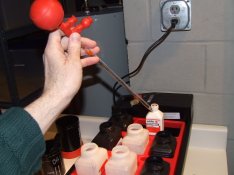
When I use very dilute Rodinal I divide the volume up into multiple bottles and then run the bottles through the Jobo one at a time.
The Jobo tempering box is nice in that it keeps all the bottles up the temperature until they are ready to be used.
Measuringrodinal2.jpg
 
OP
OP
RedSun

RedSun

Member
Allowing Ads
Joined
Aug 27, 2012
Messages
680
Location
New Jersey,
Format
Multi Format
When I use very dilute Rodinal I divide the volume up into multiple bottles and then run the bottles through the Jobo one at a time.
The Jobo tempering box is nice in that it keeps all the bottles up the temperature until they are ready to be used.
View attachment 88511

What do you mean "one at a time"? To process one roll of film, you change the developer several times?
 

pentaxuser

Member
Joined
May 9, 2005
Messages
20,352
Location
Daventry, No
Format
35mm
The min fluid level for the smallest Jobo tank is 140ml (single reel tank). Clearly that is not enough with diluted solution.

It is only not enough if you believe the Kodak specs and ignore Tinsley's experience and the fact that Ilford does not make the same specification for what everyone here on APUG seems to agree( unusually) is the same developer)

Of course you must decide what is correct but like most things connected with photography an open mind with evidence based experience will be a good guide

pentaxuser
 

jp80874

Member
Allowing Ads
Joined
Jul 28, 2004
Messages
3,488
Location
Bath, OH 442
Format
ULarge Format
When I use very dilute Rodinal I divide the volume up into multiple bottles and then run the bottles through the Jobo one at a time.
The Jobo tempering box is nice in that it keeps all the bottles up the temperature until they are ready to be used.
View attachment 88511

Dale,

Am I seeing that outlet correctly? You do want a GFI that close to water or you will be the patient, not the doctor.

John
 

ic-racer

Member
Joined
Feb 25, 2007
Messages
16,740
Location
USA
Format
Multi Format
Dale,

Am I seeing that outlet correctly? You do want a GFI that close to water ....
Very clever observation. When I got my Jobo units, the manual indicated that they should not be put in a darkroom sink, so I made 'dry' countertops on which they are placed. So that 20A electrical outlet is actually on a countertop; following electrical code as in a kitchen. That particular JOBO unit (TB-12) is light enough, even when filled with water, to just carry to the sink to fill and empty. The bigger JOBO is filled and emptied using hoses that run to the sink.
 

ic-racer

Member
Joined
Feb 25, 2007
Messages
16,740
Location
USA
Format
Multi Format
Yes, REDSUN, the total developing time (say 15 min) is divided up into 5 or 6 steps of filling and emptying, each with a new developer bottle. I use a computer spreadsheet to figure out the start-stop times for each bottle and to calculate how many bottles are needed.
 

darkroom_rookie

Member
Allowing Ads
Joined
Jul 5, 2010
Messages
386
Format
Medium Format
I'm using Adox Adonal @ 1+50 & 19 minutes for just recently expired 8x10" Efke 100. 750ml in a Jobo 3004 drum, hand-rolled back and forth, gives beautiful negatives.
 
Photrio.com contains affiliate links to products. We may receive a commission for purchases made through these links.
To read our full affiliate disclosure statement please click Here.

PHOTRIO PARTNERS EQUALLY FUNDING OUR COMMUNITY:


Ilford ADOX Freestyle Photographic Stearman Press Weldon Color Lab Blue Moon Camera & Machine
Top Bottom