
• Welcome to Photrio!
    Registration is fast and free. Join today to unlock search, see fewer ads, and access all forum features.
    Click here to sign up

ISO Flexibility with ND-Filters

Forum statistics

Threads
203,279
Messages
2,852,249
Members
101,756
Latest member
rsj1360
Recent bookmarks
0

Korwin

Member
Allowing Ads
Joined
Jan 23, 2010
Messages
2
Format
35mm
Hello,
I´m absolute new to analog photography. Shooting my second film now.
So don´t wonder about the stupid questions.

I´m just so used to have the possibility to shoot with different ISO from digital photography, and I was wondering if I could just buy a ISO 1600 film and a couple of ND Filters, like ND4 +ND2 to get 4 stops down if I need ISO 100.

So would there be a significant difference between a ISO 100 film and a ISO 1600 Film with ND Filters?

Thanks.
 
Doesn't work like that because 1600 ISO films are very grainy can't resolve fine detail, so shooting with a ND filter at 100 EI will be rather disappointing in terms of quality.

Ian
 
First, a "1600" film maybe have a true speed of 800-1000. Second, they are very grainy and have rather low contrast. (In my mind these modern T-grain ultra-high speed film also have a "boring" mushy grain, but that is my personal taste.) A 100 ISO film on the other hand have from small grain (e.g. PlusX, FP4) to almost invisible grain (Tmax 100, Delta 100).
All film does have grain, in general the faster the film, the larger the grain. Also faster film have "lower" contrast, which can be good ... or bad.
In short, high-speed and low-speed films have very different personalities, with 400 films somewhere in the middle. Try some different films out and learn to use each one of them to your advantage.

I do use ND filters for adjusting film speed, but for other reasons. When shooting with some old lenses without any apertures, I need either much shorter exposure times than are avilable on my large format camera or a slower film than what I got.

//Björn
 
First, a "1600" film maybe have a true speed of 800-1000. Second, they are very grainy and have rather low contrast. (In my mind these modern T-grain ultra-high speed film also have a "boring" mushy grain, but that is my personal taste.) A 100 ISO film on the other hand have from small grain (e.g. PlusX, FP4) to almost invisible grain (Tmax 100, Delta 100).
All film does have grain, in general the faster the film, the larger the grain. Also faster film have "lower" contrast, which can be good ... or bad.
In short, high-speed and low-speed films have very different personalities, with 400 films somewhere in the middle. Try some different films out and learn to use each one of them to your advantage.

I do use ND filters for adjusting film speed, but for other reasons. When shooting with some old lenses without any apertures, I need either much shorter exposure times than are avilable on my large format camera or a slower film than what I got.

//Björn

Agree with all your points but one - TMZ has really really "pretty" grain very much like TX only bigger and lower overall gamma. I have been playing with TMZ for quite a few years and I agree if you TRY to get rid of the grain via "fine grain" developers you get mushy grain but if you go with something that has more bite and acutance it looks pretty fantastic.

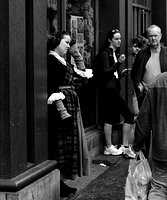
Here is TMZ shot at 3200 (yep pushed 2 stops) developed in Pyro.

2000-067-10.jpg


Here is what the grain looks like at 40x - looks even 'better' in a print.

2000-067-10-grain.jpg


Shot on Leica M6 w/ 90mm Summicron wide open at 1/30 hand held.
 
Last edited by a moderator:
Hi Korwin, welcome to APUG. Film has its own looks, which I think is vastly different from digital. Some will like the look of, say Tri-X while another will like T-Max 400, another will like Neopan 400, or HP-5. Each film will have its own identity or personality. Much different than digital. Its just one of many reasons many prefer film even though they have a digital camera.
 
Agree with all your points but one - TMZ has really really "pretty" grain very much like TX only bigger and lower overall gamma. I have been playing with TMZ for quite a few years and I agree if you TRY to get rid of the grain via "fine grain" developers you get mushy grain but if you go with something that has more bite and acutance it looks pretty fantastic.

Here is TMZ shot at 3200 (yep pushed 2 stops) developed in Pyro.
...

Yes, that's pretty nice. Much different from my experiments with that film which was made with TMax developer containing more silver solvents than the various Pyro developers (hence the fuzzier grain). I have some rolls of TMZ around somewhere, which I'll give a try in Pyrocat HD. Maybe finally I can get TMZ to sing me a song. :smile:

//Björn
 
Yes, that's pretty nice. Much different from my experiments with that film which was made with TMax developer containing more silver solvents than the various Pyro developers (hence the fuzzier grain). I have some rolls of TMZ around somewhere, which I'll give a try in Pyrocat HD. Maybe finally I can get TMZ to sing me a song. :smile:

//Björn

A couple notes - if your TMZ is old it will look like shit. This film fogs so badly with age from background radiation it is not funny.

If you do go with Pyrocat you may want to go with 1+1+50 or 1+2+100 as if you do not your dev time will be eons and you may still have issues getting contrast out of TMZ.

The neg above was NOT my first try with TMZ in Pyro - it is a crazy combo that I think I am the only one that enjoys the aesthetic.

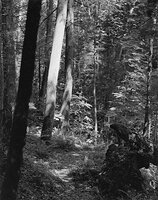
Here is another one - this is actually a different pyro formula than the first and I needed to make it more active to suit my needs.

I shoot TMZ for aesthetic reasons not just the speed - it has a tonal scale that is really nice - I wish it came in 8x10 when I didn't want the grain effects.

2000-067-15.jpg
 
Last edited by a moderator:
Hello,
I´m absolute new to analog photography. Shooting my second film now.
So don´t wonder about the stupid questions.

I´m just so used to have the possibility to shoot with different ISO from digital photography, and I was wondering if I could just buy a ISO 1600 film and a couple of ND Filters, like ND4 +ND2 to get 4 stops down if I need ISO 100.

So would there be a significant difference between a ISO 100 film and a ISO 1600 Film with ND Filters?

Thanks.

If you shoot Ilford XP2 you can just change your ISO as you want, with no filters or special processing. In fact, you can have shots ranging from ISO 50 to 800 all on the same roll. Pretty special stuff, I think...
 
thanks! great tips! going to try some different films.
 
One way to get some flexibility in this regard is to carry two camera bodies, if you shoot 35mm or a camera with a fixed back, or backs loaded with different films for medium format, and in large format, it's quite easy to carry filmholders with different films and to develop each exposure for the given lighting conditions. At one time it would have been an expensive proposition to carry a second body, but film bodies are cheap these days for the most part (presuming you don't insist on only using brand new Leica M7's say), so it's not such a stretch.
 
Hello,
I´m absolute new to analog photography. Shooting my second film now.
So don´t wonder about the stupid questions.

Welcome to the dark room side. :wink:

I´m just so used to have the possibility to shoot with different ISO from digital photography, and I was wondering if I could just buy a ISO 1600 film and a couple of ND Filters, like ND4 +ND2 to get 4 stops down if I need ISO 100.

The real technical answer is no, BUT you can get very close to what you are trying to do and you don't even need the ND filters.

Negative film, especially color negative or B&W Chromogenic film, has a lot more latitude than digital. What that means is that you can miss what might be called the technically perfect exposure by a very significant chunk and still get very usable negatives.

How much latitude?

Well Ilford's XP2 claims +3 to -1, Kodak's brochures claim +3 to -2, so that means if you used a 400 speed film, like Kodak BW400CN, you could shoot at an "EI" of 50, 100, 200, 400, 800, or 1600 and still get very usable results using normal development. No push or pull required.

FYI. The ISO rating of the film is whatever the box says it is. An EI, Exposure Index, is simply what you manually set the camera ISO setting to. (Basically you are just lying to your camera's meter so that you get the speed and aperture setting you want.)

So would there be a significant difference between a ISO 100 film and a ISO 1600 Film with ND Filters?

Thanks.

Yes, the lower the ISO rating the finer the detail and the grain will be smaller.

That said I find 400 ISO negative film very hard to beat.
 
Photrio.com contains affiliate links to products. We may receive a commission for purchases made through these links.
To read our full affiliate disclosure statement please click Here.

PHOTRIO PARTNERS EQUALLY FUNDING OUR COMMUNITY:


Ilford ADOX Freestyle Photographic Stearman Press Weldon Color Lab Blue Moon Camera & Machine
Top Bottom
