• Welcome to Photrio!
    Registration is fast and free. Join today to unlock search, see fewer ads, and access all forum features.
    Click here to sign up

IS Tri-X Supposed to be this Grainy?

Recent Classifieds

Forum statistics

Threads
202,848
Messages
2,846,418
Members
101,564
Latest member
swedafone
Recent bookmarks
0
My ten years of experience with Tri-X and replenished XTOL has NEVER produced grainy results like the OP has. It is called using the right developer and RTFM.

Good for you. My twenty years of experience with TRIX and various developers but not XTOL has also never produced grainy results like the OP has.
 
That's exactly how my Tri-X looks when I run it through the Coolscan V. The wet prints look fine, the Epson V700 scans look fine. The Coolscan V scans...wtf (yes ICE is off).

Cheers,
Andi
 
Good for you. My twenty years of experience with TRIX and various developers but not XTOL has also never produced grainy results like the OP has.

Yes, there are other developers that will produce finer grains, I pointed out one way to do that.
 
I started shooting black & white right around the time Kodak changed Tri-X. I had heard about Tri-X being grainy, punchy, etc. Those adjectives must have applied to the older formulation, which I never got a chance to try. I started shooting the new version, and was surprised to find that the grain was not noticeable, developed in either D76 or XTOL. I've never had grain like what you're showing here, even when I rate it at EI 1600.
Dale
 
I like 400TX (135) in D-76 (1+1, 11min, 68°F).
Yes, those are grainy (the negative scans far more than the prints), but I don't mind. For less grain there are other films out on the market.
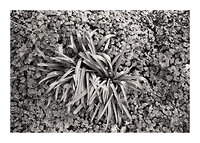
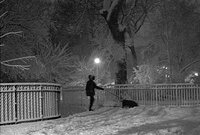
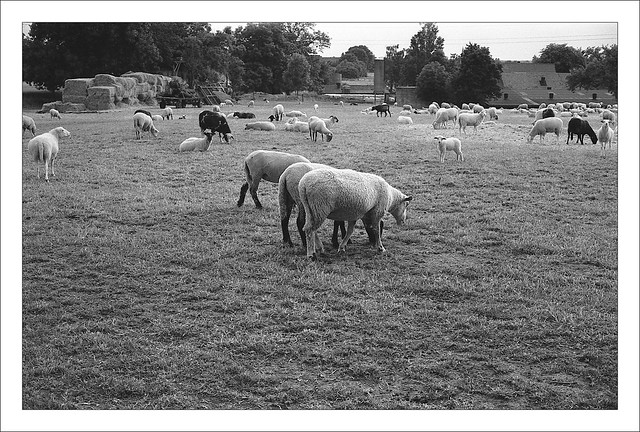
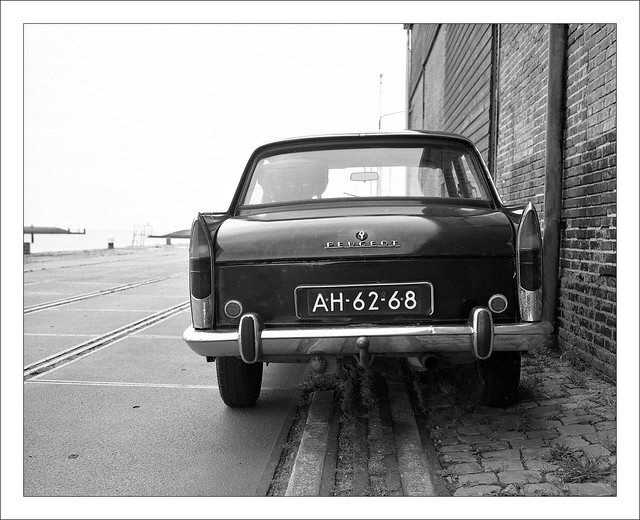
A few examples with an old Konica III rangefinder - Hexanon f/2 48mm :


untitled by Andreas, on Flickr

untitled by Andreas, on Flickr

Over the rooftops by Andreas, on Flickr

The flock by Andreas, on Flickr
 
I've always processed TRI-X in ID-11 which I understand is the same as D76. Never had grain like that, whether printing traditionally or scanning.

However, I am going to stick my neck out and suggest that the "scan" method might be accentuating grain. I know OP has said that examination of the negatives with a loupe reveals the grain is present...but the grain in the shots posted here looks....electronic.

I've shot fresh TRI-X, 16 year outdated TRI-X...frozen TRI-X....all developed in ID-11 and have had results broadly similar to the better photos posted here...not so much grain for sure...unless shot in a crappy point and shoot with a poor lens.

In my experience with outdated film, which is not inconsiderable, it doesn't exhibit more grain...it fogs, loses speed...which might result in more grain if I then processed for longer in an attempt to achieve box speed rather than over expose a stop.

Also...four inversions every 30 seconds? I don't remember Kodak's advice but I've always done two inversions every minute, stock ID-11.
 
Hey guys, "OP" here. As I mentioned in my last post, I decided to load up another roll of this Tri-X Pan and shoot it. So I did, yesterday. Developed it in D-76 yesterday too. 20C for 9 minutes, according to the inside of the Tri-X Pan box. And yes, Agulliver, I agitated it every 30 seconds. I was taught to do it this way many years ago, and that's the way I've always done it. But this time, instead of inversions, I decided to try spinning it gently, using the spindle.

The results were troubling. The whole roll looks like it was either underexposed or underdeveloped. Probably the latter, I'm thinking. Maybe I should have inverted instead of spinning? This Tri-X Pan expired in 2004, and I don't know how it was stored before I acquired it a few years ago. I'm now almost certain it came with a Canon A-1 outfit I bought then. It was probably just left in the bag for 10 years.

Anyway, I have one more roll, and I think I'll increase development times with it by at least a minute. I had to do that with the Plus-X I had that expired in 1983, but which had been frozen for all the intervening years. Those negs were thin if I developed it at recommended times, but by increasing development time by about a minute, this added nicely to the negs' density.

I've examined this latest roll with a loop and the grain is pronounced with some of the negs, not so bad with others. And I agree with Agulliver, the grain looks almost electronic.

I'm still getting used to the way the Pentax MX meters scenes. I think at least part of the problem is having underexposed shots -- when I thought I was getting correct exposure according to the MX's meter. It's accurate, but its center-weighted metering pattern is probably what is fooling me. I was able to rescue some of the shots, thanks to Photoshop's excellent raw file converter, but I couldn't rescue all. Following are some of the latest results.

These first three were exposed properly, it appears. They still show grain when viewing at higher magnifications, but I don't find it objectionable. The fourth was somewhat underexposed, it appears, so I hit it pretty hard with the Curves function, a look I don't mind, to be honest.

A leaded window from the exterior, Pentax MX, Tokina 70-210/4-5.6 SD, Tri-X Pan
pentax_mx_leaded_window_4a.jpg


A leaded window from the interior, same exposure details as above.
pentax_mx_leaded_window_inside_4a.jpg


Front Porch Scrollwork, same exposure details.
pentax_mx_front_porch_scrollwork_2a.jpg


Cat on Driveway, hard contrast. Pentax MX, Tamron SP 24-48, Tri-X Pan

pentax_mx_raja_front_yard_1a.jpg
 
For a bit of a taste of the old Tri-X try Ilford HP5+.
 
Photrio.com contains affiliate links to products. We may receive a commission for purchases made through these links.
To read our full affiliate disclosure statement please click Here.

PHOTRIO PARTNERS EQUALLY FUNDING OUR COMMUNITY:


Ilford ADOX Freestyle Photographic Stearman Press Weldon Color Lab Blue Moon Camera & Machine
Top Bottom