• Welcome to Photrio!
    Registration is fast and free. Join today to unlock search, see fewer ads, and access all forum features.
    Click here to sign up

Is this developing method correct?

Boardwalk

A
Boardwalk

  • 6
  • 4
  • 64
Speculative Silence

D
Speculative Silence

  • 1
  • 0
  • 38

Recent Classifieds

Forum statistics

Threads
202,118
Messages
2,835,405
Members
101,123
Latest member
Jirikid
Recent bookmarks
0

mingaun

Member
Allowing Ads
Joined
Apr 9, 2011
Messages
86
Format
35mm RF
Hello,

After looking at YouTube I came up with the following steps to develop my Adox CMS 20 film, my first attempt at developing film. All the working solution will be at 20C but my washing water will be at 28C. Can someone help verify if my steps below are correct

1. Developer fluid (adotech) agitate first 30s then 5s of every 30s thereafter for five minutes.
2. Pour in stop bath (eco-pro acid stop bath) and agitate continuously for 30s.
3. Pour in rapid fixer (premium Arista) and agitate the first minute and leave it for one minute.
4. Rinse first wash with water continuously for 5minutes
5. Immerse in Eco-pro hypo wash for 5 minutes agitating it for the first half of the time.
6. Final wash with water for 10minutes
7. Immerse in wetting agent for 30s without agitating
8. Hang to dry

Thanks
Mark
 

mwdake

Member
Allowing Ads
Joined
Aug 25, 2007
Messages
794
Location
CO, USA
Format
Multi Format
I would not go from 20c to 28c.
Try to get your wash water down closer to your solutions or gradually increase the wash water temp if you have to.
 

Rick A

Subscriber
Allowing Ads
Joined
Mar 31, 2009
Messages
10,038
Location
Laurel Highlands
Format
8x10 Format
You will need to temper your wash water to the same temp as your other chemmies. If you dont, you could cause a problem with reticulation. The rest sounds ok, but I dont use those chems to know for sure. If you wash your film ala Ilfords method you will save water.
 

tkamiya

Member
Allowing Ads
Joined
Oct 3, 2009
Messages
4,284
Location
Central Flor
Format
Multi Format
I go from 20C to mid 20s all the time and never experienced any type of problem. I *think* reticulation can be an issue if you go DOWN in temp, not up... I *think* if you go too high in temp, emulsion softening may become a problem. 28C may be on a high side though. I don't know where OP lives, but tap water that warm in your locality??

I don't know Arista fixer but 2 minutes total in fixer seems too short even if it is a rapid fixer. Is that what instructions say?
 
OP
OP

mingaun

Member
Allowing Ads
Joined
Apr 9, 2011
Messages
86
Format
35mm RF
i live in Malaysia and my tap water is that warm. Occasionally it might go down to 27C. Right now i am using ice to cool down my working solution. Not sure if it is physically possible to use ice and wash at the same time. I guess i might just have to try it and see how it goes. The rapid fixer says 1-2 minutes and i am already erring on the longer time.
 
OP
OP

mingaun

Member
Allowing Ads
Joined
Apr 9, 2011
Messages
86
Format
35mm RF
Seems like the general consensus here is to use a longer fixing time. Will it do any harm if i lengthen the fixing time to more than what is recommended by the brand? Maybe double the time to two minutes?
 

walbergb

Member
Allowing Ads
Joined
Sep 19, 2005
Messages
429
Location
Brandon, Man
Format
Multi Format
Increasing fixing time, within reason, shouldn't be a problem. Better if you learn to learn to read your film. After a couple of minutes of fixing, you can take a brief look at your film. If you see anything that looks cloudy, then put the cover back on and fix for another minute. The edges of the film should be clear except for base fog. Different films will look different when cleared. Also after storing your film, if you see your film changing colour over time, you can always put the film back in the fixer. Return the strips onto the reel, soak the reel in water to soften the emulsion, and fix for a couple more minutes. You will still have to hypo, wash, and rinse as before.

Another suggestion I have is to save the lead portion of your unexposed film (1-2 inches). Put it in a small amount (50 ml) of fixer and time how long it takes to clear. The general rule of thumb is to fix your film for double that amount of time. This method takes into account the type of film and fixer combination you use.

One final comment. I agitate 10 seconds out of every 30 seconds. I've never heard of letting the film sit in fixer for a minute without agitation (not saying it can't or shouldn't be done).
 
OP
OP

mingaun

Member
Allowing Ads
Joined
Apr 9, 2011
Messages
86
Format
35mm RF
Thanks for the tip walbergb. Thats seems like a good solution to the problem.

I notice nobody commented on the hypo was solution. I read a lot of website that claims it is a redundant step. Is that true? Also if i was the film in water for too long will it be a problem?
 

MattKing

Moderator
Moderator
Joined
Apr 24, 2005
Messages
55,399
Location
Delta, BC Canada
Format
Medium Format
We need a "sticky" here on APUG which sets out how to do a clearing test.

Here is how to test for the correct fixing time.

Take a piece of undeveloped film (a one inch piece of the leader will work fine).

Put a small drop of your fixer on the emulsion side and lay it down flat. Watch it until the area under the drop appears clear or close to clear.

Put that piece of film leader into a container with a little bit of your fixer (enough to submerge it), begin timing and agitate it regularly.

The film will start to clear. When it has cleared enough that you cannot tell where the drop had been, note how much time has elapsed - that is the clearing time. You need to fix the film for between two and three times the clearing time. For example, if the clearing time is one minute, than your total fixing time should be at least two minutes, and preferably three minutes.

If possible, it is best to split that total time into two, and do the first half in one batch of fix, and the second half in another batch of fresh(er) fix. If you do do this, a total fixing time of twice the clearing time should suffice.

If you reuse your fix (and you probably should) you will find that the clearing times get longer with reuse. I discard used fix after the clearing time has increased to 1 1/2 the original time.

You can do your clearing time test at the same time as you fix the roll of film. That way you know that when the test piece of film is cleared, your roll of film is between 1/2 and 1/3 fixed.
 
OP
OP

mingaun

Member
Allowing Ads
Joined
Apr 9, 2011
Messages
86
Format
35mm RF
Matt thanks for the input and sounds like a good idea. But to be honest all this is really getting over my head. It is spinning at the moment. Coming from digital to film for the first time i have to say i am in a bit of a culture shock. It is much more complicated than i thought. In digital there is so much automation, now in film it is all manual... phew. I hope the end result will be worth it.
 

Steve Smith

Member
Allowing Ads
Joined
May 3, 2006
Messages
9,110
Location
Ryde, Isle o
Format
Medium Format
If your water comes out of the tap at 28 degrees then see if you have a graph of time vs. temperature with your developer. If the time for 28 degrees is not ridiculously short (less than 4 minutes) then consider using it at that temperature rather than trying to keep it at 20.

Another option would be to go up in stages. i.e. develop at 20, stop at 22, fix at 24, initial rinse at 26 then final rinsing at 28.


Steve.
 
OP
OP

mingaun

Member
Allowing Ads
Joined
Apr 9, 2011
Messages
86
Format
35mm RF
going up in stages while washing is what i plan to do at the moment.
 

marco.taje

Member
Allowing Ads
Joined
Aug 11, 2009
Messages
116
Location
Gallarate, I
Format
Medium Format
One other option, mingaun..

If you use Ilford's recommended washing method, you will actually need just three times the quantity held by your tank. This would make it easier to prepare that quantity of water, bring it down to reasonable temp and then use it for the wash procedure.

Just a thought.
 
OP
OP

mingaun

Member
Allowing Ads
Joined
Apr 9, 2011
Messages
86
Format
35mm RF
Marco, i did not know that! That would be perfect. I actually thought i need to use running water all the time. I need to find more information on this method.
 

George Collier

Subscriber
Allowing Ads
Joined
Feb 23, 2005
Messages
1,374
Location
Richmond, VA
Format
Multi Format
I used a fill and dump method in summers for many years, making a bucket of water with ice and tap water. Ilford's method must be adequate, but I've never wanted to trust that few times for fill and dump. My method was 20 - 25 times and I still have negs from the 60's that are good.
Re the temperature, the consequences mentioned are the extreme ones, but it's also generally accepted that consistent temperature throughout the entire "wet time" will give you smoother, tighter grain patterns. I think most folks shoot for +/- 1 degree.
Also, you don't mention how you submerge the film in PhotoFlo, but it is generally recommended that you remove from the reel to submerge to avoid leaving PF on the reel by mistake. Many folks use a "see-saw" method to dunk the film for 30 sec; right hand up, left hand up ("wash on - wax off":tongue:)
 

Jeff Kubach

Member
Allowing Ads
Joined
Sep 29, 2007
Messages
6,912
Location
Richmond VA.
Format
Multi Format
I used a fill and dump method in summers for many years, making a bucket of water with ice and tap water. Ilford's method must be adequate, but I've never wanted to trust that few times for fill and dump. My method was 20 - 25 times and I still have negs from the 60's that are good.
Re the temperature, the consequences mentioned are the extreme ones, but it's also generally accepted that consistent temperature throughout the entire "wet time" will give you smoother, tighter grain patterns. I think most folks shoot for +/- 1 degree.
Also, you don't mention how you submerge the film in PhotoFlo, but it is generally recommended that you remove from the reel to submerge to avoid leaving PF on the reel by mistake. Many folks use a "see-saw" method to dunk the film for 30 sec; right hand up, left hand up ("wash on - wax off":tongue:)

I have to remember that!

Jeff
 

RalphLambrecht

Subscriber
Allowing Ads
Joined
Sep 19, 2003
Messages
14,962
Location
K,Germany
Format
Medium Format
Marco, i did not know that! That would be perfect. I actually thought i need to use running water all the time. I need to find more information on this method.

mingaun

Actually, using hypo clearing agent prior to a 10-minute wash under slowly running water is still the best way to wash film in my opinion. Ilford's method was designed around a need to conserve water during the water shortages in Britain at the time. If properly implemented, it works well, but is more laborious and not superior to running water.
 
OP
OP

mingaun

Member
Allowing Ads
Joined
Apr 9, 2011
Messages
86
Format
35mm RF
After further thoughts, i have decided to change my steps a little, namely excluding the hypo wash after confiding with some individuals who has used this film before.

1. Developer fluid (adotech) agitate first 30s then 5s of every 30s thereafter for five minutes.
2. Pour in stop bath (eco-pro acid stop bath) and agitate continuously for 30s.
3. Pour in rapid fixer (premium Arista) and agitate the first minute and leave it for one minute.
4. Final wash with water using the Ilford method (this is the only way i can wash the film at 20C)
5. Immerse in wetting agent for 30s without agitating.
8. Hang to dry.

Any comments or advice is much appreciated
 

tkamiya

Member
Allowing Ads
Joined
Oct 3, 2009
Messages
4,284
Location
Central Flor
Format
Multi Format
Of course, you can do whatever you wish. But... Skipping HCA and using low water method, you might have some issues down the road. If any fixer is left in the film, unwashed, you won't see any effects immediately. But in few years or maybe sooner, you will see stains and discolorations. At which point, it's too late. If you intend to keep your negs for a while, I would strongly suggest using HCA or washing far longer. (or both)

Everybody has opinions..... and you'll hear a bunch. I'd prefer to error on side of caution and process conservatively when it comes to negatives. I fix longer and wash conservatively.

edit
I just looked up Arista Premium liquid fixer.... it does say it clears film in 30 seconds or less. Wow!
 
Last edited by a moderator:
OP
OP

mingaun

Member
Allowing Ads
Joined
Apr 9, 2011
Messages
86
Format
35mm RF
tkamiya, thanks for the reminder. I know that it would be better to rinse it with more volume of water but my main concern now is still temperature. My tap water is 28.5C. I feel temperature will have a more detrimental effect than volume of water. I may be wrong. I wish someone can just tell me to use 28C water and no problem. I will be happily doing that. I even thought of filling up a whole big bucket of 20C water and pouring it in slowly for 5 minutes but i think i might break my back. Thus my dilemma.
 

RalphLambrecht

Subscriber
Allowing Ads
Joined
Sep 19, 2003
Messages
14,962
Location
K,Germany
Format
Medium Format
... Everybody has opinions..... and you'll hear a bunch. I'd prefer to error on side of caution and process conservatively when it comes to negatives. I fix longer and wash conservatively. ...

Amen to that!

... I know that it would be better to rinse it with more volume of water but my main concern now is still temperature. My tap water is 28.5C. I feel temperature will have a more detrimental effect than volume of water. I may be wrong. I wish someone can just tell me to use 28C water and no problem. I will be happily doing that. I even thought of filling up a whole big bucket of 20C water and pouring it in slowly for 5 minutes but i think i might break my back. Thus my dilemma.

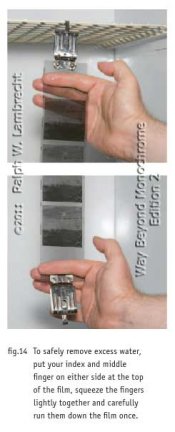
A temperature of 28C is high, but the only risk is emulsion damage from excessive swelling. If handled with care, 28C is a maximum but possible washing temperature. The warmer the water, the better the washing, by the way. I suggest to use two bath fixing (2 min each), HCA (2 min) and a standard wash of 10 minutes in slowly running water. Then, a final bath in distilled water, hang to dry and use nothing but your fingers to get rid of excess water.
 

Attachments

  • FilmDrying.jpg
    FilmDrying.jpg
    18.8 KB · Views: 95

marco.taje

Member
Allowing Ads
Joined
Aug 11, 2009
Messages
116
Location
Gallarate, I
Format
Medium Format
I certainly have little competence to say either method is better. But I think Ilford has a bit of it. I suppose that, before recommending something, this something has been tested, at least a bit. Now, if somebody wants to do something different, that's ok, but doing so with the assertion of a manufacturer recommended method being insufficient sounds a bit pretestuous to me.

But regarding the fixer... yes, I also think that 2 minutes is very low. Even manufacturers generally state a time variable between 4 and 6 minutes. I generally stick to 6, with 2 inversions every 30s.
 
OP
OP

mingaun

Member
Allowing Ads
Joined
Apr 9, 2011
Messages
86
Format
35mm RF
A temperature of 28C is high, but the only risk is emulsion damage from excessive swelling. If handled with care, 28C is a maximum but possible washing temperature. The warmer the water, the better the washing, by the way. I suggest to use two bath fixing (2 min each), HCA (2 min) and a standard wash of 10 minutes in slowly running water. Then, a final bath in distilled water, hang to dry and use nothing but your fingers to get rid of excess water.

Editing my post because misunderstood your statement.

Ralph can i just wash with water at 28C for 2min right after fixing which was done at 20C, then followed by a hypo wash for 2min also at 28C and then a final wash in water at 28C for 10minutes. And if i understood you correctly i just use my fingers and need not use a wetting agent?
 
Last edited by a moderator:

Steve Smith

Member
Allowing Ads
Joined
May 3, 2006
Messages
9,110
Location
Ryde, Isle o
Format
Medium Format
Ilford's method was designed around a need to conserve water during the water shortages in Britain at the time.

And the fact that a lot of us have water meters so it costs money to keep the tap running.


Steve.
 
Photrio.com contains affiliate links to products. We may receive a commission for purchases made through these links.
To read our full affiliate disclosure statement please click Here.

PHOTRIO PARTNERS EQUALLY FUNDING OUR COMMUNITY:


Ilford ADOX Freestyle Photographic Stearman Press Weldon Color Lab Blue Moon Camera & Machine
Top Bottom