
• Welcome to Photrio!
    Registration is fast and free. Join today to unlock search, see fewer ads, and access all forum features.
    Click here to sign up

Is this cheating?

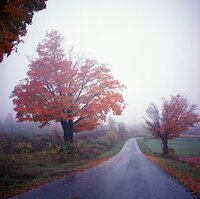
Rainy Day Trees

A
Rainy Day Trees

  • 4
  • 0
  • 49
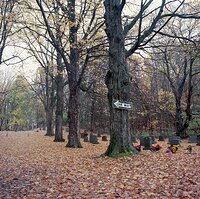
One Way

A
One Way

  • 1
  • 1
  • 47

Forum statistics

Threads
203,148
Messages
2,850,572
Members
101,698
Latest member
Weishampel
Recent bookmarks
0
For the uninitiated, pencil masking is simply taping the neg in the carrier (better to have a glass carrier) then taping a piece of frosted mylar over the glass. Place the sandwich over a lightbox and dodge whatever you wish with a soft (or hard) pencil. Once you get it the way you want it, you can make any number of prints that are basically the same. I really use it though for very small areas or complex shapes that need to be dodged which are impossible to do any other way.

My favorite diffusion material is the frosted side of the Print-File 4x5 individual sleeves. Since it isn't so opaque it doesn't effect the exposure like frosted mylar. It also allows the pencil lines to be more precise due to the same fact.

Here is a before/after example of a print that probably could not be made any other way. There are other methods going on here too, but the main manipulation is done with a mylar mask. They are cropped differently as well. Straight proof scan/print scan. You can see how low in contrast the negative is. Hope this helps.


Devil's Wind, Death Valley 1998
Untitled-1.jpg
 
Thanks for explaining that Patrick. Why would Ross write that "it does NOT work with condenser enlargers" ?
 
So does that mean this technique works fine with a condenser enlarger as long as you have that plexi glass in place ? i.e. Ross' statement I quoted above needed some qualifying.
 
Patrick - good example!

I agree. Really illustrates the technique well.

Only slightly off topic, but a similar technique can be used for paper negatives. It's been years since I've done them but, I often used pencil on the back of paper negatives, before making the positive, for the same reason.
 
So purely from an analog standpoint. Could you take a peice of frosted mylar (or even thin paper), and draw your mask on the enlarged image, then place your mask directly on top of the paper for your dodge or burn exposure?
 
It's easy to turn a condenser light source into a diffused one. But you do need scattered light for most masking purposes. For diffusion sheet in contact with film I prefer 5-mil mylar, frosted on both sides. You can buy it in big sheets or rolls. Inspect cut sheets of it on a light box for any blemishes before using them. But don't use acetate or thin mylar, which will easily kink. It's a bit of a pain to register film with masking over the lightbox, but OK for learning purposes. Once you get serious, it is wise to invest in a punch and register system. Large format sheet film is obviously the easiest to work with, and flimsy 120 roll film the worst.
 
It's all relative, Michael. That's why old school portrait photographers liked 11x14 cameras - it was so easy to do the smudge or dye work
directly on the film itself. It's easy to do on 8x10 too. But try it on something like a little 645 neg, or even on an attached mylar sheet with
diffusion, and things get rather problematic. It can be done, but it's only a matter of time till the folks in the white coats haul you off to a
padded cell. What is unfortunate is that so many basic methods of work have simply been forgotten. If you browse used book stores, you
can sometimes come up with old Kodak darkroom or graphics arts manuals that show the traditional tricks. Masking can be either as simple or
as complex as one wishes, just like printing itself.
 
To address some of the above posts, in my experience (which is two decades worth FWIW) there doesn't need to be any diffusion plexi used. I have always placed the mylar (or whatever else was available including paper) directly above the glass of the negative carrier. My current enlarger is a Saunders 4550 and the mixing box for 35mm is a combined diffusion/single condenser (similar to a Leitz V35). The technique works fine without adding any diffusion. The glass of the negative carrier provides enough space that whatever you put on top of it will be out of focus.
 
Come on , Cheat us as much as you want , making better art is more important.

Nah, not relying on a computer in an age where everyone else does is what makes me happy, and if I am happy, I am going to make my best art, especially when selling prints is my career. I have a strict internal policy against digital and my darkroom, it just works.

I like seeing talent raw, not cooked.
 
Last edited by a moderator:
The problem with placing something above the neg glass is that it does need to be stiff so it won't buckle with heat. Some neg carriers, like pro
Durst in particular, have built in registration pins. So you could use these for a piece of plexi or white polycarbonate with drilled alignment holes, and achieve approximate register. True register is a different subject, if you ever decide to get into lith highlight masks etc. Masking is a lot of
fun if you like hand-on darkroom work in general. There are soooo many ways of doing it, and various options to explore, even with a low
budget.
 
Anybody remember Minit Mask?
 
The flaw with Minit Mask was that was generic at best and couldn't be tailored by the color of light like panchromatic film. Another problem was that photochromic glass loses its efficiency over time. But the worst part is that the whole futzing part with the carrier had to be done in darkness, so avoiding dust was pretty difficult. I never invested in it, thank goodness. More sophisticated photochromic masking systems still exist for a limited number of industrial resist applications, but I'd be surprised if they ever catch on in general photography. It's just too easy to do better with pan sheet film, once you get past the more elementary techniques. Of course, many of these options can be used in combination, for those inclined to a challenge.
 
Hey Drew. Thanks! I guess the technology was over hyped. Older ways of masking are sometimes better.
 
Well ... I guess I forgot what was REALLLY worst with photochromic glass masks.... You had to flash expose it over and over, generally for every single print. You couldn't just make your master film mask and leave it taped in place year after year. And in your case you'd be doomed... your feline lab assistants would start seeing ghost mice floating around the room after awhile, coming back to haunt them!
 
Nah, not relying on a computer in an age where everyone else does is what makes me happy, and if I am happy, I am going to make my best art, especially when selling prints is my career. I have a strict internal policy against digital and my darkroom, it just works.

I like seeing talent raw, not cooked.


i think there is something to be said for this.
i don't use a comp when i am in my dr either
but i don't think it is cheating to use one.
i see it a little different between raw and cooked
instead i see it like using extracts to make beer
or grains AND extracts or all grain.

all are able to make delicious beverages.
it is just personal preferences.
and it is good to see some people using all grains
when making homebrew. i like using a combination ....
 
Surely there can be no such thing as cheating when we are seeking to create an image? Are we not in danger of wearing our analogue credentials as some kind of scout badge? We use photography to express ourselves in our images. Working with analogue tools suits us or we wouldn't be on this forum, but if a photographer chooses to manipulate their images with an addition of some digital techniques that doesn't make them a cheat, neither does it make them, or their work, inferior...


RR
 
I dunno...people should do whatever pleases them but I wouldn't do this. An imperfect analogy would be a painter projecting a paint-by-numbers template onto a canvas and filling in the colors with a brush and calling it "painting."
 
I mean, why not just Photoshop a perfected digital negative and contact print it and call it analog. Technically, it is. It has no more of an intermediate digital step between negative and silver print than does what's being described here. Why use a negative in an enlarger at all? Where is the line one doesn't cross.

I watched a video on platinum printing last night and it was done just exactly as I describe above.
 
yes, please continue the analog masking talk! I'm new to printing and find this very interesting. Yes digital is everything wrong with the world...blabbity blabbity blah....lets not beat the dead horse thats been dead for quite some time.


Soooo...I shoot 6X7 and sometimes 35mm. No LF yet. What would be the best way for me to go about doing some of these selective masking techniques? Film plane or paper plane? I'd imagine at the paper it may be easier as I'm working with a larger image. I have a Beseler 23C II with the VC head, so that should work should I decide to do it at the film plane. I do not have a glass carrier though. Any thoughts?
 
Ctein and Barry Thornton have both written some pretty good guides to masking in their books.
 
Film masking should always be done with sheet film. For 6x7 use you'd want 4x5 TMX100 exposed by contact with a 5-mil frosted mylar sheet
in between. For developer, highly diluted HC-110 works best. I won't go into details here. But then somehow you have to register the images
together for printing, and then tape them together with dimensionally-stable mylar tape. 35mm is a little easier to visually register over a light
box using the sprocket holes. But the idea is to learn the basics, and then if you want to get serious, buy a film punch and matching register
contact frame. You don't need register pins in the carrier because the mask will be taped in register to the original neg to begin with. And you don't need scan & PS controls to do even advanced masking. That's a huge myth. But if that's what you like, there are suitable forums for that too. But I must stress that at this point in history, TMX has the best properties for small format masking, esp once you go advanced.
For large format film FP4 also does a good job, but is a tad too grainy too be ideal with 35mm or roll film negs. (Yeah, yeah... I can anticipate
all the calculator-crowd arguments to this remark, but I've thoroughly tested all the reasonable options, so save yourself a headache).
 
There is deep technical knowledge in techniques of masking intermediate photographs to produce final photographs but there hasn't been a parallel effort in unpacking the conceptual challenges.

Photographs can be usefully classified as primary photographs, secondary photographs, tertiary photographs and so on. A primary photograph is camera-original material that has absorbed light from the original subject. A secondary photograph is a photograph of that primary photograph...and so on. The idea that taking photographs of photographs is "printing" tends to make people blind to what is actually going on. Photography is making pictures out of light sensitive substances while printing includes a broad range of processes that make pictures by laying down ordered marks. That prints can be contrived to resemble photographs does not negate the principle that "different" is not "the same".

In common practice the primary photograph is a film negative and secondary photography is performed using photographic emulsion coated on paper rather than film base. A secondary photograph will treat the primary photograph as subject matter. But it also can include blurry images of additional subject matter for example the photograph-maker's hands, a burning card, a dodging wand, and perhaps a mask. Even if the mask is electronically produced the final result remains a photograph. But the introduction of a digitally contived element does imbue a photograph with a quality I call "The Curse of The Hidden Pixel".

The "curse of the hidden pixel" is fatal to an expectation that a photograph is causally linked to material reality by chemical and physical processes. If no such expectation is entertained there is no problem. Pragmatically though I reckon hidden pixels are incorporated in photographs as often to deceive as to entertain. And I can't refrain from absolute contempt for an art where success is equated with successful deception.
 
In common practice the primary photograph is a film negative and secondary photography is performed using photographic emulsion coated on paper rather than film base.

:smile:
 
Nobody would pay a nickel to see Raphael Nadal play tennis with a net two inches high. Craftsmanship matters, the process matters, and overcoming difficulties matter.
 
Photrio.com contains affiliate links to products. We may receive a commission for purchases made through these links.
To read our full affiliate disclosure statement please click Here.

PHOTRIO PARTNERS EQUALLY FUNDING OUR COMMUNITY:


Ilford ADOX Freestyle Photographic Stearman Press Weldon Color Lab Blue Moon Camera & Machine
Top Bottom
