

• Welcome to Photrio!
    Registration is fast and free. Join today to unlock search, see fewer ads, and access all forum features.
    Click here to sign up

Is this a processing problem?

Vertical WPC

A
Vertical WPC

  • sly
  • Jan 30, 2026
  • 0
  • 0
  • 5
Conversations.

A
Conversations.

  • 8
  • 4
  • 65

Recent Classifieds

Forum statistics

Threads
202,046
Messages
2,834,372
Members
101,088
Latest member
PHXPhotoGuy
Recent bookmarks
0

Etch

Member
Allowing Ads
Joined
Aug 15, 2012
Messages
9
Format
Multi Format
Hi
I'm new to film photography and send all my film to a pro lab for processing.
I've been testing different varieties of black and white film to find the ones I like best for serious work.
I recieved a roll of t-max 100 back the other day and most of the skies show a problem.
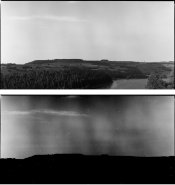
The attached file shows a crop of the sky of one of the worse images. The first is a standard scan and the second one has the levels adjusted to show the problem more clearly.
I'm wondering if this is a processing problem or whether it could be caused by a filter? I'm using some rather cheap Lee colour filters made from polyester. They are square and quite bendy. I'm pretty sure I used an orange filter on this one.
Thanks.
 

Attachments

  • Tmax.jpg
    Tmax.jpg
    396.7 KB · Views: 158

pentaxuser

Member
Joined
May 9, 2005
Messages
20,378
Location
Daventry, No
Format
35mm
I take it you are sure that the scan of the neg faithfully replicates the problem on the neg which is obvious to your eye? It cannot be a scanning issue?

I'd have expected a more defined sky with an orange filter but I doubt that the Lee filter will be the problem unless it has an obvious defect which presumably you'd have noticed.

Has this pro-lab processed other films of yours satisfactorily?

If a pro-lab processes the film only how do you produce prints? If the defect is in the neg but your camera hasn't produced such negs before then it suggests that the pro-lab's processing is at fault. If it is a pro-lab then talking to them and returning the neg should produce an acknowledgement that the fault is theirs.

With the cost of pro-lab processing and the risk of relying on others, I'd consider purchasing the equipment to do it yourself.

pentaxuser
 
OP
OP

Etch

Member
Allowing Ads
Joined
Aug 15, 2012
Messages
9
Format
Multi Format
The problem is visible on the negative itself.
I have had a problem with a roll of Pan-F which they developed but it was a different type of problem which they claimed was most likely moisture damage. And not caused by them.
I've only had problems so far with black and white film. I've also been using slide film.
I'll probably e-mail them tomorrow but thought i'd ask here first for an impartial opinion.
 

polyglot

Member
Allowing Ads
Joined
Jun 12, 2009
Messages
3,467
Location
South Australia
Format
Medium Format
It looks to me sort of like surge marks from developing. Do you know how they're processing (agitating, specifically) the B&W film? Doesn't look like filter issues.

My guess is that their colour stuff runs through an automated processor and the B&W (do they charge a lot more for B&W?) gets done by hand, which would explain why their colour results are good and the B&W are not.

Since this is roll-film, I would recommend you process it at home. It's a little time-consuming but so very much cheaper and you get much better control than just handing it over. For about $50-100 of equipment and about $1/roll in chemistry you can do your own in the kitchen sink; see the FAQ in my signature.
 
OP
OP

Etch

Member
Allowing Ads
Joined
Aug 15, 2012
Messages
9
Format
Multi Format
I don't know how they are processing specifically. The lab is peak imaging in the UK, on their site it says they use refrema processing machinery, which means nothing to me. The price is the same for both slide and B+W.
At the moment i'm just experimenting with film. If i start shooting it a lot I probably will look into developing it myself.
 

chamon88

Member
Allowing Ads
Joined
Aug 8, 2007
Messages
10
Location
Montreal
Format
Medium Format
How they process the B&W film by hand , dips dunks ,roller transport ? That happen on all frame and what size of film 35 , 120 ?


Chamon
 

Gerald C Koch

Member
Allowing Ads
Joined
Jul 12, 2010
Messages
8,131
Location
Southern USA
Format
Multi Format
If you value your pictures then process your own film. Then you can have some one make the prints. Yeasr ago there were companies that took pride in their work. For example Henri Cartier-Bresson never did any developing and relied on a reputable lab.
 

cepwin

Member
Allowing Ads
Joined
May 26, 2012
Messages
336
Format
35mm
I agree with Gerald. There's a learning curve but bw is relatively easy. The hardest thing for me was learning how to reel the film (learned the hard way the reel must be dry, fix for the correct time, etc.) I'd encourage you to give it a try.
 

bdial

Subscriber
Joined
Jan 2, 2005
Messages
7,516
Location
North East U.S.
Format
Multi Format
I agree that it looks like surge marks, which are usually caused by agitation technique. It's due to developer surging through the sprocket holes of 35mm film, and causing excessive chemical activity where the developer is flowing the strongest (through the holes). It's not a result I would expect from a "Pro" lab, although all human endeavors are subject to mistakes. However, the lab should work with you in refunding part or all of your fees, and work on identifying the problem in their processing scheme.

Doing it yourself has much merit, it will not guarantee error free results, but you will be in control of your film destiny.
 

dehk

Member
Allowing Ads
Joined
Aug 4, 2010
Messages
881
Location
W Michigan
Format
Multi Format
Surge marks yes, however is the negative severely over exposed / developed also?
 
OP
OP

Etch

Member
Allowing Ads
Joined
Aug 15, 2012
Messages
9
Format
Multi Format
Thanks for your replies. I will see what the labs response is.
I should have pointed out in the opening post that this is 120 film not 35mm.
No, the negative is not severely over exposed.
The strange thing is, the frame before is identical in everything (exposure,filters,light etc) other than it being in landscape orientation and there is no such problem in the sky.
 

MDR

Member
Allowing Ads
Joined
Sep 1, 2006
Messages
1,402
Location
Austria
Format
Multi Format
Exhausted developer and or oxidation.

Dominik
 

bdial

Subscriber
Joined
Jan 2, 2005
Messages
7,516
Location
North East U.S.
Format
Multi Format
That it isn't 35 puts a slightly different wrinkle on things, but it's still an agitation or developer problem, that still can be dealt with by the lab. Skys are often where processing problems show up, because density differences are very obvious there.
 
Joined
Jan 21, 2003
Messages
15,715
Location
Switzerland
Format
Multi Format
The fact that it's a Refrema indicates it's a dip&dunk machine, which probably uses nitrogen burst agitation.
The film hangs vertically into the deep tanks, so if any surge marks were to occur from processing they would be going the other way, or side to side in the scans shown above.
 

pentaxuser

Member
Joined
May 9, 2005
Messages
20,378
Location
Daventry, No
Format
35mm
Peak Imaging has a very good reputation which I am sure it values so customer satisfaction is crucial to its business. I am sure it will be receptive to your concern. I'd make contact with it as a priority. Let us know how the contact with Peak goes

pentaxuser
 
Photrio.com contains affiliate links to products. We may receive a commission for purchases made through these links.
To read our full affiliate disclosure statement please click Here.

PHOTRIO PARTNERS EQUALLY FUNDING OUR COMMUNITY:


Ilford ADOX Freestyle Photographic Stearman Press Weldon Color Lab Blue Moon Camera & Machine
Top Bottom
