• Welcome to Photrio!
    Registration is fast and free. Join today to unlock search, see fewer ads, and access all forum features.
    Click here to sign up

Is N+1 really necessary?

Recent Classifieds

Forum statistics

Threads
202,092
Messages
2,834,988
Members
101,111
Latest member
gil9002
Recent bookmarks
0

brian steinberger

Member
Allowing Ads
Joined
Jan 5, 2007
Messages
3,055
Location
Pennsylvania
Format
Med. Format RF
Say I have a low contrast scene where the shadow value falls on zone III and highlight on zone VI which I'd like to be zone VII in the final print. What differences in a final print would I see if I printed a neg with a range from zone III to VI (given N development) printing the highlight up to zone VII using a higher contrast filter vs. giving that negative N+1 development to bring it up to zone VII and printing with a normal contrast filter?

My experiences have been that a lower contrast negative printed using a higher contrast filter gives more pleasing mid-tones, and highlights with more contrast than printing a neg given N+1 assuming there is adequate shadow detail. N+1 negs seem to have the mid-tones pulled up in value as well.

Anyone have thoughts, suggestions on this?
 

JLP

Subscriber
Allowing Ads
Joined
Feb 22, 2006
Messages
1,608
Location
Oregon
Format
Multi Format
Yes and no! I think it depends on the scene you are photographing and also how you measure your light.
If it is a foggy scene with no clearly defined subject i think your approach is good, leave it at about 4 or 5 zones on the film.
If it is a scene with a a subject that you want to stand out i would suggest processing the negative with a +1 or +2 development time to get some micro contrast which i have a hard time getting if i don't develop the negative to more than 5 zones. I do always try to expand the grays as much as i can processing the film but i need to know where my highlights are when i expose the film so i don't blow them out in the processing stage.
 

nworth

Member
Allowing Ads
Joined
Aug 27, 2005
Messages
2,228
Location
Los Alamos,
Format
Multi Format
By using N+1 development of the negative you mostly just achieve your objective of moving Zone VI to VII and pretty well leave alone the shadow values. Using a higher contrast filter expands the contrast of everything, possibly compromising the shadow values. I suspect the choice should be made in light of long experience with the materials used.
 

ic-racer

Member
Joined
Feb 25, 2007
Messages
16,751
Location
USA
Format
Multi Format
Unless you photograph extremes of light with very high or low contrast lenses, a single development time should be fine if you print with multigrade paper or you have a wide selection of paper grades.
 

eddie

Member
Allowing Ads
Joined
Jul 24, 2005
Messages
3,259
Location
Northern Vir
Format
Multi Format
Micro contrast is an interesting topic in itself. How is micro contrast enhanced differently by giving N+1 development vs. increasing contrast at the printing stage?

I'm not sure I can explain my experience well enough, but I'll try...

This was something we explored while I was in college (1970's). In a very controlled studio environment, we exposed two sheets of film- one N, and one N+1. We printed to match the highlights, using a higher grade filter for the N exposure, lower for the N+1. There was a slight, but definite difference in the values of the midtones. The "higher" values in zone v lightened ever so slightly. I think it's easier to understand if you envision zone v not as an exact value, but as the range between the lightest zone iv value, and the darkest zone vi value. I'm not sure my explanation makes any sense but, put simply, if you stretch the tonal range of zone vi, there is some expansion of parts of zone v, too.
 

JLP

Subscriber
Allowing Ads
Joined
Feb 22, 2006
Messages
1,608
Location
Oregon
Format
Multi Format
In short i find it much easier to make prints if i have a negative with a large tonal range and as many zones as i can get safely in my negatives. It is easier to print " down" than up as far as i know but, i don't know it all so take it as what it is.
I suggest that you go out and find a scene with similar ligthing and shoot one sheet or a roll each way and process accordingly. It's an interesting test and a good learning experience and does not cost very much.
 

Chuck_P

Member
Allowing Ads
Joined
Feb 2, 2004
Messages
2,369
Location
Kentucky
Format
4x5 Format
What differences in a final print would I see if I printed a neg with a range from zone III to VI (given N development) printing the highlight up to zone VII using a higher contrast filter vs. giving that negative N+1 development to bring it up to zone VII and printing with a normal contrast filter?

"Increasing the contrast of a print does not make the whites whiter; it makes the blacks blacker." -----(Anchell, The Variable Contrast Printing Manual). Changing filtration settings in the enlarger does not afftect the whites as long as the paper and filters are speed matched, meaning that you can change the filtration and keep the same basic exposure while not affecting the whites of the print. This is one of the great advantages of using VC paper.

If you want to affect the most important highlight value in the final print, then do it with development controls. N + 1 is absolutely necessary when you consider that old saying that is so very true----"expose for the shadows and develop for the highlights".

The only other thing I would comment on is that you said the shadow value "fell" on zone III and the highlight "fell" on zone VI----with black and white negative film, you base the camera exposure on the "placement" of the shadow on the gray scale in which case it's the highlight that "falls" on the grayscale relative to the shadow placement. All other luminances "fall" on the gray scale relative to the "placement" that is made in determining the camera exposure.
 

Nicholas Lindan

Advertiser
Advertiser
Joined
Sep 2, 2006
Messages
4,316
Location
Cleveland, Ohio
Format
Multi Format
The shape of VC paper's HD curve changes as you change the contrast filtration. At low contrast grades the curve is bumpy and may have flat spots. At higher contrast grades the curve becomes much smoother.

Because of this the look of a lower contrast negative printed with a higher contrast filter can look better than if the negative had been developed to a higher contrast and a lower contrast printing filter had been used.

There is an application note on the Darkroom Automation web site that explains the source of the low-contrast VC paper problem:
http://www.darkroomautomation.com/support/appnotevcworkings.pdf

[It's the same app note that has been on the web site for a year or more. Please email me if this (or other) app note displays with a 'Star Trek' font on your computer.]
 
OP
OP
brian steinberger

brian steinberger

Member
Allowing Ads
Joined
Jan 5, 2007
Messages
3,055
Location
Pennsylvania
Format
Med. Format RF
Thanks everyone for the replies. Good information here.

David, interesting article. Seems there are some in both camps. One thing I have found that no one has mentioned yet is when I expose FP4 for N development I expose it at EI 100. If I expose at EI 100 for N+1 the mid-tones get pulled up too much, basically increasing the density of the entire negative. What I have done to correct this is expose directly in between 100 and 200 and develop for N+1. The results are much better. I know Ansel Adams mentioned the need for reduced exposure when giving N+1 development, but not many mention it. I remember taking a workshop in NYC back in 2006 and the instructor looked at me like I was crazy when I suggested reduced exposure with N+1 development. It tends to echo Michael's point of modern emulsions having more of a short toe, straight line curve where N+1 would pull more of the whole curve upward, which is what I'm experiencing. Reduced exposure seems to keep the low mids and shadows down after N+1 development.
 

2F/2F

Member
Allowing Ads
Joined
Apr 29, 2008
Messages
8,031
Location
Los Angeles,
Format
Multi Format
The only other thing I would comment on is that you said the shadow value "fell" on zone III and the highlight "fell" on zone VI----with black and white negative film, you base the camera exposure on the "placement" of the shadow on the gray scale in which case it's the highlight that "falls" on the grayscale relative to the shadow placement. All other luminances "fall" on the gray scale relative to the "placement" that is made in determining the camera exposure.

The proper definitions of placement and fall are important. But the idea that shadows are the only thing that one may place in all cases is just wrong. You can place a metered subject on any zone, and let all the other tones fall around it. In practice it is usually lower tones that are placed, but not 100 percent of the time.
 
Joined
Jan 7, 2005
Messages
2,743
Location
Los Angeles
Format
4x5 Format
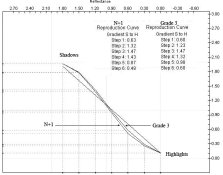
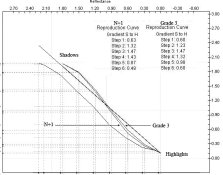
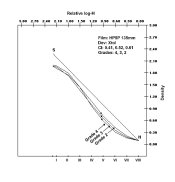
I've attached a tone reproduction curve example. This curve represents how the print value's relate to the original scene's. One curve represents a 1.80 LSLR scene processed Normal and printed on a higher grade of paper (grade 3). The other curve represents a 1.80 LSLR scene processed N+1 and printed on a normal grade of paper (grade 2). In the top right hand corner of the curve are the gradients for each step. The N+1 curve has higher gradients in the mid-tonal range and the Grade 3 curve has higher gradients in higher tones.

Both curves have higher mid-tone gradients than with a "normal" curve from a 2.1 LSLR processed normal and printed on a grade two. The straight line is a reference curve that represents the original scene. Any tones falling over the reference curve are darker than the original tones and any tones falling below the reference curve are lighter than the original scene. A preferred tone reproduction curve that "looks" like the original scene generally fall about 0.15 logs below the reference guide (except for the highlight). I've added a tone reproduction curve with a normal reproduction curve as a reference.
 

Attachments

  • Reproduction curve - Comparing N+1 and Grade 3.jpg
    Reproduction curve - Comparing N+1 and Grade 3.jpg
    126.7 KB · Views: 126
  • Reproduction curve - Comparing N+1 and Grade 3 - with Normal reference.jpg
    Reproduction curve - Comparing N+1 and Grade 3 - with Normal reference.jpg
    139 KB · Views: 141
Last edited by a moderator:

pentaxuser

Member
Joined
May 9, 2005
Messages
20,382
Location
Daventry, No
Format
35mm
I cannot get to the David Kachel link provided and the Paul Butzi link takes me to the Wayback Machine which simply seems to go round in a loop. The Butzi article is quoted but not opened.

Anyone else having problems?

pentaxuser
 

Nicholas Lindan

Advertiser
Advertiser
Joined
Sep 2, 2006
Messages
4,316
Location
Cleveland, Ohio
Format
Multi Format
David Kachel ... provides an alternate viewpoint.

It's not an alternate viewpoint.

There are several effects that need to be discussed:

  1. The effects of N+/-xxx film development
  2. The effects of idealized VC paper response w/ and w/o N+/-xxx film development
  3. The effects of the bumps, dips and flat spots in real-life VC paper HD curves
  4. The inability of VC paper to alter highlight and shadow contrast at the same time

The Darkroom Automation application note addresses points 3 & 4.

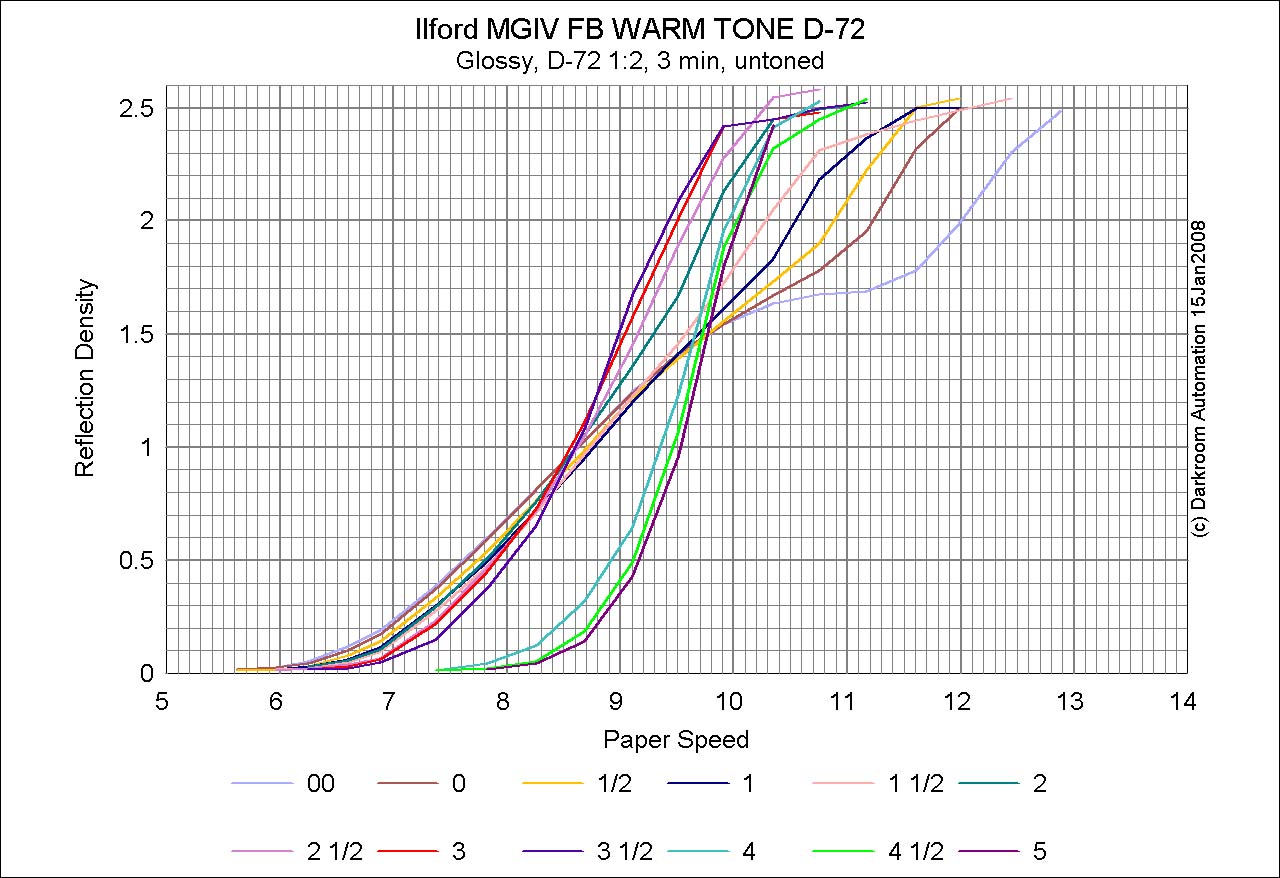
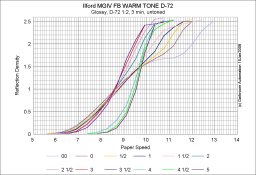
The problems with VC paper can be seen in the curves for MGIV WT:
mgivfbwtd72hd.jpg


Several things are very clear:
  • There is a significant dip in contrast at 1.5 to 2.0 print OD for low contrast filtration
  • Almost all contrast change happens in the shadows when going from grade 00 to grade 2 1/2
  • Highlight contrast only changes in grades 3 to 5, at which time the shadow contrast remains mostly fixed
The shape and location of bumps and dips in the HD curves changes with the specific emulsion and base. RC papers have different curves from FB.

There are no subtle reasons for the differences in grade 0 and grade 3 prints [with negative development adjusted to hold a constant over-all contrast].

Only trial and error with different combinations of development and paper grade will reveal the best combination for your particular case.

The general statement can be made that variations in local contrast will decrease as paper grade increases. For some prints this may be good, for others bad.
 

Attachments

  • mgivfbwtd72hd.jpg
    mgivfbwtd72hd.jpg
    183.7 KB · Views: 87
Last edited by a moderator:

lxdude

Member
Joined
Apr 8, 2009
Messages
7,094
Location
Redlands, So
Format
Multi Format
I cannot get to the David Kachel link provided and the Paul Butzi link takes me to the Wayback Machine which simply seems to go round in a loop. The Butzi article is quoted but not opened.

Anyone else having problems?

pentaxuser

They are working fine for me, except the Butzi article's picture examples don't work.
 
Joined
Jan 7, 2005
Messages
2,743
Location
Los Angeles
Format
4x5 Format
The Butzi article is testing for something different than what the OP defined. Butzi is basically processing the film for different LSLRs, then matching the paper as opposed having one scene range which is shorter than a normal subject range, processing one N and printing on a higher grade or processing N+ and processing on a grade two. The attachment represents the results from a similar test as Butzi's.
 

Attachments

  • Reproduction Curve TMY G2 3 4.jpg
    Reproduction Curve TMY G2 3 4.jpg
    61.3 KB · Views: 102
Last edited by a moderator:
Joined
Sep 10, 2002
Messages
3,676
Location
Eugene, Oregon
Format
4x5 Format
My reading of the David Kachel article seem at odds with some of the views above, that is, unless I'm misunderstanding what is being said here.

From what I understand, Kachel advocates using a higher paper grade when local contrast (micro-contrast) needs to be increased. In cases where the local contrast is not high enough, he even recommends contraction developments in conjunction with a higher paper grade. It's just the opposite for cases where local contrast needs to be decreased: overdevelop and then use a lower paper grade.

FWIW, I've been doing this very thing for years, having read the Kachel articles long ago. I am convinced that he is correct. I often develop to "less than ideal" and then expand with paper grade in order to increase local contrast. The second case, overdeveloping and using a lower grade, I have found to be needed only rarely. Nevertheless, it is helpful when needed.

From what I understand of the above, many of you are advocating using expansion development to increase local contrast. This seems to be the opposite of what Kachel recommends.

Comments?

Best,

Doremus Scudder
www.DoremusScudder.com
 

Mainecoonmaniac

Member
Allowing Ads
Joined
Dec 10, 2009
Messages
6,297
Format
Multi Format
Ive been printing for over 20 years and I'm still conflicted about the Zone system and shifting zones through development. I started printing during the 80s when multi-grade paper was pretty good. I worked for an old school photographer years ago that was using graded paper only. His philosophy was that MG paper was for photographers that didn't have their craft down. He told me that I always should "build" a negative for grade 2 paper. Sometimes when I shoot and process with a standardized time, I get negs that are so flat that I have to bump up the contrast to grades 3 or 4 to get the contrast I wanted. I heard of some photographers just use a standard percentage increase or decrease in processing time depending on how flat or contrasty the scene one is shooting. I like MG paper because I can have half grade increments when I print, where most graded paper are full grades. Another advantage is MG paper is being able to using many grades in a print. Reading Andrew Sanderson is an eye opener. http://www.thewebdarkroom.com/?p=479 I have great respect for the masters and their graded paper prints, but maybe don't be so tied to the Zone System? Everybody's thoughts are appreciated.
 

Chuck_P

Member
Allowing Ads
Joined
Feb 2, 2004
Messages
2,369
Location
Kentucky
Format
4x5 Format
2F/2F;1262780 The proper definitions of placement and fall are important. But the idea that shadows are the only thing that one may place in all cases is just wrong. You can place a metered subject on any zone said:
2F/2F,

That was my statement regarding "place" and 'fall" but somehow attributed to Steinberger in your post #13.........anyway, I don't disagree with you. In my own work in keeping with the ZS, I "place" shadows, so it was the example I used.
 

piu58

Member
Allowing Ads
Joined
May 29, 2006
Messages
1,545
Location
Leipzig, Germany
Format
Medium Format
"Increasing the contrast of a print does not make the whites whiter; it makes the blacks blacker." -----(Anchell, The Variable Contrast Printing Manual).

I cannot fully agree with that. If you want to have a real black in your image you have to use the minimum time for maximum black for the print. Doing so you have a deep or "black" black in every image.

Increasing the contrast you get more visible details in the shadows, that is true. And, of course, the muddy white come out more lucide.
 
Joined
Sep 10, 2002
Messages
3,676
Location
Eugene, Oregon
Format
4x5 Format
Uwe,

The Anchell quote was based on a printing technique of first finding the correct exposure for the highlights of the prints. If, then, the blacks are not "black enough," contrast should be increased by changing paper grade (or developer manipulations, etc.). I use this approach also, but with graded papers. This is the printing counterpart of "expose for the shadows, develop for the highlights." It is reversed for printing: "expose for the highlights (the least dense areas of the print, just like the shadows are the least dense areas of a negative) and adjust contrast for the shadows (the most dense areas of the print, like the highlights are the most dense areas of a negative).

If you key on mid-tones when printing and then adjust contrast to get the snap you want in a print, then the Anchell statement doesn't apply. There is more than one way to skin a cat.

Best,

Doremus Scudder
www.DoremusScudder.com
 

Dismayed

Member
Allowing Ads
Joined
Feb 26, 2011
Messages
438
Location
Boston
Format
Med. Format RF
I cannot fully agree with that. If you want to have a real black in your image you have to use the minimum time for maximum black for the print. Doing so you have a deep or "black" black in every image.

Increasing the contrast you get more visible details in the shadows, that is true. And, of course, the muddy white come out more lucide.

I think it depends on how you approach printing. I was taught to expose my photo paper for the highlights, and to adjust contrast from there. It sounds as if you do the exact opposite.
 

Chuck_P

Member
Allowing Ads
Joined
Feb 2, 2004
Messages
2,369
Location
Kentucky
Format
4x5 Format
So far, posts 13, 23, and 25 are "Reply With Quote", but the quote in the post is not accurately crediting the person who said it. What's up with that?
 
Photrio.com contains affiliate links to products. We may receive a commission for purchases made through these links.
To read our full affiliate disclosure statement please click Here.

PHOTRIO PARTNERS EQUALLY FUNDING OUR COMMUNITY:


Ilford ADOX Freestyle Photographic Stearman Press Weldon Color Lab Blue Moon Camera & Machine
Top Bottom