• Welcome to Photrio!
    Registration is fast and free. Join today to unlock search, see fewer ads, and access all forum features.
    Click here to sign up

Is food grade chemistry OK for use for photography?

Recent Classifieds

Forum statistics

Threads
203,204
Messages
2,851,322
Members
101,721
Latest member
rptn
Recent bookmarks
0
I reread my notes and tried again.

Ray
 
I'm confused. What is food grade chemistry?
 
I'm confused. What is food grade chemistry?

I would assume that food grade would be that which would be normally used in the preparation of food products. Medical grade would be that used in the preparation of medical products like drugs. While we often use the term for that available in the grocery store, not all grocery store products are food or medical grade. For example household bleach which is chlorine in solution is still toxic, so it would not be food grade.
 
I would assume that food grade would be that which would be normally used in the preparation of food products. Medical grade would be that used in the preparation of medical products like drugs. While we often use the term for that available in the grocery store, not all grocery store products are food or medical grade. For example household bleach which is chlorine in solution is still toxic, so it would not be food grade.

Now don't get too serious.

I guess if I have to explain what I thought to be a humorous referral to my aging memory, It wasn't a very good quip.:D
 
I'm confused. What is food grade chemistry?

A lot of us are! :wink:

Not to get too serious, but it is interesting to remember that "food grade" has a meaning yet chemicals that are not food grade, may be IDENTICAL to those that are! "Food grade" is a certification process... here, it costs about 80 USD to have a product certified (well, price may depend upon the chemical.)

The trick is to find out what product has been certified, but does not carry the lable (this happens when the item is submitted for certification by the consumer and not the mfg.)

Hummm...
 
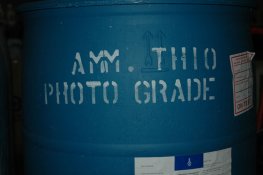
I went to all of the trouble and expense to prove that photograde chemistry does exist.

Here is an example of a drum of Ammonium Thiosulfate solution from the company that supplied Kodak at one time. I was graciously allowed to photograph the drum at one of the companies that sells it to us.

Test results are supplied by the supplying company and I am capable of determining which grade is appropriate for each solution that I design or consult about, or I know which tests must be run to properly determine the utility of each chemical.

At least this is proof of the fact that it exists. :D

PE
 

Attachments

  • photograde1.jpg
    photograde1.jpg
    72 KB · Views: 144
The SPSE Handbook lists purity specifications for photographic chemicals.
 
Perhaps one of y'all can tell me what +30 means on a CofA for borax decahydrate.
 
The SPSE Handbook lists purity specifications for photographic chemicals.

My 1973 edition of the SPSE Handbook only lists the ANSI standards that specify they purity of photographic chemicals. It does not list the actual "purity specifications".

If a different edition does, I'd be interested in finding out which edition you have...
 
"+30" what?

Upon thinking about it some more, I'll bet it's a particle size analysis, and the "+30" refers to the fraction/percentage that is retained on top of a #30 sieve. That is, the percent that is "+" or above the #30 sieve.

A #30 sieve has square metal mesh with openings that are 0.595 mm in size.
 
Last edited by a moderator:
There are colloid (small particle) limits as well as large particle limits. IDK the values offhand nor could I get them easily.

As I remember it, no particles are allowed due to their abrasive and image destroying properties. The control of particles is very strict in photo grade materials, much more so than in many other grades as I have alluded to before.

PE
 
Kirk,
I guess I should have said it references them to the relevant specifications. I have the same edition.
My apologies. The book used to reside in the bathroom ;>) but I guess APUG has taken over. This is truly an amazing forum that Sean and all of us have created.
 
Upon thinking about it some more, I'll bet it's a particle size analysis, and the "+30" refers to the fraction/percentage that is retained on top of a #30 sieve. That is, the percent that is "+" or above the #30 sieve.

A #30 sieve has square metal mesh with openings that are 0.595 mm in size.

I believe you got it. It appears at the end of the assay that shows decahydrate, pentahydrate, etc. and Cl.
Cl.......<50 ppm

+30.......1%
which I expect means all but 1% passes a #30 sieve or the opposite.
 
Last edited by a moderator:
Photrio.com contains affiliate links to products. We may receive a commission for purchases made through these links.
To read our full affiliate disclosure statement please click Here.

PHOTRIO PARTNERS EQUALLY FUNDING OUR COMMUNITY:



Ilford ADOX Freestyle Photographic Stearman Press Weldon Color Lab Blue Moon Camera & Machine
Top Bottom