• Welcome to Photrio!
    Registration is fast and free. Join today to unlock search, see fewer ads, and access all forum features.
    Click here to sign up

Invest in 4x5 equipment?

Dublin 1977

H
Dublin 1977

  • Tel
  • Feb 16, 2026
  • 2
  • 2
  • 54
Love wins.

A
Love wins.

  • 3
  • 0
  • 71

Recent Classifieds

Forum statistics

Threads
202,262
Messages
2,838,215
Members
101,237
Latest member
Pollypocket
Recent bookmarks
1

Don_ih

Member
Allowing Ads
Joined
Jan 24, 2021
Messages
8,703
Location
Ontario
Format
35mm RF
suspect we mostly would prefer

But the fact is, what we prefer is thwarted by that which is widely and easily available.

Currently, many people serious about photography make few or don't make any prints.
 

Petrochemist

Member
Joined
Oct 20, 2021
Messages
169
Location
Uk
Format
Multi Format
With large formats you can achieve shallower depth of field.

Whilst that may be true of landscape & portraits - for many it would not be true as FF lenses generally come in much faster variants.

It's certainly not true as an absolute, my digital microscope gets a DOF considerably less than 0.1mm despite a tiny sensor. Depth of field is heavily influenced by magnification, and very few photographers would go to more than lifesize on large format
 

wiltw

Subscriber
Allowing Ads
Joined
Oct 4, 2008
Messages
6,743
Location
SF Bay area
Format
Multi Format
Why is the print the standard and not the web? Most photos we look at aren't prints.

But a 4k monitor has only 4096 x 2160 in even the best professional grade products, so why use such a limited resolution as any definition of 'the standard'?!

If we used such a limited resolution as 'the standard' we would all be comparing the latest digital Hasselblad vs. the Canon 10D (a 4k camera), wouldn't we?
 
Last edited:

wiltw

Subscriber
Allowing Ads
Joined
Oct 4, 2008
Messages
6,743
Location
SF Bay area
Format
Multi Format
With large formats you can achieve shallower depth of field.

Well, yes, but what is the point of having only the surface of an eyeball in focus, without the tip of the nose?!

And if you use a truly equivalent lens on both formats (exact same FOV), using 48mm vs. 180mm (or 2*short dimension of frame) and the largest typical available f/stop on that FL (assume f/1.4 vs f/5.6) at a subject distance of 20' there is only 0.3' difference in the DOF depth, an even smaller value difference if considering 20/20 vision DOF, hardly a difference in practical terms.

Rather immaterial differentiator, DOF.
 

MattKing

Moderator
Moderator
Joined
Apr 24, 2005
Messages
55,529
Location
Delta, BC Canada
Format
Medium Format
Any "standard" is determined substantially by the intended use of the results.
Which is why Ralph's question needs to address the question of intended use first.
Of course, in many cases our photos get used for many different things.
So the answer as almost always is - "it depends".
 

Pieter12

Member
Allowing Ads
Joined
Aug 20, 2017
Messages
8,310
Location
Magrathean's computer
Format
Super8
Why is the print the standard and not the web? Most photos we look at aren't prints.
Speak for yourself. For me and many others I suspect, a photo is not complete unless it is printed.
Well, yes, but what is the point of having only the surface of an eyeball in focus, without the tip of the nose?!
A multitude of fine portraits are shot that way. Ears out of focus, too.
 

wiltw

Subscriber
Allowing Ads
Joined
Oct 4, 2008
Messages
6,743
Location
SF Bay area
Format
Multi Format
Speak for yourself. For me and many others I suspect, a photo is not complete unless it is printed.

A multitude of fine portraits are shot that way. Ears out of focus, too.

'fine portrait'...Portraiture clients used to complain about such photos being 'out of focus'. We should not judge based upon the goals of a hobbyist photographer.
 

GregY

Member
Allowing Ads
Joined
Apr 12, 2005
Messages
4,071
Location
Alberta
Format
Large Format
Speak for yourself. For me and many others I suspect, a photo is not complete unless it is printed.

A multitude of fine portraits are shot that way. Ears out of focus, too.

Thank you Pieter12!
 

gbroadbridge

Subscriber
Joined
Nov 18, 2004
Messages
874
Location
Sydney, Australia
Format
Medium Format
The web is a ubiquitous technology but cannot be "the standard" until/unless everyone has fully calibrated monitors with large color gamuts.

The same photograph or painting will not look the same hung in two different galleries.

After all there is no 'standard' gallery light.
 

Alan Edward Klein

Member
Allowing Ads
Joined
Aug 29, 2017
Messages
10,224
Location
New Jersey formerly NYC
Format
Multi Format
The web is a ubiquitous technology but cannot be "the standard" until/unless everyone has fully calibrated monitors with large color gamuts. Both of these are unlikely to happen. That's why neither digital source material nor scans of analog images look consistently the same across various displays.

As an example, I have two displays on my system. One has an 8-bit LUT and the other is a wide gamut monitor with a 10 bit LUT connected to an Nvidia card via DisplayPort. Both are of approximately the same vintage. I have carefully calibrated the latter and used it to adjust the former. No matter what I do, I cannot get them to match the look of a given image. IOW there is a wide variation monitor-to-monitor rendering - and this from the same manufacturer, BTW.

The web was always designed to be a "good enough" technology for cheap mass distribution and it succeeded admirably. But when I want to see the richness of an image, whether produced digitally or analog, I want to look at a print. However, I do look at the web for cat pictures...

But you're scanning the "standard" print for the web. So all the issues you mentioned are the same. In addition, no two chemical prints are the same. So which one is the standard?
 

Alan Edward Klein

Member
Allowing Ads
Joined
Aug 29, 2017
Messages
10,224
Location
New Jersey formerly NYC
Format
Multi Format
Most photos you look at aren't prints.....

But I can't see your prints and you can;t see mine. You're a country away from me on the other side of the continent. So the web is the way most of us view each other's pictures.
 

Alan Edward Klein

Member
Allowing Ads
Joined
Aug 29, 2017
Messages
10,224
Location
New Jersey formerly NYC
Format
Multi Format
Any "standard" is determined substantially by the intended use of the results.
Which is why Ralph's question needs to address the question of intended use first.
Of course, in many cases our photos get used for many different things.
So the answer as almost always is - "it depends".

Exactly. It's; like arguing, which vehicle is better, a pickup truck, a sedan, or an SUV?
 

Pieter12

Member
Allowing Ads
Joined
Aug 20, 2017
Messages
8,310
Location
Magrathean's computer
Format
Super8
But you're scanning the "standard" print for the web. So all the issues you mentioned are the same. In addition, no two chemical prints are the same. So which one is the standard?
There is no standard. That is part of the uniqueness of the art. Witness the various versions of Adams' Moonrise, Hernandez, New Mexico. But what a photographer prints is what he or she expects you to see, not messed with by the limited range of a monitor, nor as in most cases as a transmitted-light image rather than reflective.
 

chuckroast

Subscriber
Joined
Jun 2, 2023
Messages
3,255
Location
All Over The Place
Format
Multi Format
But you're scanning the "standard" print for the web. So all the issues you mentioned are the same. In addition, no two chemical prints are the same. So which one is the standard?

The physical print is the standard of excellence.

The scan for web sharing is a significantly downsampled, lower information space copy that can only give you a sense of the composition and final image, it does not and cannot well replicate a fine silver or alt process print.

The web is certainly the standard for convenient interchange and we pretty much all use it that way. But it is so at the cost of image fidelity and quality.

There are, of course, cases where this simply doesn't matter. The billions of phone snapshots taken annually leap to mind. So do pretty much all "news" photographs which have the half life measured as a homeopathic quantity. For for the many of us - here and elsewhere - that are working hard to create things of beauty, the web won't cut it.

As @MattKing notes above, the purpose of the work determines the medium.
 

Alan Edward Klein

Member
Allowing Ads
Joined
Aug 29, 2017
Messages
10,224
Location
New Jersey formerly NYC
Format
Multi Format
The physical print is the standard of excellence.

The scan for web sharing is a significantly downsampled, lower information space copy that can only give you a sense of the composition and final image, it does not and cannot well replicate a fine silver or alt process print.

The web is certainly the standard for convenient interchange and we pretty much all use it that way. But it is so at the cost of image fidelity and quality.

There are, of course, cases where this simply doesn't matter. The billions of phone snapshots taken annually leap to mind. So do pretty much all "news" photographs which have the half life measured as a homeopathic quantity. For for the many of us - here and elsewhere - that are working hard to create things of beauty, the web won't cut it.

As @MattKing notes above, the purpose of the work determines the medium.

I consider my photos on the web things of beauty, just as you consider your prints things of beauty. This is really starting to sound like a Canon vs Nikon discussion or film vs digital. Let's not go there.
 

chuckroast

Subscriber
Joined
Jun 2, 2023
Messages
3,255
Location
All Over The Place
Format
Multi Format
But I can't see your prints and you can;t see mine. You're a country away from me on the other side of the continent. So the web is the way most of us view each other's pictures.

So why, pray tell, are things like print exchanges, and post card exchanges still a thing?

Yes, we can use the web for convenient image exchange and we all do. But, excepting trivial work, we cannot use it for high quality image exchange the preserves the look the originator intended in a print.

The math is unstoppable here. A typical monitor has an 8 bit LUT and very real limitations in contrast and brightness control. Some of them undergo some color shift as you try to fiddle the contrast and brightness where it belongs. And it is always transmitting light, never reflecting light to produce the image.

But none of this is new. No reasonable person would have expected a Kodak Brownie to produce comparable quality output as, say, an 8x10 Deardorff. The medium absolutely defines what the image can be. So it's not a "web" vs. "print" debate, really. It's a "what medium faithfully represents the intent of the original creator to the level required for the task at hand."

My only point in the comment to which you originally responded is simply that - given the inherent limitations of web production in the first place - I have found that scanning prints more closely will reproduce what I have created, rather than trying to scan the negative and fiddle that scan into looking like the print.
 

_T_

Member
Joined
Feb 21, 2017
Messages
451
Location
EP
Format
4x5 Format
The worst kind of artist is the kind who thinks that being an artist somehow makes them better than other people in any way.
 

Vaughn

Subscriber
Allowing Ads
Joined
Dec 13, 2006
Messages
10,302
Location
Humboldt Co.
Format
Large Format
Speak for yourself. For me and many others I suspect, a photo is not complete unless it is printed.
…

Printed, matted, and framed…and lived with for a while. That’s optimal for me.
If it is on a wall then I have not abandoned it…yet.

I have been using primarily LF for the last 45+ years. Rollei TLRs have weaved themselves in there, too.

I took one of each on a recent 5 week trip in Japan… the Rolleiflex for when I was traveling relatively fast with my sons, and the 4x5 for when I was on my own and on my own schedule.

I have developed the 60 4x5 sheets of FP4+ and I have 4 of the 8 120 rolls on reels and in developing tanks ready to go. Pretty happy with the 4x5 negatives and now wondering (thanks to this thread) how I might weave them with the images I will find on the roll film. All would be contact printed which equalizes the formats as far as resolution, anyway.

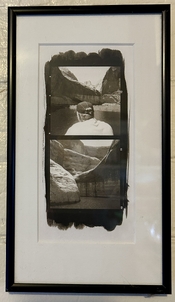
This is a quick iPhone image of a framed piece in my kitchen… two adjoining frames, pt/pd print. My brother-in-law on a boat on Lake Powell. Fun stuff.
 

Attachments

  • IMG_2712.jpeg
    IMG_2712.jpeg
    1 MB · Views: 4

Pieter12

Member
Allowing Ads
Joined
Aug 20, 2017
Messages
8,310
Location
Magrathean's computer
Format
Super8
Although many museums and galleries post images from their shows on the internet and there are books of art and photography galore, there is no substitute for seeing the real thing in person. Scale, subtleties, delicacy and depth are lost in translation.
 
Photrio.com contains affiliate links to products. We may receive a commission for purchases made through these links.
To read our full affiliate disclosure statement please click Here.

PHOTRIO PARTNERS EQUALLY FUNDING OUR COMMUNITY:



Ilford ADOX Freestyle Photographic Stearman Press Weldon Color Lab Blue Moon Camera & Machine
Top Bottom