• Welcome to Photrio!
    Registration is fast and free. Join today to unlock search, see fewer ads, and access all forum features.
    Click here to sign up

Internegatives. Learning...

Forum statistics

Threads
203,366
Messages
2,853,526
Members
101,804
Latest member
Ema
Recent bookmarks
1
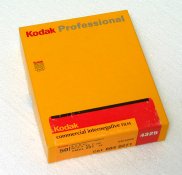
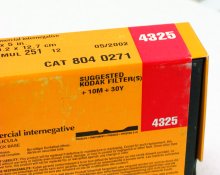
There's more! I was given this yellow box yesterday. Stored in room temperature for a couple of years. Have about ten underexposed and a few too contrasty transparencies to scan, but would love to print them in my darkroom. What could be its ISO now, 8 or less? How much of a nightmare can I really expect?

KODAK_1.JPG KODAK_2.JPG
 
It requires extreme fine tuning of exposure.

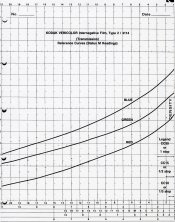
The balance must be neutral to a gray scale, and the toe of your slide must be on the upswept part of the curve I've supplied. If you miss, it is a mess.

PE
 

Attachments

  • Internegative film curve.jpg
    Internegative film curve.jpg
    483.9 KB · Views: 133
E-225T manual recommends exposure times not exceeding 30 seconds. In my setup, using 100 ISO film (Kodak 100T), 3 to 5 seconds exposure at f11 gave very good results. Considering 10M+30Y filtration and rather dark transparencies, could I simplify testing by exposing 30 seconds at f5.6, f8 and f11? The lens and its distance to easel would be the same.
 
You may be able to do that but you will have to fine tune it more than just by stops. They are rather coarse "knobs" to be turning.

PE
 
Some new findings. Following the manual ("Determining a Starting Exposure"), I am now able to make precise metering of lux values using a Gossen lux meter with a very small cell probe (no dome). Using just a lensboard and no lens, the lux value of 32 for a starting exposure of 10 seconds can be precisely achieved by moving the enlarger head up or down. Also, I have many black cards to minimize light scattering and flare. Could this be a better starting point for the initial test exposure?
 
Velvia is a pain in the butt to make internegs from. And you probably won't like my answer. What I have successfully done is to make a masked contact dupe with modified tonality onto 8x10 Astia 100F (which in itself was a fairly complicated procedure require multiple masks), and then via this, make a Portra 160 contact interneg. The basic problem is the inherently high contrast of Velvia and edgy nature of its dyes, particularly in relation to saturation. Porta has trouble corresponding to these directly. It's easier to make an interneg from one of the more ordinary chrome films, but even then, contrast masking skills are quite valuable. But internegs are a backburner project for me because I have so many original color negs to choose from too, and really not enough time to print color much at all at the moment.

 
Photrio.com contains affiliate links to products. We may receive a commission for purchases made through these links.
To read our full affiliate disclosure statement please click Here.

PHOTRIO PARTNERS EQUALLY FUNDING OUR COMMUNITY:


Ilford ADOX Freestyle Photographic Stearman Press Weldon Color Lab Blue Moon Camera & Machine
Top Bottom