• Welcome to Photrio!
    Registration is fast and free. Join today to unlock search, see fewer ads, and access all forum features.
    Click here to sign up

Infrared Film in Pinhole?

Forum statistics

Threads
203,511
Messages
2,855,763
Members
101,876
Latest member
GUOWEN
Recent bookmarks
0

sidphoto

Member
Allowing Ads
Joined
Jan 13, 2005
Messages
5
Location
Nebraska
Format
4x5 Format
Can infrareds film be used in pinhole cameras? I have a 4x5 pinhole that I would like to try in.
 
castilg said:
Be carefull as to not leave the camera or film in the mid day heat ,the long exp time may fog the film.
The heat will affect the film no differently than any other film. In other words IR film is not sensitive to that part of the IR spectrum.

Don Bryant
 
I've thought about doing this myself but was wondering about how to deal with filters: since the pinhole is so small and likely close to the filter itself, will flaws in the filter be magnified?

I have two pinhole "lenses" for my Mamiya TLR but no filter thread and I have manually held a filter over the pinhole when necessary. I'd like to try using a polyester theater gel instead (taping it to the inside of the pinhole), which brings to mind the quality issue...
 
Pinhole images tend to be fairly soft anyway, so I wouldn't see a polyester or gel filter making much difference - even if scratched. I'd tape it to the inside of the box for convenience, if nothing else, as exposures are likely to be several minutes long.
 
MSchuler said:
I have two pinhole "lenses" for my Mamiya TLR

Can you please tell me more about how you did this? I'm getting an 80mm lens and a laser pinhole but I'm not a very handy person. Perhaps we should start a new thread? I don't know what the protocols are.

There have been examples of lovely infrared pinholes at

/f295.tompersinger.com

Lots of helpful folk there as well.
 
The optimum pinhole size for infrared will be about 1.34 times the diameter that is used for color film.

I use Cachet Macophot 820c and either a 29A or R72 filter.

Transmission specs for filters can be seen at http://www.a1.nl/phomepag/markerink/irfilter.htm (the R72 is about like an 89B)

In the summer sunny 16 - between 3 hours after sunrise and 3 hours before sunset,
set your hand held meter at ISO 6 (29A) or ISO 3 (R72) to start. You may get better results hitting it harder and developing less than recommended. (My gut feeling is that the recommended development is at least a one stop push).

I've found the reciprocity of this film to be about 1 Stop at 2 minutes (i.e. expose for 4 minutes if you meter for 2).


You may see a comparison of different IR films at http://www.pauck.de/marco/photo/infrared/comparison_of_films/comparison_of_films.html
 
Pinhole lenses

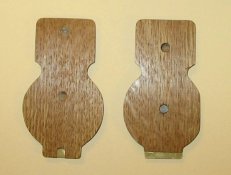
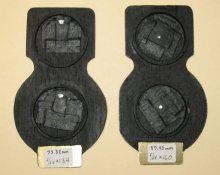
Attached are two images of the front and back of my Mamiya TLR pinhole lenses - I hope that this answers your question.

Both use a 1/16" thick piece of oak for the plate (just because I had it around.) The pinholes were bought ready-made and are secures with gaffer's tape. The plate on the left has about 10mm of rise. Both use a much larger pinhole for the upper lens - it helps with framing a TINY bit if the sun is very bright and the subject very contrasty.
 

Attachments

  • front.jpg
    front.jpg
    45.2 KB · Views: 263
  • back.jpg
    back.jpg
    48.3 KB · Views: 321
Wow!
This is so much easier than what I've planned. Why does the plate on the left have 10 mm of rise? How does that make the picture different?
Did you figure out optimal focal lengths, how far to extend the bellows, when you chose the pinhole size?
How do you visualize what you're recording, a template on the ground glass? There should be a formula here, maybe the pinhole designer site can help me think this through.
Did you decide on the size of the viewing pinhole by-guess-and-by-gosh? Do you know how big they are?
The plate fits under the latch, right? I can't bear the thought of putting tape right on my camera!
Thank you for your patience!
 
Yes, the brass fits under the latch, but I've found that the rings which surround the pinholes hold the plate tightly enough to the camera that the latch isn't needed. The rings were created by taking 1/32" basswood strips, soaking them in water and using the lens mount on the body and/or a metal pipe as a form in/on which to dry them. Two such rings were then glued together to create a seamless 1/16" thick wood ring that fits the camera perfectly. There may (must?) be an easier way to do this... Also, I've found that it is easier to make a bunch of these plates all at once, given the excessive labor my approach involves.

The rise works like rise in a large format camera, to help limit converging verticals. The large format people could probably explain the benefits in more detail.

The pinholes came from the manufacturer (see http://www.pinholeresource.com) with a chart of the optimum focal length for each one and the exposure require. This info appears on a legend on the back of the lens.

Generally I just point the camera at the target, see if anything appears on the viewing screen and shoot. I don't use these as much as I should, so REAL pinhole photographers can probably provide more information on technique.


mdohoney said:
Wow!
This is so much easier than what I've planned. Why does the plate on the left have 10 mm of rise? How does that make the picture different?
Did you figure out optimal focal lengths, how far to extend the bellows, when you chose the pinhole size?
How do you visualize what you're recording, a template on the ground glass? There should be a formula here, maybe the pinhole designer site can help me think this through.
Did you decide on the size of the viewing pinhole by-guess-and-by-gosh? Do you know how big they are?
The plate fits under the latch, right? I can't bear the thought of putting tape right on my camera!
Thank you for your patience!
 
Photrio.com contains affiliate links to products. We may receive a commission for purchases made through these links.
To read our full affiliate disclosure statement please click Here.

PHOTRIO PARTNERS EQUALLY FUNDING OUR COMMUNITY:



Ilford ADOX Freestyle Photographic Stearman Press Weldon Color Lab Blue Moon Camera & Machine
Top Bottom