
Mirandas were pretty expensive when new, from the old magazine prices in the back of modern and popular photo just about expensive as Nikon F or Canon F1.
-
Welcome to Photrio!Registration is fast and free. Join today to unlock search, see fewer ads, and access all forum features.Click here to sign up
- Home
- Forums
- Analog Workflow Forums (100% Analog/Traditional)
- Analog Equipment
- 35mm Cameras and Accessories
You are using an out of date browser. It may not display this or other websites correctly.
You should upgrade or use an alternative browser.
You should upgrade or use an alternative browser.
I'm in love with... a Miranda?
-
A
- Thread starter MMfoto
- Start date

Recent Classifieds
-
For Sale FS: Fujinon 250mm f/6.7 Lens
- Started by B.S.Kumar
-
For Sale Kodak Ektachrome Infrared EIR aka Aerochrome
- Started by YoIaMoNwater
-
Want to Buy Old Kodak 101 roll film
- Started by blee1996
-
For Sale Schneider Kreuznach Super Angulon MC 120mm f8
- Started by RoboRepublic
-
Sold JOBO MultiTank 2 2521 4 X 5
- Started by Inayat Noor
Forum statistics
- Threads
- 203,557
- Messages
- 2,856,505
- Members
- 101,904
- Latest member
- Melissa.cat.smith
- Recent bookmarks
- 0

Out of curiosity, what features allowed Miranda to claim their cameras were vibration-free?

Mirandas were pretty expensive when new, from the old magazine prices in the back of modern and popular photo just about expensive as Nikon F or Canon F1.
The Miranda was about $250, while the Topcon Super D and the Nikon F with Photomic T were both about $420 in 1964 with f/1.4.; the Super D had risen to $490 by 1970. I recall the appeal of the Sensorex was that, like the Super D, the prism could be removed without losing TTL metering function; both use mirror patterns etched in the reflex mirror.

Miranda Sensorex
Miranda Sensorex is a 35 mm SLR system film camera manufactured by Miranda. There are seven almost-the-same but distinct versions of Sensorex.[1] There are two very peculiar features in Miranda: the interchangeable prism (the Nikon F and Topcon Super D were notable professional 35mm SLRs at the...
"The camera also featured a low noise shutter and vibration-free mirror mechanism. "
The Topcon D-1 was the price peer of the Sensorex in the mid-1960s, at $269 with f/1.8, rising to $276 in 1970 (per Topcon price sheet). The Canon F-1 launched in 1971, at about $675
Last edited:

blee1996
Subscriber
I also feel that Topcon and Miranda are kind of peers, let alone they both feature front shutter button. On one hand, the Miranda cameras tend to be more refined while Topcon bodies more utilitarian. On the other hand, I think Topcon lenses are one tier above the Miranda lenses. Even today, those Topcor RE lenses are quite under-appreciated (and a good bargain for that reason).
The later Mirandas with TTL metering did not have interchangeable focusing screens and lacked motor drive or film winders of Topcon. The longest Miranda lens I have found was a 400mm 3rd party for the 44mm screw mount, it was preset Soligar, I have seen early Miranda branded 800mm in adds that would have been offered for the D to G models. Topcon made a complet lineup of lens, not the same range as Nikon, Canon, Minolta or Pentax. Miranda did make a bellows and exention tubes, microsopce and telepscope adaptors. When a working PJ in the 70s I saw working pros with Canon, Minolta, Pentax along with Nikon, even a guy with Petri, never saw anyone with a Miranda.

4season
Member
- Joined
- Jul 13, 2015
- Messages
- 2,198
- Format
- Plastic Cameras
I attempted to service a Miranda D outfit in my teen years, when I lacked the tools, skills and temperament to do it right.  The matching 50 mm Soligor lens contains a bunch of ball bearings, so be prepared to catch them if you disassemble the thing. Today, I'd probably find it pretty basic, but it might be time to replace the cloth shutter.
The matching 50 mm Soligor lens contains a bunch of ball bearings, so be prepared to catch them if you disassemble the thing. Today, I'd probably find it pretty basic, but it might be time to replace the cloth shutter.- Joined
- Sep 16, 2006
- Messages
- 1,890
- Format
- 35mm
I once had a Canon FD lens serviced and when I went to pick it up, one of the balls from the ball bearing assembly was loose in the box holding the lens. The lens had to be disassembled so the ball could be put back. One of the Miranda's I will probably never want is the DX-3.
I think what helped Topcon hang on a little longer was a contract with the Government. I used to own two Super D bodies and both were stamped U.S. Navy.
Should have kept them, collectable. The Navy used Topcon while the Army and Air Force and Marines used Nikon. I attended a military photographers workshop in the mid 70s, hosted by the Navy. The top officer in charge of photography operations attended. When the subject came up of why the Navy used Topcon it was asserted that because some of the Topcons were marked with the Bessler logo as Bessler was the distributor Navy procurement thought that Topcon was made in the U.S. This guy was quite clear that the Navy picked Topcon after much testing and deliberation, TTL meter built in the body, rugged, lens were excellent, and the price as right. Then he said that the Navy was buying Canon F1s as Topcon had not updated their system.
Today I'm digging out a Miranda EE and a few lens, I may be need to buy a pack of hearing aid battereies, and shot a roll of film next week.
Today I'm digging out a Miranda EE and a few lens, I may be need to buy a pack of hearing aid battereies, and shot a roll of film next week.
Alan Townsend
Member
I bought a new Sensorex in 1968 when I was in high school. I read an article in Consumers Guide comparing the Sensorex to the Pentax Spotmatic and Minolta SRT101 that ranked the Miranda above the other two. I believe they all had the same list price, around $250. Mostly I liked the viewfinder interchangeability. My camera became nonfunctional only a few years later, around 1972. The shutter locked up on mine, and I could not get it fixed. I have read this was not uncommon for these cameras. I did like it myself for several reasons.I was looking for a Miranda 50/1.4 and found one that came with a Mirana F body. I can't explain it, but I instantly fell for this little camera. It feels like a miniature Pentax Spotmatic, or a Spotmatic era Pentax MX. Simple controls. Clean viewfinder with a plain, central spot microprism. Unique shutter release on the front side. Fits in the hand nicely. It's a very simple and pleasant camera. I've owned and handled more cameras than I'd like to admit to, and this one just sings to me. Looking forward to using it more.
Question for the Miranda heads here: Are these cameras easy/difficult to get serviced?
Today, I have a Minolta SRT101, which is a much better camera, as was the Spotmatic. While not as sexy as Miranda, these other cameras have better long term reliability and much better sales numbers making used parts common. The thing I love about the SRT101 is the mirror lock up function. I also have an X700 Minolta that I bought new, and it's nowhere near the quality of the SRT. I loved my Miranda, too, but she done me wrong, so I cheated on her. I guess it was okay since she died.

I stumbled into a Miranda Dr at a flea market a few years ago, mistakenly thinking the bayonet was Exakta mount (I was confusing Miranda with Topcon because they both have front shutter releases). I've had a succession of a few models since then. I would say the Sensomat RE was arguably the pinnacle of features/quality. It has stop-down metering and automatic diaphragm with the auto-miranda lenses, but is compatible with the earlier lenses and viewfinders. It has both front and top shutter releases, and the shutter speed dial doesn't rotate with exposure like the early models. I recently added a Sensorex, pictured here next to the Sensomat RE. The prisms on the Sensorex are not compatible with the earlier models. The main improvement is open-aperture metering, and it also has a self timer. Some reviewers have said the quality was starting to go down by the release of the Sensorex. I don't know; my copy certainly has problems and I'm keeping it just as a backup to the Sensomat RE because it's light tight and the shutter works, but little else. The open-aperture metering feature needs lenses that have a little outrigger coupling tab to engage an external aperture coupler pin on the Sensorex.
A very useful accessory is a thin adaptor ring that allows you to put M42 lenses on a Miranda, and you get focus to infinity. You lose automatic diaphragm though. This is what I use for long lenses on mine.
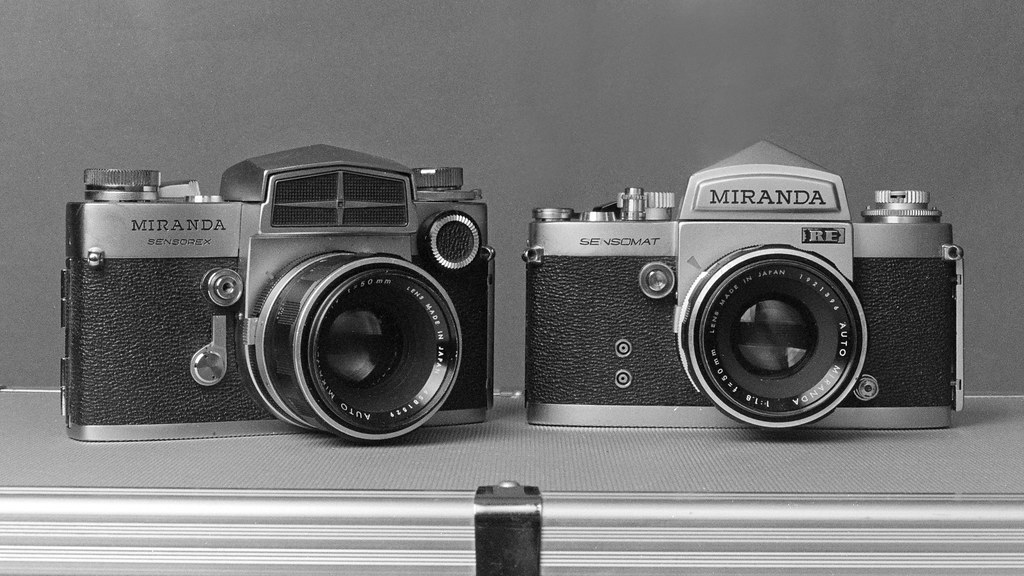 Miranda cameras by Howard Sandler, on Flickr
A very useful accessory is a thin adaptor ring that allows you to put M42 lenses on a Miranda, and you get focus to infinity. You lose automatic diaphragm though. This is what I use for long lenses on mine.
Miranda cameras by Howard Sandler, on FlickrMiranda also made a couple of cameras with M42 mount, one under the Soligar brand. Not sure what lens they came with, Miranda or Soligar.
ags2mikon
Member
The Soligor TM. Also sold as the Pallas TM. Mine had lenses marked as Soligor. All the Mirandas have shutter issues late in life,

Miranda also made a couple of cameras with M42 mount, one under the Soligar brand. Not sure what lens they came with, Miranda or Soligar.
The Miranda TM had the lens brander Auto Miranda, the identical Soligor TM was Auto Soligor, some lenses carry both names. Probable depended on the market and how well Soligor lenses were known there.
Ian
ags2mikon
Member
If you are not happy with the lens quality on your TM, there is always Takumar, Fujinon and many others to choose from.
Here in the UK the Soligor lens brand was quite well known in the mid to late 1960s and 70s, the camera was sold here as the Soligor TM.
Ian
Ian
Petri also made a M42 mount camera, came late just as most were making K mount bodies. There were only a few Petri branded lens, the 50mm I have is quite good, the bodies were poorly made.
- Joined
- Sep 16, 2006
- Messages
- 1,890
- Format
- 35mm
I was always skeptical of "consumer" reviews of photo equipment. There are two reasons. In the first place their slant was in favor of anything cheap. The fact that it might not last very long or work properly was not a concern. I still have some fun with Petri and Miranda and Mamiya ZE cameras even though I know they are not made as well made as Nikon or Canon or Pentax cameras. My second reason is that no reviewer of consumer products can be an expert in every area.
| Photrio.com contains affiliate links to products. We may receive a commission for purchases made through these links. To read our full affiliate disclosure statement please click Here. |
PHOTRIO PARTNERS EQUALLY FUNDING OUR COMMUNITY:  |