• Welcome to Photrio!
    Registration is fast and free. Join today to unlock search, see fewer ads, and access all forum features.
    Click here to sign up

I'm going to buy some (1000ft) Eastman Double-X

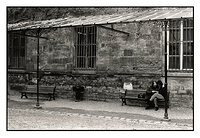
Amour - Paris

A
Amour - Paris

  • 0
  • 0
  • 37
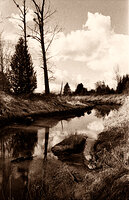
Bend in the river

H
Bend in the river

  • 2
  • 0
  • 55

Recent Classifieds

Forum statistics

Threads
203,235
Messages
2,851,836
Members
101,738
Latest member
parkeradam
Recent bookmarks
2
Both, the two characteristics aren't mutually exclusive. Here are the characteristic curves, RMS granularity, and MTF resolution charts for Double-X from Kodak. The developer used to generate these data points is D-96. While I don't have an actual H&D curve plotted for it, I can pretty much tell by eye how it is when you print it. Note though that I developed the stuff in D-76 1+1 for about 7 minutes at 75F. Being a more aggressive developer than Kodak's recommended D-96, it's not surprising to see that the high end would shoulder off more quickly. Yet despite that the range through the middle displays less differentiated separation than you see with Tri-X.
 
I have never had a problem printing Double-X. I have put it through Pyrocat-P, 777, Rodinal (favorite) and Edwal 12. I am not one to drag out a densitometer. I only know if something works or not, and Double-X works, but like I stated above, you would be better off with something else. If money is tight, use either of the Freestyle Premium or Legacy films. I am using the Legacy now since I have had some problems with the Premium. I don't think XX is a good first film.

If you are scanning the film then it doesn't matter what you use. You haven't given us that information yet though.
 
Yet it is far more grainy than Tri-X, which is 2/3 stop faster, and doesn't have a contrast curve suitable for printing on enlarging papers. In my estimation, it's resolving power isn't any better than Tri-X and not as good as Plus-X,

If you look at the Kodak's RMS granularity values for Double-X and Tri--X you will find that Double-X is actually a bit finer grained than Tri-X. Perhaps something in your processing is causing the increased granularity.

I have shot over 1000 feet of this film and have another approx 2000 ft more in my freezer. I find that when Double-X is developed to a CI suitable for darkroom printing that the rated speed is the same as Tri-X. I use HC-110 diluted 1:49 as a developer. Sometimes I wil use Rodinal at 1:49.
 
I like the method of working. This is a year long project (started in May, with the unimpressive Fomapan =P) and should take the remaining two semesters of my collegiate career. This film appeals to me not only because of the samples and reviews that I have seen, but also works for the timeline I am planning. I want to view the images as objectively as possible, so that means having some gap (months, maybe..) between taking the shot and editing. So, when I run out of film the editing begins. =)

I like Winogrand's way of shooting because, though it could seem haphazard, I find it very liberating. Not having images in my head to search for...everything is a potential photograph. Yes, 99% is failure or at lest near miss, but in that I hope to maybe see thought-process or patterns...certain compositions or motifs that I seem attracted to. That is where the two books come in. One will hopefully be by 1% of successful images and the other will be contact sheets for the whole project.

Thank you all for your responses. The discussion has been interesting =p. I might end up buying 400ft lengths instead for manageability's sake. Still have some time to figure it out...
 
Photrio.com contains affiliate links to products. We may receive a commission for purchases made through these links.
To read our full affiliate disclosure statement please click Here.

PHOTRIO PARTNERS EQUALLY FUNDING OUR COMMUNITY:



Ilford ADOX Freestyle Photographic Stearman Press Weldon Color Lab Blue Moon Camera & Machine
Top Bottom