Would anyone happen to know the reciprocity characteristics of this film? I have checked the Ilford spec sheet and searched the web to no avail. I am planning on shooting with an R72 filter metering the shadows at EI 12. I would like to shoot at F/22in 35mm and F/32 in 120 so full sun exposures may be between 1-30 seconds.
Oddly enough, the data sheets for several other Ilford films have a graph for reciprocity correction. Three that I looked at appeared to be quite similar, so I suppose that might be a starting point. I have only run one roll of SFX200, done with an assortment of filters. An exposure metered at ISO 3 worked decently with an 89B filter, at an exposure of 1/15 @ f/11. That was what I considered the best out of a couple of bracketed exposures, so it may have included some reciprocity compensation, although that is a fairly short exposure. I have been led to believe an 89B is about 695nm cutoff, so you might need a little more exposure with an R72 (720nm).
The Ilford graphs on several other films seemed to suggest a measured exposure of 5 seconds should be shot at about 12, a measured exposure of 10 seconds might call for about 30 or so. A 30 second exposure -- well -- bring a chair to sit down!
My own experience using their compensation with Delta 100 for some pinhole shots led me to believe the chart was over-compensating, so I'm not too sure how reliable the stuff is. I fear your best bet is to experiment a little with some bracketing. Maybe someone more obsessive about these details will chime in here.
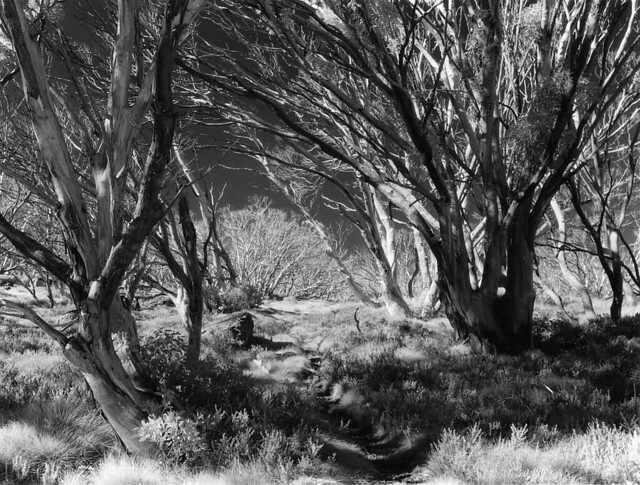
Worn Path, Mount Wheatley. Ilford SFX 200 exposed at EI = 6 in a Mamiya RB67 camera fitted with a 50mm f4.5 lens and IR680 filter.
I've exposed a lot of SFX 200 through infrared filters like IR680 and IR720. In each case I used an EI = 6 on a Sekonic L-758D meter and aimed it at an approximate mid-tone. Observations:
The correlation between visible light metering and actual infrared exposure is vague but it's better (only just) than nothing.
Metering the shadows didn't work for me. The shadows, if illuminated by blue sky, have virtually no infrared in them. Conversely if the shadows are illuminated by scattered light from green leaves then there's loads of infrared available.
Trying to compensate for reciprocity failure didn't work for me. Because effective IR exposure is unpredictable I simply expose using numbers off the lightmeter. If reciprocity failure happens then the shadows just go dark. Which kinda looks "natural" in the unnatural world of infrared images.
I did quite a bit of reading and it seems exposure ratings are all over the place from ei 3-12 and people meter anywhere from the deep shadows to the midtones.
Looking at the old Kodak HIE, reciprocity seemed to come into play over 10 seconds. The way I read their chart was from 11-100 seconds the adjustment was 1.6. Since SFX is more inline with regular film than HIE I thought there might be more of an adjustment and was suprised to find Ilford didn't include that information in their data sheet.
If people are shooting at ei 3-6 then it would seem that adjustments have been included as Ilford recommends a 4 stop increase from ei 200 for an R72 or 89B filter. I calculated an ei of 12 (6 would be a +1 and 3 would be a +2). Since IR is variable I'll shoot a couple of rolls bracketing from 3-12 and see what I get.
"The correlation between visible light metering and actual infrared exposure is vague but it's better (only just) than nothing."
Is an important part of understanding the problem. As near as I can see, the ratio of IR to visible light varies during the course of the day and during the course of the year. Compound that with potential meter spectral response issues, and the fact we can't actually see IR, which precludes some "intuitive" adjustments we might use in the visible spectrum, and all one can do is experiment. Fortunately B&W negative films are pretty forgiving as to exposure latitude.
Photrio.com contains affiliate links to products. We may receive a commission for purchases made through these links. To read our full affiliate disclosure statement please click Here.