
What Rick and ic-racer say is true: Prints always look darker under safelight.
I haven done a safelight test. But I load the paper under the same safelight as with I develop, and I stare at the paper's surface a couple times, cleaning it. As my highlights come paper white, I think there's no fogging.
All Rapid fixers will start to dissolve and bleach the image if you over fix, it's a property of the Ammonium Thiosulphate. It happens more with Warmtone papers particularly where you use increased exposure and decreased development to increase warmth. You're effectively doing the same with your paper negatives.
My negatives are warm in tone. You're right. I'm using the fixer at an 1+9 dillution (which I think it means 1 part fixer 9 parts water, does it?), but since I'm using tiny pieces of paper (4x4cm, 1.5748x1.5748in) I figured out they may be fixing way faster than a 8x10 print, right? There's less silver to dissolve in the first place.
The overall "underwater" effect I think it's my poor skills in the darkroom. I think I'm not agitating well in the developer and (or) fixer (I'm literally rocking the tray, up and down) But I'm anyway experimenting with the developer, so... maybe that's the problem.
pentaxuser, if you want me to explain everything I do, I will:
I prepare a crude for of parodinal using tylenol tablets and lye pellets. 2,5mg acetaminophen in 15,7 g of lye pellets into 50ml of tap water at room temperature. I let it sit in daylight 15 minutes, during which time it becomes lightly pink. (I leave it on daylight on purpose, p-aminophenol oxidizes faster in presence of light, and I need to see the change in colour to tell if It's formed.) I then dilute that to make 237ml of water. Everything is room temperature.
My stop bath is a mere strong dilution of lemon juice in water.
My fixer is Ilford rapid fixer 1 part fixer 9 parts water. It stinks like vinegar. (As it contains acetic anhydride, I think it's normal)
With the chemistry ready, I would cut a piece of Kentmere VC select RC photographic paper to 12 squares of the measures above and a couple of strips that I would fog and use to test developer and fixer. This is the time where there's more exposure to the safelight.
My safelight is around 40cm of the working surface. It's a red LED strip meant for its use as a car stop light. I power it with a 9v battery.
I'd then tape a square into my pinhole camera, which I find has no light leaks. It's a box, inside a box, and then inside another box. I can post a photo if you'd like.
I'd close the camera, ensure the shutter is closed and then go to my backyard to expose. Guessing and ISO of 1.5 and using a carboard
"meter" issued by Ilford.
Some people have said it's not well designed, that it doesn't work, but I've been successful so far with the exposure.
Once exposed I would then get back into the "darkroom" which is a bathroom that has been made lightproof.
I would connect the safelight, put on my gloves, turn off the room light, then take the paper out of the camera and put it in the developer.
When I say room temperature it's not 20°c, it's colder. It's quite cold here, and a completely closed room just gets colder. I want to warm up the developer and see what happens, but I don't have more tablets for now, and I wouldn't anyway have any way of measuring the temperature of the water.
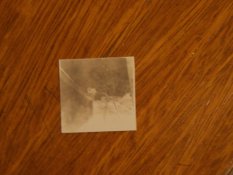
I would then develop, rocking the tray quite actively until an image appears and I can see deep blacks on the paper. I'd take it out and examine it on the safelight. It'd look contrasty, the way it should be, but still soft and "underwater", like this:
I then would develop for a couple seconds more, and then I'd place it in the stop bath and rock the tray a few times.
Then it goes in the fixer for 1 minute (Ilford recommended time for 1+9 dilution) and the moment I place the paper in the fixer I notice the edges going white and the dark blacks becoming grey.
I'd then wash for the time it takes me to put another piece of paper in the camera. Time during which I don't turn on the room light.
When I turn on the lights I see something like the image I posted first.
I'd then go out of the darkroom and dry the paper with a hair-dryer.
That's it.